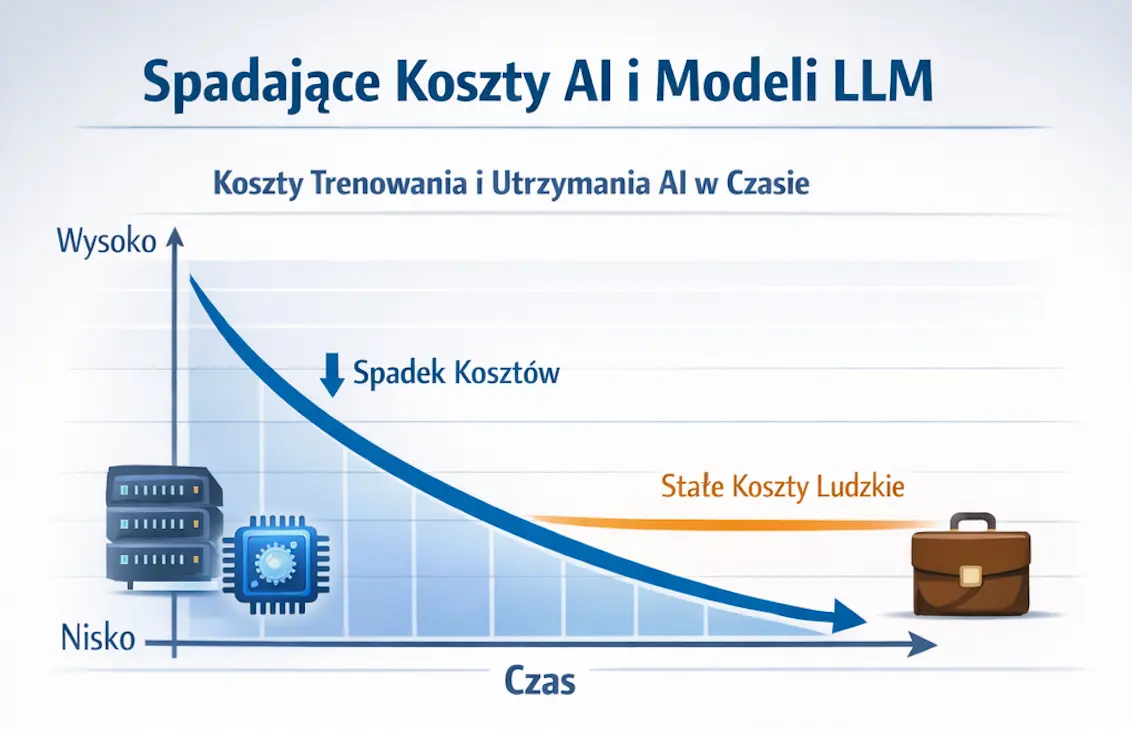
Not long ago, many companies treated AI as a curiosity, an experiment or an expensive add-on to existing processes. In 2026, that mindset is becoming outdated. The reason is simple: the cost of AI and language models is falling faster than most of the market assumes, while their effectiveness in analysis, reasoning and long-context workflows continues to improve.
This is not just a story about models becoming “better.” It is a story about the economics of cognitive work changing. And when the cost of performing a task drops by orders of magnitude, businesses do not simply optimize processes. They start redesigning them.
AI 2026 analysis: the biggest shift is the cost of a unit of cognitive work
In public discussions about AI, people usually focus on benchmarks, new models and impressive demos. From a business perspective, however, the key question is different: how much does AI cost when it has to perform a real business task?
That is where the largest change is happening. In 2024, complex reasoning workflows could still be expensive and resource-intensive. Today, similar task classes can often be completed much more cheaply thanks to more efficient models, better routing, caching, shorter responses and increasingly mature agent architectures.
For business leaders, that means model quality alone is no longer enough. What matters is the ratio between cost and effectiveness. And that is exactly where LLMs are improving the fastest.
Language model costs are falling faster than in most technologies
The strongest market signal is not that AI can do something new. The strongest signal is that it can perform a similar class of work at a dramatically lower cost.
In practice, this means that in some use cases we are no longer seeing incremental improvements, but cost declines measured in orders of magnitude. For businesses, the implication is clear: tasks that were recently too expensive to automate are moving into a zone of attractive ROI.
That is why AI for business is no longer just a topic for innovation teams and labs. It is becoming a question of operations, margins, scalability and competitive advantage.
AI vs human cost comparison: why this is becoming critical
At some point, every company asks the same question: is AI already cheaper than humans for the same type of task? This is not an ideological question. It is an economic one.
In some simpler or semi-structured tasks, the answer is already yes. This is especially true for text analysis, summarization, classification, operational research, first-draft content creation, document processing and repetitive customer service scenarios.
In more complex areas, the answer depends on several factors:
- whether the model works alone or within a human-supervised system,
- how high the cost of an error is,
- whether the workflow requires legal or domain accountability,
- how well the tooling and integration workflow is designed.
Even with these caveats, the AI vs human cost threshold is no longer an abstract debate. It is becoming a real strategic parameter.
ARC-AGI and why it keeps appearing in LLM discussions
One of the benchmarks most often referenced in discussions about the limits of reasoning models is ARC-AGI. Its importance comes from the fact that it does not simply test memory or familiarity with known data, but the ability to handle novel situations, identify patterns and solve problems the model has not explicitly seen before.
That matters because these tasks are much closer to real cognitive work than traditional benchmarks based on repeating known templates. ARC-AGI does not answer every question about intelligence, but it does highlight how challenging efficient generalization still is.
It is still important to stay precise. Public discussions around ARC-AGI often include oversimplified or aggressive interpretations. For business analysis, it is better to treat ARC-AGI as a directional signal about model progress rather than a single magic number that settles the future of AI.
How much does AI cost in practice? The answer is not just token pricing
When people ask how much AI costs, they often look only at price tables per million tokens. That is not enough. In practice, the true cost depends on the entire pipeline:
- prompt and context length,
- number of model calls per task,
- whether the system uses tools, search and validation,
- whether it benefits from caching,
- how many iterations are needed to reach a correct answer,
- the cost of mistakes and rework.
That is why two companies can run “the same” task at very different final costs. One may have a well-designed agent system and sensible quality control. Another may burn budget through redundant calls and badly designed context management.
That is exactly why true LLM costs should be measured at the workflow level, not just at the model level.
Why AI automation in companies should start with economics, not hype
Many AI projects start with the question: “what can we automate?” A better question is: which tasks currently have the highest cognitive cost and can also be turned into repeatable workflows?
That is where AI automation creates the biggest impact. Most often, these are areas such as:
- customer service and first-line contact,
- sales and lead qualification,
- document and email analysis,
- back-office and administrative operations,
- creating first drafts of offers, reports and content,
- appointment booking, coordination and follow-up.
A company that starts from process economics reaches measurable outcomes much faster than an organization that adopts AI only because “everyone else is doing it.”
Will AI replace employees? The change will be more subtle and more real
The question will AI replace employees is usually framed too broadly. In practice, the market rarely changes in a binary way. More often, AI takes over parts of jobs while humans move higher in the value chain.
That does not mean the impact will be small. On the contrary. If one person, empowered by AI, can now do work that previously required two, three or five people in a given process, the labor market and cost structure of firms change fundamentally.
The most exposed targets are not job titles as such, but repeatable components of cognitive work: replying, classifying, checking, rewriting, comparing, summarizing, preparing drafts, handling simple conversations and managing standard exceptions.
Language models in 2026: fewer hallucinations, better long tasks, greater usefulness
One of the most important trends is that modern models are not only getting cheaper, but also more usable in real work. This includes:
- better performance on longer context windows,
- greater response stability,
- stronger instruction following,
- fewer obvious mistakes in selected task types,
- higher usefulness in document, spreadsheet and operational workflows.
This matters enormously for businesses. Even if a model is not “perfect,” it only needs to cross the threshold of practical usefulness and economic viability. At that point, it is no longer compared with an ideal—it is compared with the real organizational and financial alternative.
Poland still underestimates the scale of the change
In Poland, too few companies still evaluate AI through operational metrics. Too often, the conversation ends with whether a chatbot can write a nice paragraph. The more important questions should be different:
- how much does a given unit of cognitive work cost in our company today,
- which processes are the most repetitive,
- where do delays, errors and team overload happen most often,
- what is the cost of not responding on time,
- what ROI could a well-implemented AI layer generate?
Companies that start measuring these factors earlier will gain an advantage. Not because they have a trendy system, but because they understand the economics of their own processes better.
LLM SEO: what language models are and why their cost matters for business
LLMs are AI systems capable of analyzing, understanding and generating natural language. For business, the key issue is not only what they can do, but how much it costs them to perform a real task. As language model costs fall, the business case strengthens for customer service, document analysis, sales, back-office workflows and process automation. That is why topics such as AI 2026 analysis, how much AI costs, AI vs human cost comparison and AI use cases in business are becoming increasingly important for founders and executives.
From model price to production AI economics
Token or inference pricing is only one line in a production AI cost model. A real workflow may also include context retrieval, vector or database access, tool execution, telephony or messaging, observability, retries, moderation, storage and human review. The right comparison is therefore not “price per token vs salary”, but cost per successfully completed business outcome.
For internal, document or CRM workflows, see AI Automation. For customer-facing calls, bookings and support, see AI Assistant. When AI is embedded inside a multi-tenant product, the AI-native SaaS architecture must also account for permissions, tools and audit.
Summary
The biggest AI revolution today is not only about model quality. It is about the fact that the same or a similar class of cognitive work is getting cheaper and cheaper. And when cost falls, strategies, processes and business models change.
That is why 2026 may become the year when AI stops being treated as an experiment and starts functioning as a normal operational layer inside companies.
Softech designs and implements AI systems for business: voice AI, AI receptionists, customer service automation, operational workflows and custom solutions built on top of LLMs. If you want to understand where AI can generate real ROI in your organization, the best place to start is by calculating the cost of cognitive work and mapping the processes that can be automated first.