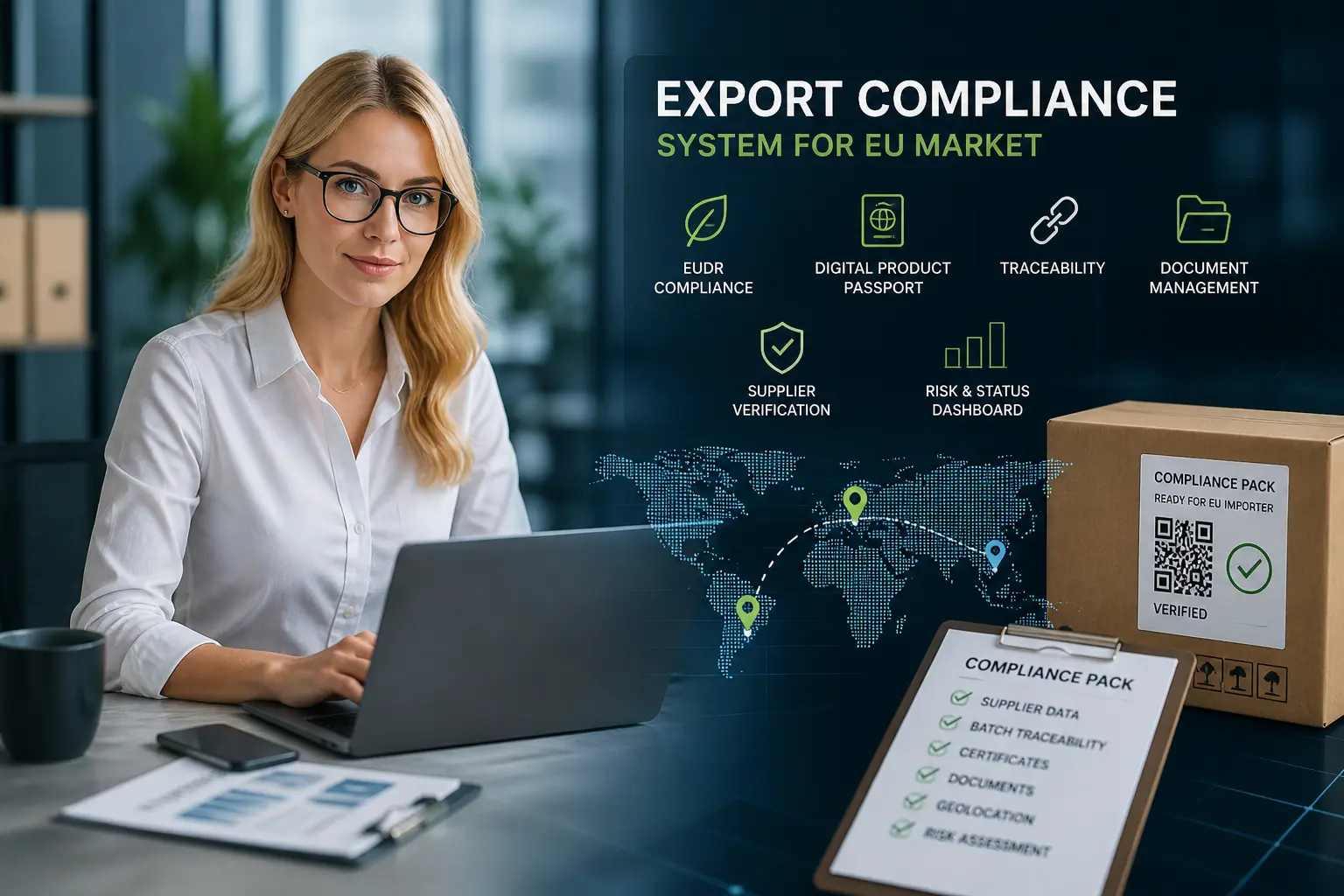
For many small and medium-sized exporters, the European Union is one of the most attractive sales markets in the world. The problem is that access to this market increasingly depends not only on product quality, price or relationships with importers. It also depends on the ability to prove product compliance, documentation readiness and supply chain transparency.
Current EUDR implementation status — verified August 2026
As of August 2026, the EUDR is scheduled to apply from 30 December 2026 for large and medium operators and for micro/small operators already covered by the former EU Timber Regulation, and from 30 June 2027 for most other micro and small operators. The European Commission also updated the Information System rules and implementation guidance in July 2026. Treat these dates as regulatory context, not as a substitute for legal advice, and verify the applicable role and product scope before implementation.
The software implication is concrete: teams preparing now need a data model that can preserve supplier identity, product/batch lineage, plot or origin evidence where applicable, document versions, risk decisions and references to due-diligence submissions without making the LLM or a spreadsheet the source of truth.
A coffee exporter from Colombia, a textile producer from Turkey, a wood supplier from Indonesia, a cocoa processor from Ghana or a component manufacturer from Vietnam no longer competes only through the product itself. These companies also compete through data quality, documentation, supply chain transparency and the speed with which they can deliver information required by European buyers.
This is where a new type of software becomes highly relevant: an export compliance system for small and medium-sized companies selling to the EU. Such a solution can organize supplier data, documents, product batches, certificates, geolocation, traceability and export-ready compliance packs for European counterparties.
At Softech.app, we build custom web systems, SaaS platforms and business automation tools. This type of solution fits directly into the direction of global trade: less spreadsheet chaos, fewer scattered PDFs, more structured data, more automation and a digital trail of compliance. You can explore our approach to building business systems in the Web Application & SaaS Product Engineering section.
Quick answer: export compliance software should connect supplier onboarding, batch traceability, geolocation, document evidence and approval state in one auditable workflow. The goal is not to “automate regulation”, but to make the data and evidence needed by buyers and compliance teams structured, searchable and reproducible. See the Supply Passport OS case study for a production example.
Exporting to the EU is becoming a data game
For years, export was mainly driven by price, quality, logistics, certificates and commercial relationships. These factors still matter, but the European market is increasingly moving toward a model where companies must not only declare compliance, but also prove it. This requires data about product origin, suppliers, raw materials, documents, batches, locations, certificates and change history.
This is especially important for small exporters from countries such as Brazil, Colombia, Ghana, Kenya, India, Vietnam, Indonesia, Turkey, Morocco and other developing markets. These companies often have strong products and competitive prices, but they do not always have a professional system for handling the requirements of European importers.
In practice, an exporter may lose a contract not because the product is weak, but because the company cannot quickly prepare complete, credible and structured documentation required by an EU client.
Why small exporters to the EU face a growing problem
The biggest issue is not always the lack of documents. Many companies already have certificates, invoices, declarations, photos, supplier information and quality data. The real problem is that this information is scattered. Some of it is stored in email inboxes, some in spreadsheets, some in scanned PDFs, some in messaging apps and some only in employees’ heads.
This model may work at a small scale and with simple orders. It does not work well when an EU importer expects a repeatable process, auditable history, fast access to data and documentation connected to a specific product batch.
A typical small exporter often operates with documents in emails, certificates as PDF scans, supplier data in spreadsheets, communication through WhatsApp, photos and locations saved manually, no change history and no single dashboard showing compliance status.
This creates operational risk. When a European buyer asks about raw material origin, supplier documents, batch status or geolocation data, the company has to search manually. The more suppliers and batches the exporter handles, the higher the risk of errors, delays and loss of trust.
European importers will require data from suppliers
In many cases, formal regulatory obligations sit with the company placing the product on the EU market. But importers cannot create source data that they do not have. That is why, in practice, they push many documentation requirements down to their suppliers.
An importer may ask the exporter where the raw material comes from, who the sub-supplier was, whether the product contains specific components, whether legal origin can be proven, whether geolocation data exists, whether documentation is complete, whether certificates are valid and whether a product batch can be linked to a specific source.
This means that suppliers from Brazil, Ghana, Indonesia, Kenya, India, Turkey, Vietnam, Colombia or Morocco need more than a product and logistics. They need a system that helps them answer European buyer requests quickly, credibly and professionally.
What is an export compliance system for EU suppliers?
An export compliance system is a SaaS platform or custom web application that helps an exporter collect, organize, verify and share the data needed to sell into the European Union. It is not a classic CRM. It is not a simple document workflow. It is not just an ESG dashboard.
It is an operating system for exporters that answers one key question: can we quickly prove to a European buyer that our product meets the requirements of the EU market?
Such a system can connect supplier data, product batches, documents, certificates, geolocation, change history, risk status, checklists and export-ready documentation packs. As a result, the exporter stops reacting chaotically and starts managing compliance as a structured business process.
Which companies benefit most from this type of system?
Coffee and cocoa exporters
Companies from Colombia, Brazil, Ghana, Côte d’Ivoire, Kenya or Ethiopia will need to document raw material origin, production plots, suppliers and product batches more effectively. For them, a compliance system can mean plantation mapping, linking coffee or cocoa batches to suppliers, collecting certificates, generating importer documentation and reducing the risk of contract loss.
Wood and wood product exporters
For companies from Indonesia, Vietnam, Malaysia, Brazil or African countries, proving legal and compliant origin of wood becomes increasingly important. The system can manage supplier data, legality documents, batch history, risk checks and ready-to-export documentation for European buyers.
Textile producers from Turkey, India, Bangladesh, Morocco and Vietnam
The textile sector is one of the areas exposed to growing requirements around digital product data, material origin and supply chain transparency. For textile producers, the system can store material composition, fabric origin, quality certificates, subcontractor data, dyeing information, production information, transport data and documentation for brands selling in the EU.
Electronics, component and small device manufacturers
For companies from China, Vietnam, India, Taiwan, Turkey or Malaysia, data about components, suppliers, materials, technical documentation, product compliance, recycling instructions and product lifecycle may become increasingly important. A compliance system helps structure this information and present it in a way European buyers can understand.
Key features of an export compliance system
1. Supplier and sub-supplier database
The system should allow the company to create digital supplier profiles. Such a profile may include the company or farm name, country and region, contact details, certificates, verification status, assigned products or raw materials and cooperation history. This helps exporters understand which data is complete and which information still needs to be collected.
2. Traceability and batch origin tracking
The strongest value of the system is the ability to link a specific product batch to its source. A typical chain may look like this: plantation, coffee batch, warehouse, container, export invoice and EU importer. In the system, each batch can have a batch number, harvest or production date, supplier, location, documents, certificates, compliance status and change history.
This turns export from a process based mostly on trust into a process based on data.
3. Geolocation and source mapping
For agricultural and forestry-related products, source location data can be important. The system can support GPS points, plots, maps, field photos, assignment of plots to suppliers and structured data export. This is especially relevant for coffee, cocoa, wood, rubber, soy and other products where origin is a key part of compliance.
4. Document vault
Exporters often have documents, but not in one organized place. The system should allow them to store certificates, invoices, supplier declarations, lab results, customs documents, quality documentation, photos and communication history. The most important value is not storage alone, but linking each file to a specific supplier, product, batch, contract or order.
5. AI compliance assistant
An AI assistant can give small companies a major operational advantage. This module can analyze missing documents, create checklists for a specific product, explain requirements in simple language, generate summaries for importers, detect inconsistencies in data, suggest which documents should be completed and prepare English-language descriptions of documentation.
For companies from developing markets, this can be the difference between “we do not understand the EU requirements” and a clear, structured package ready for a European client.
6. Compliance pack for European buyers
The system should generate a ready-made compliance package that may include a PDF, online link, QR code, risk status, document list, batch history, supplier data, certificates and origin information. Such a package can be shared with an importer, auditor, logistics partner or end client.
This matters because a European counterparty does not want to search through dozens of emails and files. They want a clear, ready-to-review set of information.
Benefits for small exporters
Maintaining access to the EU market
The most important benefit is simple: the company reduces the risk of losing European clients. If an importer has to choose between two suppliers, one sending chaotic PDFs and another offering a structured digital compliance pack, the second supplier looks safer, more professional and more future-ready.
Faster responses to importer requests
Without a system, every documentation request means manual file searching. With a system, the exporter can generate batch status, supplier data, documents, declarations and compliance summaries in minutes. This shortens contract handling time and increases the chance of closing the sale.
Stronger negotiating position
Compliance readiness can become a premium argument. The company is no longer selling only coffee, textiles, wood or components. It is selling lower risk, faster documentation, transparency, credibility and audit readiness. This can support stronger margins.
Fewer errors and lower risk of shipment delays
Missing documentation can cause delays, additional costs or contract loss. The system helps detect problems earlier: missing certificates, incomplete supplier data, unassigned batches, expired documents, missing locations or inconsistent information.
More professional image with European clients
For a small company from Ghana, India, Brazil, Turkey or Vietnam, a digital compliance system can signal that the business is ready to work with the European market. This strengthens trust, especially during the first contract.
Why this is a technology opportunity right now
Large ESG and compliance platforms already exist for corporations. The problem is that small companies often do not need a complex enterprise system. They need a simple, practical tool that solves a real problem: we export to the EU, the client requires documents, we do not know what is missing, we need to collect data from suppliers and we want to generate a compliance pack.
This creates space for a new type of product: a lightweight, mobile-friendly and affordable compliance system for exporters. It can work as a SaaS product across many industries or as a dedicated solution for a specific segment, such as coffee, cocoa, wood, textiles or components.
How Softech.app can help build this type of system
A compliance platform is primarily a Web & SaaS Product Engineering problem: data ownership, roles, workflow state, documents, audit and integrations must be explicit. Where AI is useful for classification, document assistance or bounded workflow steps, the AI Automation layer can be added without making the model the system of record.
At Softech.app, we specialize in designing and building custom web systems, SaaS platforms, business applications and tools that automate operational processes. For a project like this, we can design the SaaS architecture, exporter dashboard, supplier portal, document module, traceability module, GPS mapping, AI compliance assistant, PDF and QR code generation, status dashboards, importer API, multilingual versions, subscription model and cloud infrastructure.
If your company works with exporters, importers, audits, logistics, certification or B2B sales into the EU market, we can help design and build a system that solves a real compliance problem. Explore our Web Application & SaaS Product Engineering section or learn more about our approach on the About Softech page.
Summary
Exporting to the European Union is entering a new phase. Price and product quality still matter, but they are no longer enough. Companies that can quickly, clearly and credibly prove product compliance with European market requirements will gain an advantage.
For small exporters, this is a challenge. For technology companies, it is a major opportunity. For Softech.app, it is a natural direction for building modern B2B systems that solve real business problems.
An export compliance system can become for a small exporter what Shopify became for e-commerce: a tool that lowers the barrier to entering a larger market.