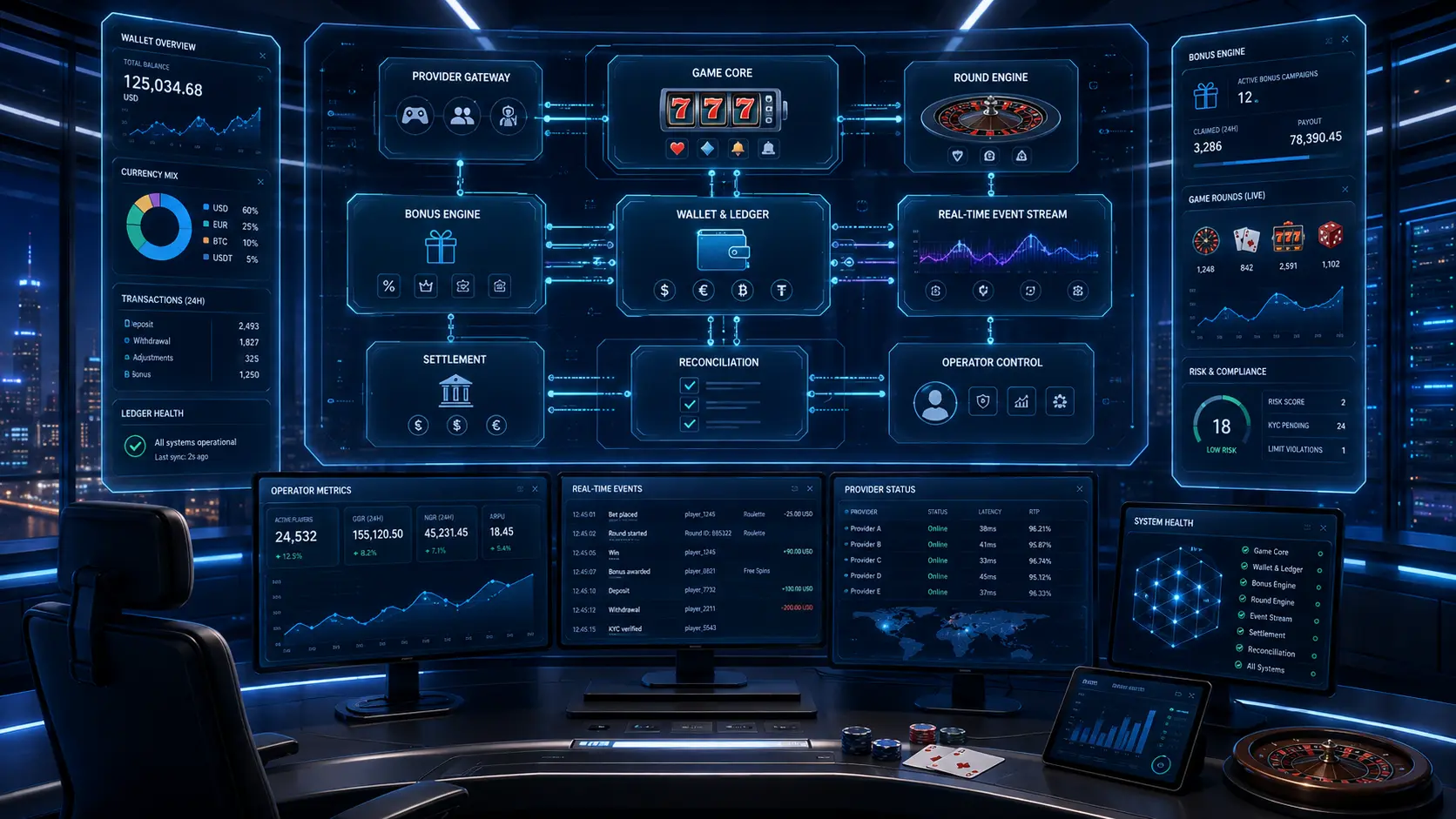
How to Build a Production iGaming Platform in 2026
A modern iGaming product is not a single game, casino frontend or operator dashboard. It is a real-time transactional system in which player state, wallet balances, bonuses, providers, payments, limits, settlement and operator operations must remain consistent even when parts of the infrastructure slow down, retry or temporarily fail.
This is why iGaming architecture increasingly resembles a combination of fintech, real-time commerce, event-driven systems and platform operations.
This guide explains how to think about a production iGaming platform in 2026: from player intent and game sessions through wallet reservations and bonus rules to round settlement, reconciliation and back-office control.
The Core Thesis
In iGaming, the game interface is only the experience layer. The real product is the consistent financial, session and operational state that can explain every event.
If the platform cannot explain the player state, available funds, applied bonus, provider result, ledger entries and final operator-visible outcome, the problem is not merely UX. It is architecture.
Why iGaming Architecture Is Changing
Operators manage more providers, markets, payment methods, bonuses and channels while the player experience is expected to remain immediate. Balance, round results, bonus state, limits and transaction history cannot synchronize later.
- real-time state becomes a first-class product problem,
- the wallet must behave like a ledger, not a balance field,
- provider integrations require idempotency and reconciliation,
- bonuses become part of the state machine,
- operators need a reproducible lifecycle for every round.
Production iGaming Architecture Stack
- Player Identity & Session
- Wallet & Ledger
- Bonus & Eligibility
- Game Session & Provider Gateway
- Round Engine
- Settlement & Reconciliation
- Event Stream & Observability
- Operator Control Plane
1. Player Identity & Session
Every action must be tied to stable player identity and a specific session. Context includes brand, currency, jurisdiction, account status, KYC, limits, blocks, device and active product session.
2. Wallet & Ledger
A production wallet is not simply a number called balance. It needs a ledger with explicit operations such as deposit, reserve, release, debit, credit, bonus credit, adjustment, refund and settlement.
- atomic financial operations,
- idempotency keys,
- immutable transaction history,
- correlation IDs,
- concurrency control,
- cash and bonus balance separation,
- provider and payment reconciliation.
Balance should be derived from the ledger. The ledger should not merely record balance changes.
3. Bonus & Eligibility
Bonusing is a rules system. Eligibility may depend on market, segment, acquisition source, game, deposit, previous promotions, limits and wagering conditions. Qualification, granting and consumption should be explicit states.
4. Game Session & Provider Gateway
Platforms rarely work with one provider. A provider gateway should normalize different provider protocols into the operator's controlled domain model.
- game session creation,
- token exchange,
- game, currency and jurisdiction mapping,
- callback normalization,
- timeouts and retries,
- provider-specific error mapping.
5. Round Engine
A game round is a state machine:
- player intent,
- wallet check,
- bonus rules,
- fund reservation,
- round execution,
- result commit,
- settlement,
- telemetry emitted.
Every phase needs a stable identity, terminal states and retry rules. Partial execution is often more dangerous than an explicit failure.
6. Settlement & Reconciliation
Settlement closes the economic lifecycle of the round. Reconciliation verifies that the operator, provider, wallet and reporting systems agree on the result.
- missing callbacks,
- duplicate callbacks,
- timeouts after successful writes,
- amount or currency mismatches,
- long-running pending rounds,
- manual adjustments requiring audit.
7. Event Stream & Observability
Events such as session.created, balance.reserved, bonus.applied, round.executed, round.settled and payment.completed should form one correlated operational trail. One correlation ID should reconstruct the player, session, round, wallet operations, provider calls, bonus decisions and final result.
8. Operator Control Plane
The back office should be a system control plane rather than a simple admin interface. Operators need player state, round timelines, wallet history, bonus decisions, provider health, manual review queues, limits, reconciliation exceptions and audit trails.
Single Wallet vs Transfer Wallet
A single wallet provides one shared balance across casino, live and sportsbook. A transfer wallet separates funds between products. Single wallet improves UX but increases synchronization and ledger demands. Transfer wallet simplifies some boundaries but introduces more player operations and intermediate states.
Event-Driven by Default
Request-response is still appropriate for operations requiring immediate results, but downstream processing should often be event-driven. A round-settled event can feed player history, analytics, CRM, fraud monitoring, bonus progression, operator dashboards and reconciliation without blocking the critical round path.
Idempotency Matters More Than Retry
Retry without idempotency can create a second debit, payout or settlement. Every financial operation and provider callback should have a stable logical operation ID.
In iGaming systems, retry should recover the result, not repeat the side effect.
The Bonus Engine Must Understand Round Economics
Problems appear when bonus systems are separated from wallet state. The platform needs to know which funds were consumed, which result belongs to cash or bonus balance and which wagering conditions remain active after the round.
Compliance-Ready Engineering
Technical architecture does not replace licensing or certification. It can, however, prepare the product for external testing, audit and market-specific requirements.
- auditable decisions,
- stable transaction IDs,
- player limits,
- roles and permissions,
- immutability of critical records,
- reproducible game and wallet history,
- market-specific configuration,
- separation of duties.
Failure-Safe Round Lifecycle
- create a correlation ID,
- verify session and player state,
- resolve bonus eligibility,
- reserve funds idempotently,
- execute the provider round,
- persist the provider result,
- settle the wallet,
- move uncertainty into reconciliation rather than repeating a side effect,
- emit downstream events,
- close the round only after the economic result is confirmed.
Common Architecture Mistakes
1. Balance Without a Ledger
Without a complete transaction trail, disputes and reconciliation become difficult.
2. Provider-Specific Domain Model
Every additional provider increases coupling and development cost.
3. Bonus Logic as a Silo
Wagering, wallet and round history drift apart.
4. Retry Without Idempotency
Duplicated financial side effects become a real operational risk.
5. No Reconciliation
Partial and pending transactions remain invisible until players complain.
6. Back Office Without Audit Trail
The operator cannot explain who changed balance, limits or state.
7. Batch-First Analytics
Risk, player limits and operational decisions react too late.
Build vs Integrate
Operators do not need to build every component. A strong architecture may use an external PAM, game aggregator, payment providers, KYC and CRM while keeping a custom control layer around player experience, wallet orchestration, bonusing, operator workflows, analytics and multi-brand operations.
Reference Architecture
- Player Web / Mobile
- API Gateway & Session Layer
- Player Account Context
- Wallet & Ledger
- Bonus Engine
- Game Orchestration
- Provider Gateway / Aggregator
- Event Bus
- Settlement & Reconciliation
- Risk / Limits / Responsible Play
- Operator Back Office
- Analytics & Observability
Executive Checklist
- Is there one authoritative source for player balance?
- Is every financial operation idempotent?
- Can a round lifecycle be reconstructed from a correlation ID?
- Are provider callbacks deduplicated?
- Do cash and bonus balances have explicit semantics?
- Does settlement have a reconciliation path?
- Does the operator have an audit trail for manual actions?
- Can the platform recover from timeouts and partial failures?
- Is jurisdiction configuration separated from core business logic?
- Can a new provider be added without redesigning the domain model?
Conclusion
Production iGaming starts where the demo ends. A game can look excellent, but wallet, ledger, bonus rules, session state, settlement, reconciliation and operator control are what make the product capable of surviving real operations.
The strongest platforms in 2026 will be designed as real-time operating systems rather than collections of loosely connected modules.
In iGaming, competitive advantage is not created only on the player's screen. It is created in the quality of the system that can explain and settle every round correctly.