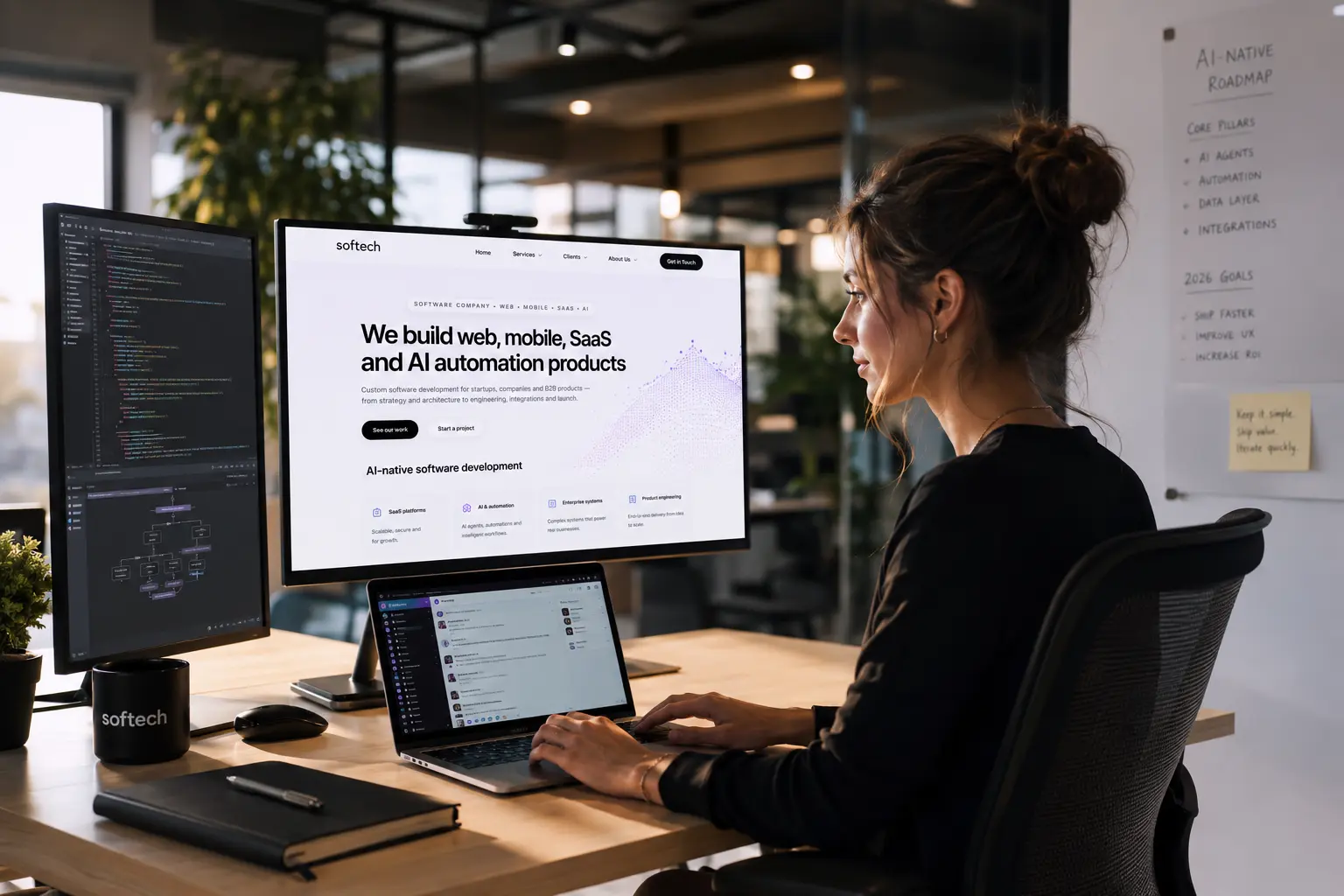
Software development is entering a new economic era. For years, the cost of building software was mainly driven by the number of people required to design, implement, test and maintain a system. AI changes that equation. It does not remove software engineering, but it changes where the real value is created.
In 2026, writing code is no longer the only bottleneck. AI can help generate interfaces, backend endpoints, tests, documentation, refactoring suggestions and prototypes. But this does not mean that software becomes easy. It means the advantage moves higher: toward understanding the business workflow, designing the right architecture, making good product decisions and building systems that solve real operational problems.
This is the core idea behind AI-native software development. AI is not a feature added at the end. It becomes part of the engineering workflow, product architecture and business operating model from the beginning.
What is AI-native software development?
AI-native software development means building software with AI integrated into the way the product is designed, developed and operated. It is not the same as adding a chatbot to an existing application. A product can have an AI feature and still not be AI-native.
An AI-native system is built around the assumption that intelligence will be part of the workflow. It can classify messages, analyze documents, suggest actions, automate repetitive tasks, summarize activity, support decision-making and help users move through a business process faster.
In practice, this means that AI must be connected to data, permissions, roles, events, documents, customer history and operational context. Without that context, AI remains a generic assistant. With that context, it becomes part of the operating system of the company.
Why code is no longer the main bottleneck
For many years, software projects were limited by implementation speed. Every feature required design, frontend, backend, database work, testing and deployment. AI does not remove those steps, but it compresses many of them.
AI can help teams explore solutions faster, generate boilerplate code, write documentation, create tests, review edge cases and accelerate prototyping. This gives good engineers more leverage. But it also exposes weak product thinking. If the team does not understand the problem, AI will only help build the wrong thing faster.
The new bottleneck is not typing code. It is understanding what should be built, why it should exist, how it fits into the business process and what trade-offs are acceptable.
The rise of product engineers
AI increases the value of people who can own a problem end-to-end. A product engineer understands not only implementation, but also the user, the business process, the data model, the UX and the operational constraints.
This does not mean that deep specialists disappear. Security, infrastructure, performance, data engineering and complex systems still require expertise. But narrow implementation work becomes less defensible when AI can generate large parts of it. The strongest engineers will be those who combine technical depth with product judgment.
In AI-native teams, the question is not only “can we build this?” The better question is: “does this workflow deserve to exist, can it be automated, and what would make the system 10x more useful for the user?”
How AI changes the economics of software
AI changes software economics in three ways. First, it reduces the cost of implementation. Second, it increases the speed of iteration. Third, it makes smaller, senior teams more productive.
This creates pressure on traditional software houses that sell developer hours as their main business model. When AI makes delivery faster, clients will increasingly ask why they should pay for the same number of hours. The market will move toward value, outcomes, automation, proprietary know-how and domain expertise.
The best software companies will not be the ones that simply use AI tools. They will be the ones that redesign their operating model around AI: discovery, architecture, delivery, QA, documentation, maintenance and continuous optimization.
AI-native systems vs classic SaaS
Classic SaaS usually gives users predefined screens, dashboards and workflows. The user enters data, clicks through the interface and manually moves work forward. This model still works, but it is increasingly limited.
AI-native systems can understand context and participate in the workflow. They can detect missing information, suggest the next action, classify a request, summarize a call, prepare a document, generate a report or identify operational bottlenecks.
The difference is not only technological. It is conceptual. Classic SaaS helps users manage work. AI-native SaaS helps users move work forward.
Why vertical SaaS has a massive opportunity now
Many industries still run on outdated software. These tools survived because replacing them was expensive, risky and often not attractive enough for large software vendors. AI changes the math.
When development becomes cheaper and faster, smaller niches become economically interesting. A modern system for a specific industry can now include workflow automation, document analysis, AI-assisted support, reporting and mobile access from the beginning.
This is why vertical SaaS may be one of the biggest winners of the AI era. The opportunity is not to build generic tools for everyone. The opportunity is to build highly specific systems that understand how a particular business really works.
What AI still does not replace
AI does not replace architecture. It does not replace product responsibility. It does not understand the business context unless the team gives it that context. It does not automatically know which trade-offs are right, which workflow should be simplified or which feature should not be built.
This is why AI-native software development still requires strong engineering judgment. Teams must design secure systems, reliable data models, clear permissions, good UX and maintainable architecture.
AI is a multiplier. It multiplies clarity, but it also multiplies confusion. A strong team becomes faster. A weak process becomes chaotic faster.
The AI-Native Company Stack
To build AI-native software effectively, companies need more than AI tools. They need a stack of capabilities: AI-augmented engineers, workflow-centric architecture, vertical SaaS knowledge, automation infrastructure and continuous AI optimization.
AI-augmented engineers use AI to accelerate work, but they still own decisions. Workflow-centric architecture connects AI to real business processes. Vertical SaaS knowledge gives the product domain depth. Automation infrastructure turns intelligence into action. Continuous AI optimization allows the system to improve over time.
This is where the biggest advantage appears. Not in prompts alone. Not in code generation alone. But in combining AI with domain knowledge, architecture and operational workflows.
What this means for companies building software today
Companies building new software in 2026 should not ask only: “Can we add AI?” A better question is: “Which part of our workflow should become smarter, faster or more automated?”
AI should be connected to real use cases: support triage, document review, CRM automation, report generation, internal knowledge search, quotation support, onboarding, compliance checks or operational recommendations.
The companies that win will not be those that add AI labels to old products. They will be those that redesign their systems around workflows, data and intelligence from the beginning.
Summary
AI-native software development is not hype. It is a shift in the economics of software. Code becomes cheaper to produce, but good product thinking becomes more valuable. Smaller teams gain leverage, but only if they understand the business problem deeply.
The future of software engineering will not belong to teams that only write code. It will belong to teams that understand workflows, design strong systems and use AI to turn business knowledge into better products.
For companies building SaaS, enterprise systems or dedicated business software, this is the moment to rethink the architecture of the product and the operating model of the team. The question is no longer whether AI will affect software development. The question is how quickly your company can become AI-native.