Searches like “fire extinguisher inspection software”, “fire hydrant inspection software”, and “fire inspection management software” usually start when spreadsheets, PDFs and paper forms stop scaling. As the number of sites and assets grows, so does the risk: missed due dates, inconsistent inspection history, scattered documentation, and audit stress.
Evaluating an implementation rather than architecture alone? See our Fire Safety & Inspection Software Development service for project scope, field workflows and TECHPRES.app production proof.
Inspection software must preserve the rule, the evidence and the performed work
Poland's fire-protection regulation, read together with the 2024 amending act, sets the general inspection and maintenance rule for fire-protection devices and extinguishers according to applicable standards, technical documentation and manufacturer instructions, with the general minimum cadence of once a year. The 2024 amendment adds an explicit exception for autonomous smoke and carbon-monoxide detectors, which follow manufacturer instructions. Software should therefore model the inspection rule as versioned policy with source provenance and exceptions rather than one global 365-day constant; the due-date policy, asset identity, technician evidence, measurements and signed protocol need their own auditable state.
This article describes software architecture and operational evidence. It does not replace a fire-safety specialist's assessment, manufacturer instructions, Polish Standards or legal advice.
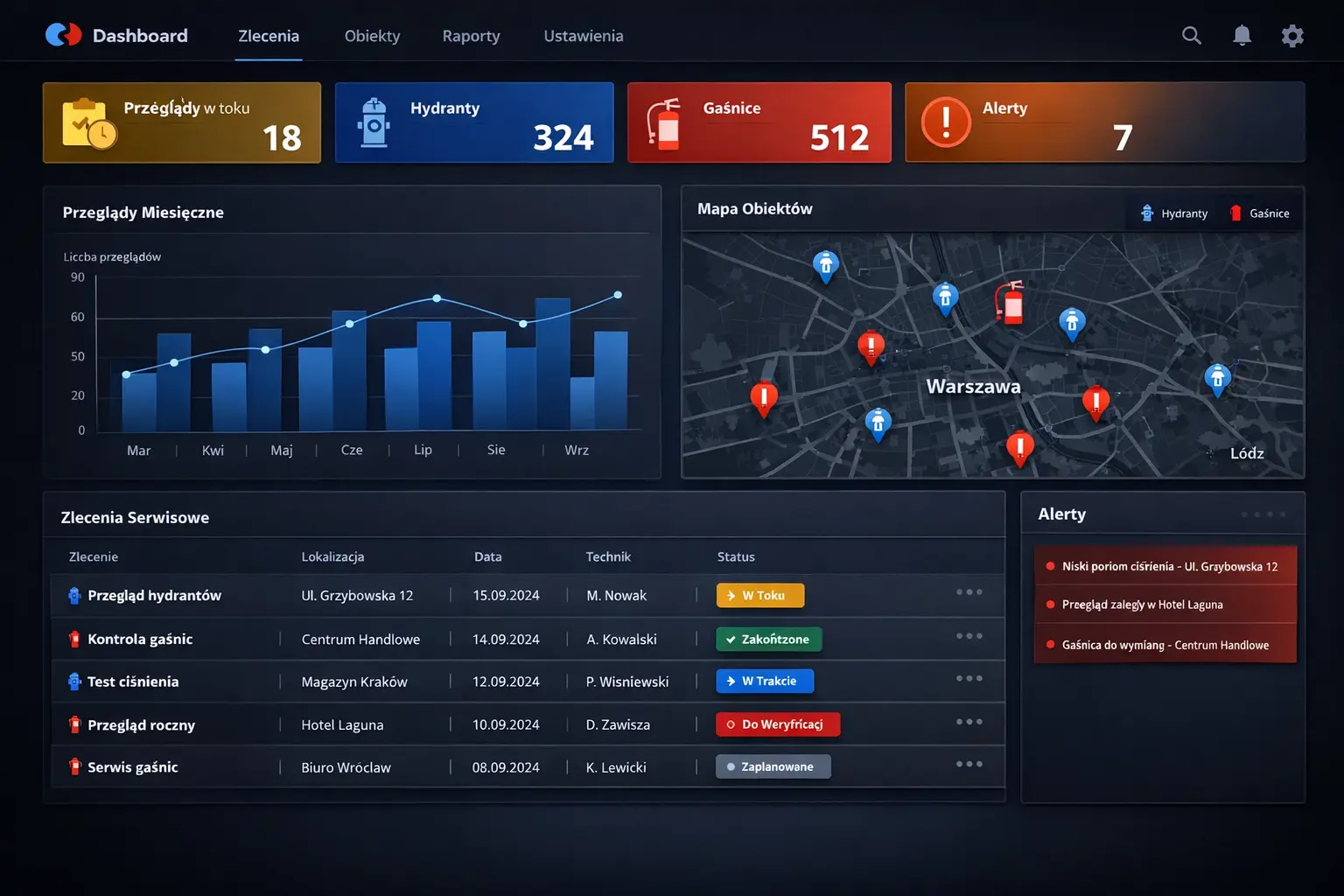
This guide uses Softech.app's production fire safety service management system as proof for the architecture for hydrants, extinguishers and measurement devices — combining a central asset registry, scheduling, field technician workflows, automated PDF protocols, and optional IoT/GSM measurement integrations.
Quick answer: fire hydrant inspection software should connect asset identity, next-due dates, technician tasks, measurements, service history and generated protocols in one operational state model. TECHPRES is the production proof; the current commercial path for similar custom systems is Business Operations Software.
1) Who is this solution for?
- B2B fire safety service companies managing many sites and thousands of assets.
- Inspection coordinators scheduling technicians and controlling due dates.
- Organizations that need audit-ready documentation and a central asset registry.
2) The challenge: spreadsheets don’t scale
The client managed hundreds of locations and thousands of assets. Data lived in spreadsheets, paper protocols, and PDF files. Scheduling was time-consuming and measurement results were entered manually. There was no single source of truth, no reliable reminders, and no automated reporting.
3) The solution: fire inspection software + automated PDF reporting + IoT-ready measurements
We built a SaaS-ready system mirroring real-world structure:
- company → site → sub-location → asset (hydrants, extinguishers),
- calendar scheduling and task dispatching,
- technician checklists and structured on-site execution,
- automatic PDF protocol generation from templates,
- manual or automated measurements (IoT/GSM) stored in one model.
Central asset registry
This is more than “record keeping”. The system creates a consistent history: status, inspections, measurements and documents linked to each asset and location.
Scheduling & reminders
Coordinators get clear visibility across due dates, priorities and workload. This reduces missed inspections and improves operational efficiency.
Field technician workflows
Technicians perform inspections using structured checklists. The outcome: fewer errors, consistent data, faster completion.
Automated PDF protocols
Once an inspection is completed, the system generates a PDF protocol using templates and inspection data (including measurements). Documents are archived and linked to assets and sites — ready for clients or audits.
IoT / GSM measurement integrations
The platform can receive measurement data via API/TCP/WebSocket and automatically connect it to a specific inspection, asset and site — reducing manual entry and improving data reliability.
4) Spreadsheet vs inspection management system
- Spreadsheet: scattered files, inconsistent history, manual reporting.
- System: single source of truth, scheduling, automated PDFs, audit-ready history.
5) Product outcome: from custom implementation to TECHPRES.app
The strongest verifiable outcome is productization. The system evolved into TECHPRES.app, a live commercial SaaS product for fire-safety service companies. The public product combines asset registry, scheduling, field workflows, automated PDF protocols and optional FH-2 Connect measurement hardware.
Earlier percentage-based efficiency claims are intentionally not repeated here as verified KPIs because the underlying baseline and analytics export are not part of the public evidence set.
6) How does implementation work?
- Discovery: workflows, data model, protocol templates.
- MVP: registry + scheduling + inspections + basic reporting.
- Document automation: PDF templates and archiving.
- Integrations: IoT / GSM measurement devices.
- Scale: reporting, multi-tenant SaaS, analytics.
7) When does a dedicated inspection system make sense?
If you need fire extinguisher inspection software that truly runs operations (not just logs data), Softech.app can build it end-to-end — UX/UI, web app, backend, integrations.
Explore: Web App Development and the case study.
FAQ
Can it run as a multi-tenant SaaS for multiple clients?
Yes — the architecture supports multi-tenancy, data separation and role-based access.
Can PDF protocols be customized?
Yes — templates can be tailored to your organization’s standards and requirements.
Is IoT integration required?
No — manual mode works fully, and IoT integrations can be added later.