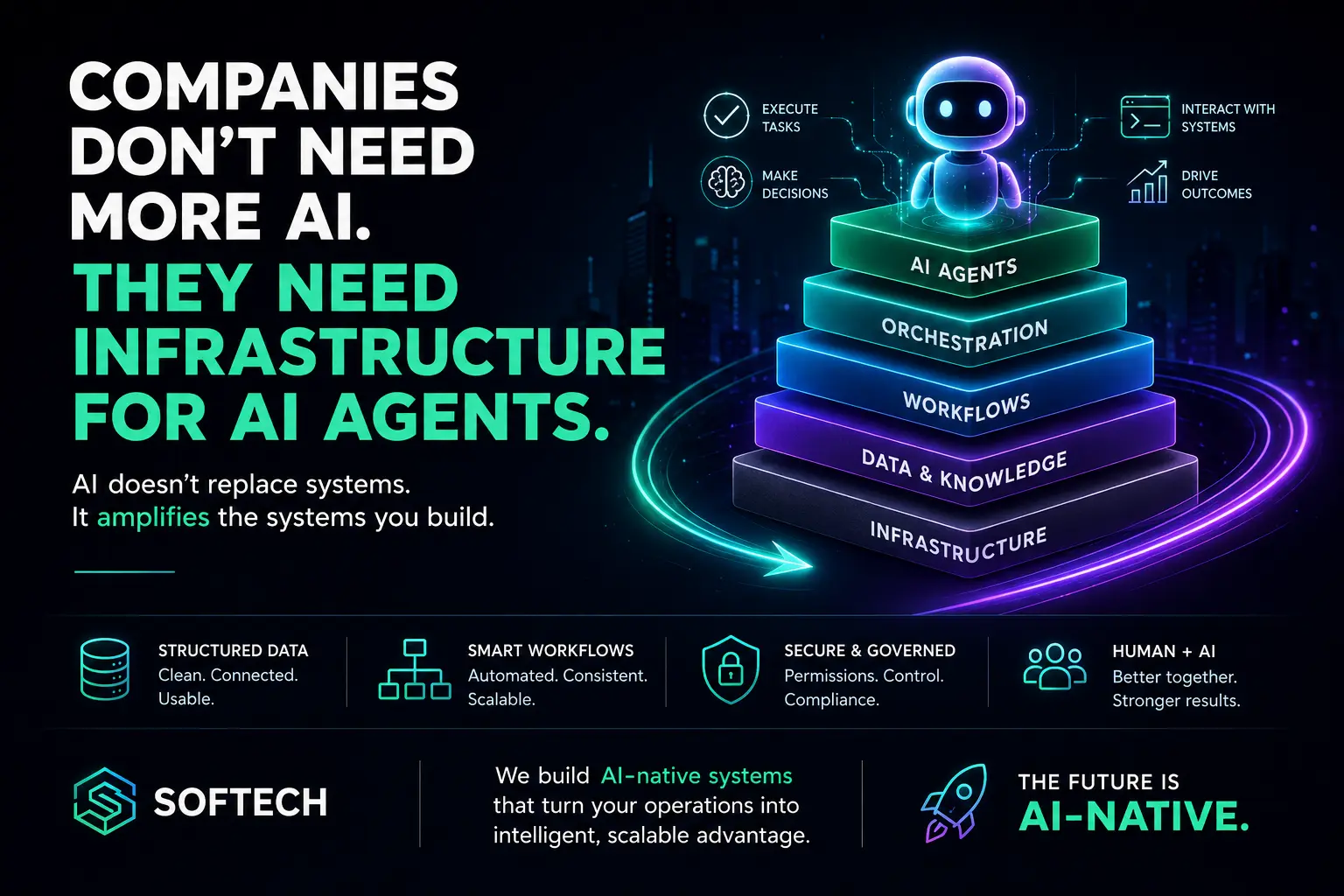
AI-native SaaS is an application architecture, not a model feature
A production AI-native SaaS product does not place a language model beside the application and give it broad access to the database. It treats AI as one execution subsystem inside the same tenant, permission, workflow and audit boundaries that govern human actions. The model may interpret intent, classify information, draft output or propose an action; the application still decides what data can be read, what operation can be executed and which state transition is valid.
This distinction becomes critical as soon as AI can do more than answer questions. A model that can create an invoice, change a booking, issue a refund, update a CRM opportunity or prepare a compliance document is participating in business state. At that point prompt quality is no longer the primary architectural problem. Authorization, idempotency, approval, observability and recovery are.
A practical reference architecture
A useful design separates the product into an application control plane and an AI reasoning layer. The control plane owns identity, tenant context, domain rules, workflow state and persistence. The reasoning layer receives a deliberately constructed context and can request only explicitly registered tools.
| Layer | Responsibility | What AI must not own |
|---|---|---|
| Identity & tenant | User, organization, membership, resource scope | Inventing or switching tenant context |
| Policy | Roles, permissions, resource-level rules | Granting itself permission from prompt context |
| Domain | Valid commands and state transitions | Writing arbitrary database state |
| AI | Interpretation, planning, drafting, recommendation | Bypassing domain validation |
| Tools | Narrow adapters to business capabilities | Unbounded generic access |
| Audit | Who, what, why, result and evidence | Optional best-effort logging |
Tenant context must be server-derived
Organization ID, membership, role and resource scope should come from authenticated application state, not from text supplied to the model. If the user asks the assistant to switch to another customer or includes an identifier in a document, that text can be interpreted as intent but cannot become authorization. The server resolves the requested object, checks membership and only then exposes the minimum context needed for the task.
The same rule applies to retrieval. A record appearing in model context means only that the retrieval layer selected it. It does not mean the model may modify, export or disclose that record. Read scope and action scope should be evaluated separately.
Tools should look like domain commands
The safest tool surface resembles a well-designed application service: createDraftQuote, rescheduleReservation, requestRefundReview or classifyInspectionIssue. Each tool validates tenant scope, input schema, current state and permission before executing. Avoid generic tools such as run SQL, update object or call arbitrary URL unless they are isolated behind a separate administrative boundary.
For side effects, tools should also support idempotency. Model retries, network retries and worker retries can otherwise create duplicate invoices, duplicate emails or repeated external API calls. A stable command key tied to the business operation gives the domain layer a way to return the previous result instead of repeating the effect.
Workflow state should remain deterministic
AI is strongest at interpreting ambiguous information; deterministic state machines are strongest at enforcing process. A useful pattern is to let the model propose the next action while the application validates whether that action is legal from the current state. A contract can move from draft to review only through the domain workflow. A high-value refund can require approval regardless of how confidently the model recommends it.
This also makes human-in-the-loop control explicit. Approval is not a vague ask-a-person-when-unsure instruction. It is a policy decision: operations above a risk threshold create a review task, preserve the model proposal and evidence, and wait for an authorized user.
Observability must connect AI behavior with product outcomes
Model latency and token cost are useful but insufficient. Production telemetry should connect a run to the tenant, workflow, tool calls, policy decisions, retries, human overrides and final business outcome. This allows teams to answer operational questions: Which tool fails most often? Where do users override the recommendation? Which automation saves time but increases support work? Which tenant is consuming disproportionate inference cost?
Do not log secrets or unrestricted prompts by default. Store structured events and redacted evidence appropriate to the product's privacy model. The audit record should explain a business action without becoming a second uncontrolled copy of customer data.
Failure modes to design for before launch
- Cross-tenant context leakage: retrieval or cache keys omit tenant scope.
- Authorization confusion: the model treats retrieved data as permission to act.
- Duplicate side effects: retries execute the same mutation more than once.
- Stale-state actions: the model acts on a snapshot after another user changed the resource.
- Over-broad tools: one generic capability silently expands the blast radius of a prompt error.
- Invisible degradation: model quality changes but the product has no task-level evals or business telemetry.
What this looks like in Softech product work
Across marketplace, booking, field-service and operational software, the durable pattern is the same: AI is valuable when attached to an existing source of truth rather than replacing it. In the KILOGRAM marketplace, AI can assist listing composition while the listing lifecycle remains deterministic. In Voice AI booking, the model interprets a phone request while availability, pricing and reservation creation remain domain operations. In TECHPRES.app, measurements, assets and protocols remain auditable operational state even as AI assistance evolves around the workflow.
That is why Softech's Web & SaaS Product Engineering and AI Automation work converge at the architecture boundary: models are integrated into the product state, not deployed as a parallel application.
Architecture decision checklist
- Define the canonical tenant and user context before any model call.
- Separate retrieval permission from mutation permission.
- Expose narrow domain tools instead of generic infrastructure access.
- Make side effects idempotent and state-aware.
- Encode approval thresholds in product policy, not only in prompts.
- Record structured audit events for model, tool, policy and human decisions.
- Measure task success and business outcome in addition to model metrics.