When does a classifieds marketplace need a mobile application?
A mobile classifieds app becomes worthwhile when people return frequently to browse, publish and respond to offers, and timely notifications support those tasks. It is not a mandatory companion to every website. If a new marketplace is still trying to attract its first sellers, a strong mobile-friendly website may be the better starting point.
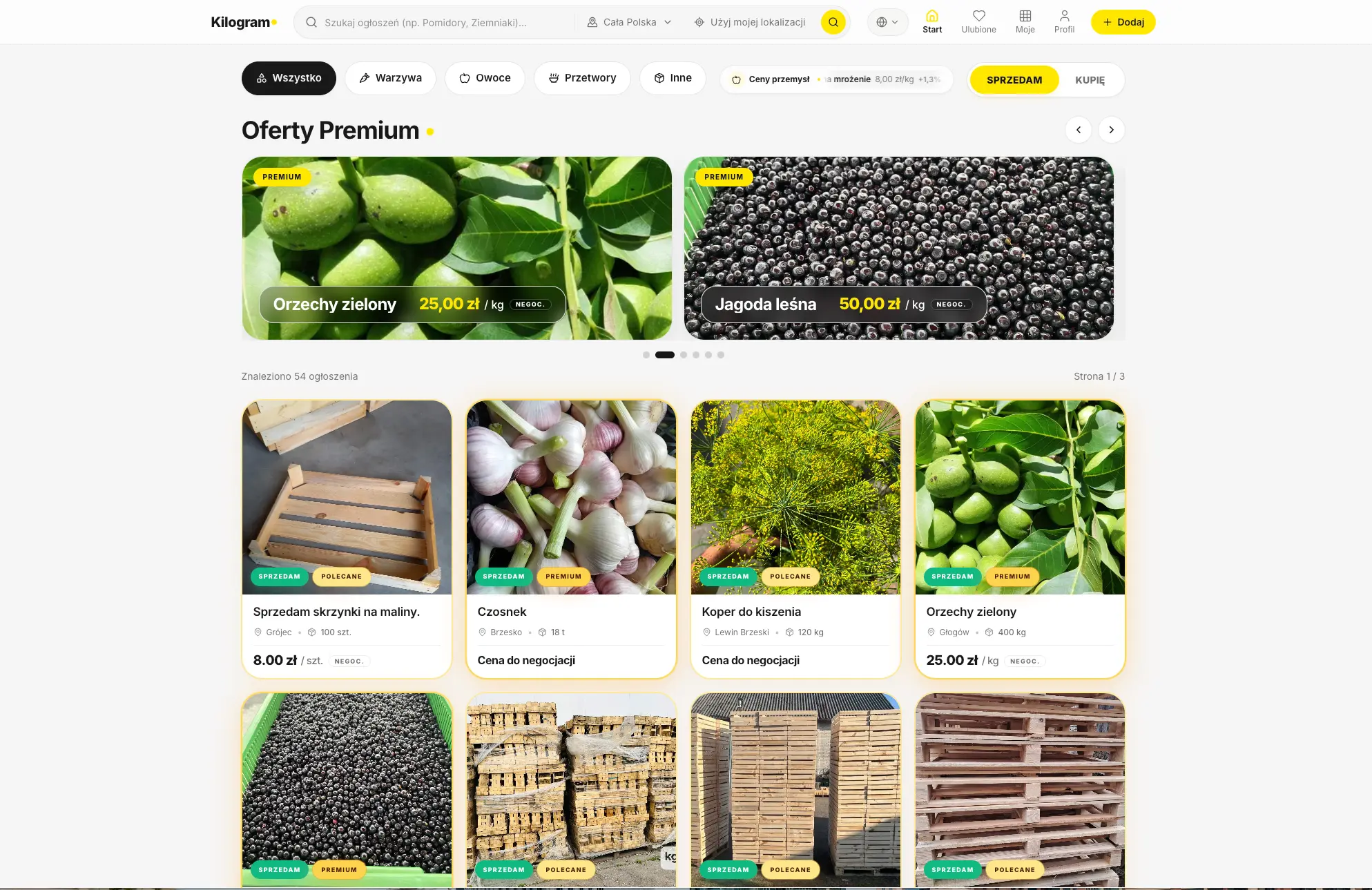
Implementation reference: KILOGRAM connects its mobile app and web marketplace through a shared API and consistent listing and permission rules. The case documents capabilities without unverified download or retention claims.
For agricultural traders, the phone is particularly practical. A seller can photograph produce in the field, enter a quantity and location and check enquiries without returning to a desk. A buyer can save an offer and revisit it later.
Choose the app based on actual user behavior and the value of repeat engagement, not on the assumption that being listed in app stores automatically delivers an audience.
How should mobile and web work together?
The website helps people discover a platform, including through public listings indexed by search engines. The mobile application often best serves returning users who post offers, follow favorites and respond to notifications. Both should operate on the same authoritative listing data and business rules.
An offer posted from a phone should appear correctly on the web. Changing a price, ending an offer or restricting an account must have the same effect everywhere. Divergent databases and authorization logic quickly create confusion and security risks.
KILOGRAM is documented as an ecosystem combining a mobile application, web experience, shared backend services and an operator console. That approach is relevant to classifieds businesses serving customers through multiple channels.
Design posting around the realities of a small screen
Creating an offer is a seller's central action. A lengthy form on a phone can become a major barrier. Break it into understandable stages: product and description, price and quantity, location and image, then a final preview.
Agricultural markets need accurate units, categories and distinct offer types. Users should understand what is mandatory and why. If connectivity fails during posting, the interface must explain whether the draft was saved or the listing was actually published.
KILOGRAM uses a staged posting flow and phone-based one-time codes for sign-in. These patterns can improve usability, provided the system also handles failed requests, rate limits and abuse protection responsibly.
Location, photos and working away from an office
Mobile devices make taking photos, attaching media and handling local notifications convenient. Nevertheless, the user should control the disclosure of location. A farm or storage address is not always appropriate for public display.
Where coverage is inconsistent, consider local drafts, an upload queue, retries and clear status messages. Not every action must be available offline. The most important requirement is never to confuse an unfinished local draft with a successfully published listing.
An international platform may require different levels of geographical precision by country. Collect only location information that is genuinely necessary to discover and manage offers.
Notifications that help rather than interrupt
Updates about relevant replies, listing status or important account events can bring users back at useful moments. Sending every new item as a push notification is likely to overwhelm recipients instead.
Distinguish notification categories, respect user settings, prevent duplicates and provide links to the relevant screen. A tap should lead to the related listing or discussion rather than a generic home screen.
KILOGRAM's documented implementation includes push notifications, an in-app notification center, read states and contextual navigation. The design should balance user usefulness with delivery cost and operational control.
Community is different from one-to-one messaging
When people can discuss topics, respond to questions and recognize helpful contributions, a marketplace can develop value beyond a list of advertisements. A community may encourage return visits and increase familiarity among traders.
Public threads and private buyer-seller conversations have different privacy, moderation and notification needs. KILOGRAM's public case study documents discussion threads and reactions; it should not be treated as proof of a private messenger.
See community and chat design for marketplaces for the operational distinctions.
Do classifieds apps benefit from AI?
AI-assisted descriptions and illustrations can lower the effort required to publish an offer. But this feature should solve a verified user problem. If people already publish easily, other improvements may have a higher return.
Product facts cannot safely be invented by a language model. AI-generated images should be distinguished from genuine product photographs, and the seller should review the final publication.
Our AI listing content guide explains the safeguards. KILOGRAM's verified case study confirms both AI-assisted listing descriptions and image generation. Any further AI capabilities should be distinguished from the product's documented scope.
Account security and permissions
Simple sign-in still requires security controls: one-time code expiry, attempt limits, session management, account recovery and administrative authorization. Contact details, location and offer history require responsible data handling.
The application should also communicate what happens after an offer is removed, an account is restricted or a connection fails. Shared server-side rules keep these decisions consistent across devices.
Security tests should include attempts to call backend endpoints directly. A user must not gain access to another person's offer management simply by modifying request data.
Delivery stages and long-term cost
Project estimation should begin with business scope rather than a programming framework. A read-only listing browser has a very different cost from a product with photos, publishing, sign-in, moderation, notifications, community and AI integration.
- User research: map important journeys and listing data.
- Experience design: posting, search, profile and saved offers.
- Shared services: accounts, categories, offers, location, permissions and state transitions.
- Mobile release: installation, sign-in, posting, notification flows and error handling.
- Quality checks: devices, weak connectivity, session recovery, security and store submission.
After release, operating-system updates, security fixes and new device requirements become part of ongoing maintenance. They belong in the budget from the beginning.
Measure business outcomes, not only downloads
Useful metrics include completed listings, time to publish, returning sellers, buyer enquiries, saved offers and meaningful returns after a notification. These indicate whether mobile makes marketplace participation easier.
Compare the same processes against the web experience. A dedicated app can be ideal for regular sellers without being the primary entry point for new buyers. Both audiences matter.
Explore the KILOGRAM marketplace case study and SOFTECH's mobile application development service.