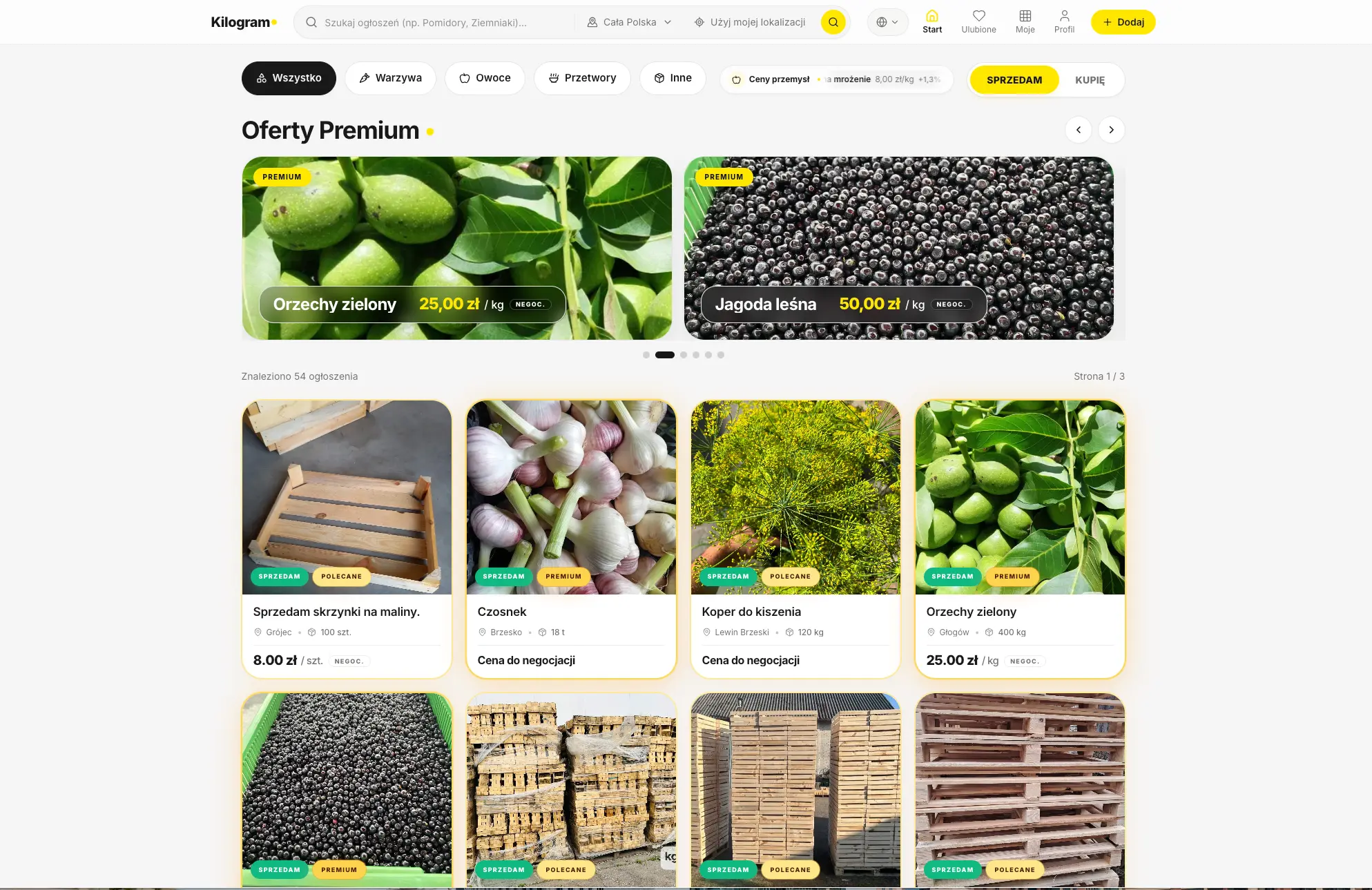
KILOGRAM as a Complete Digital Ecosystem
KILOGRAM is a marketplace platform created for publishing and discovering local product offers, particularly those related to food, agriculture, local producers and direct sales.
From the beginning, the project was not treated as a single application displaying a catalogue of listings. Connecting sellers, buyers and platform operators required a complete technology ecosystem consisting of a mobile application, web platform, backend API, database, administration panel, AI mechanisms, notifications, payments, communication and external channel integrations.
Softech’s role extended beyond software implementation. It included business process analysis, solution architecture, digital product development, UX/UI design and the iterative refinement of the platform based on real user scenarios.
KILOGRAM demonstrates that a modern marketplace application is not a collection of isolated screens. It is a system in which listing publication, communication, payment, moderation, image generation and notifications must operate as one coherent process.
The Business Challenge: Organising Local Commerce
Local product trading is fragmented across classified websites, social media, thematic groups, messaging applications and direct relationships with sellers.
For sellers, this often means publishing the same offer in several places. For buyers, it means difficulty finding a specific product in a particular location.
KILOGRAM was designed as one environment where users can:
- publish selling or buying offers,
- select category, location, price, quantity and unit,
- reach local customers,
- contact another user directly,
- save interesting listings,
- promote offers requiring faster exposure,
- use the platform through mobile and web interfaces,
- participate in a community focused on local commerce.
A listings directory alone would not solve the entire problem. The product also required secure authentication, moderation, payment support, notifications, operational tooling and an architecture prepared for continued development.
A Product-Oriented Approach Instead of Isolated Screens
In complex technology projects, it is easy to focus on another form or endpoint and lose sight of the complete user journey.
In KILOGRAM, every feature was analysed in a wider context. Publishing a listing did not only mean saving form data. The process had to include authentication, user profile, location, images, AI-generated visuals, validation, preview, promotion, notifications, moderation and later editing.
The community module similarly required more than a comment field. The product needed threads, replies, reactions, content statuses, editing history, soft deletion, permissions and administration tools.
Development was carried out iteratively. Interfaces were repeatedly refined with regard to usability, information hierarchy, clarity and visual consistency. This included the login and OTP flows, listing creation, profile, documents, security settings and the notification centre.
KILOGRAM Platform Architecture
The KILOGRAM ecosystem consists of several connected layers:
- Mobile application — the primary everyday user interface.
- Web platform — listing discovery, search, detail pages and mobile application promotion.
- Backend API — the central business logic and communication layer.
- Database — users, listings, locations, payments, documents, notifications and AI processes.
- Administration panel — the operational management centre.
- AI services — image generation and quality control workflows.
- Communication system — push notifications, notification centre and deep links.
- External integrations — social channels and services extending listing reach.
The key architectural decision was to design all these elements as parts of one product. A listing status change, moderation action or AI process result can therefore be reflected consistently in the mobile application, web platform and operator panel.
The Mobile Application as the Main User Tool
Phone Number and OTP Authentication
KILOGRAM uses phone number authentication and a one-time password. This shortens onboarding and removes the problem of forgotten passwords.
The mechanism still requires correct handling of code expiry, resending, user sessions and sensitive operations. The application also supports biometric protection, including Face ID.
A Multi-Step Listing Publication Flow
The listing process was divided into clear stages. Users can define:
- title and description,
- product category,
- selling or buying offer type,
- location,
- price, quantity and unit,
- price negotiability,
- quantity flexibility,
- an uploaded image or AI-generated visual.
Before publication, users see a complete preview and can correct information before making the listing visible.
The UX had to balance data quality with simplicity. A form that is too short reduces listing quality, while an excessive process increases abandonment.
Listing Promotion and Monetisation
The platform includes mechanisms for highlighting and promoting selected listings. This is particularly useful for seasonal products, larger quantities and offers that need to reach buyers quickly.
The solution was designed so that additional monetisation models can be introduced without rebuilding the core marketplace process.
Profile, Favourites, Documents and Settings
Users can manage their profile, save favourite listings, view documents, change language, configure security and control notification preferences.
These elements build trust and provide users with control over their data and platform communication.
The Web Platform as an Extension of the Ecosystem
The web layer makes key marketplace features available through a browser. Users can browse offers, filter by category and location and open detailed listing pages.
The interface is responsive across desktop, tablet and mobile devices.
An important part of the web platform is a mobile app promotion page with professional device mock-ups, a QR code and consistent visual identity.
The platform was prepared for further SEO, generative engine optimisation and visibility in AI-powered search systems. This requires clear information architecture, semantic listing pages, location data and content matching real search intent.
The Backend API as the Central Product Layer
The backend API is responsible for the business logic of the entire ecosystem. It is not merely a data storage interface.
The backend covers:
- user registration and authentication,
- OTP codes and session handling,
- profile management,
- listing creation, editing and publication,
- category, location, price, quantity and unit validation,
- buying and selling offers,
- favourites, documents and notifications,
- payments and listing promotion,
- community threads, replies and reactions,
- AI-generated image management,
- permission control,
- external service integrations,
- error monitoring and service health.
One of the most important challenges was maintaining consistency across multiple applications. A status changed in the administration panel must be interpreted correctly by both mobile and web clients.
Artificial Intelligence as a Real Product Capability
AI is used to generate visuals supporting listing publication. The feature is useful when a user does not have a suitable photograph or needs to prepare an attractive listing quickly.
A production AI implementation required far more than calling a model.
Building Prompts from Listing Data
The system analyses the category, type and name of the product and builds a prompt adapted to the offer context. Different products require different descriptions and constraints.
Reducing Incorrect Product Identification
Generative models may confuse less common products with visually popular alternatives. The mechanism was therefore refined through tests involving concrete examples, including wild strawberries, rhubarb and less common fruit and vegetable varieties.
Attempt History and Administrative Quality Control
The process records the model, provider, prompt version, status, attempt history and errors. Operators can inspect failed generations, retry the process or manually reject unsuitable materials.
This is what separates an AI demo from a production AI system: queues, retries, monitoring, versioning, quality control and operational tooling are required.
Community and Communication Between Users
KILOGRAM is more than a listings catalogue. Its community module allows users to start discussions, publish replies and react to content.
The solution includes:
- discussion lists,
- popular topics,
- individual thread views,
- replies and reactions,
- content editing,
- content deletion,
- thread and reply statuses.
Soft deletion preserves discussion structure when content is removed. Instead of physically deleting a record and breaking relationships, the system displays an appropriate placeholder while preserving reply context.
Edit markers inform users that content has changed. These decisions influence UX, moderation, security and data consistency.
Notifications and Contextual Communication
The communication system includes push notifications and an in-app notification centre.
Users can see read and unread messages, manage consent and move directly to the screen related to a specific event.
The mechanism supports:
- listing-related notifications,
- administrative messages,
- notification grouping,
- read status,
- deep links to relevant screens,
- user consent settings.
The architecture is prepared for further automation and personalisation.
The Administration Panel as the Operational Centre
The quality of the administration panel directly affects the operating cost of a product. If every moderation action, status change or retry requires a developer, the platform becomes difficult to scale.
The KILOGRAM panel supports:
- user management,
- listing management,
- moderation and reports,
- categories and configuration,
- notifications,
- AI-generated images,
- prompts and generation parameters,
- attempt history,
- queues and statuses,
- errors and retries.
The goal was to provide tools that allow operators to respond independently without involving the technical team in every daily situation.
External Channel Integrations
Social integrations are another area of development, including the ability to publish or promote listings through the KILOGRAM Facebook channel.
The flow was designed as part of listing creation. External promotion can therefore become a natural publication step rather than a separate task performed later.
Integrations increase listing reach and make use of existing communities without fragmenting the core experience.
Security, Stability and Network Resilience
A mobile application must work under weak coverage, network switching and temporary service outages.
KILOGRAM includes mechanisms for detecting missing or low-quality internet connectivity and displays clear messages explaining the likely cause of a problem.
The wider approach includes:
- OTP authentication,
- biometric protection,
- session management,
- access control,
- data validation,
- protection of sensitive operations,
- health check endpoints,
- backend monitoring,
- error and retry handling,
- clear empty and failure states.
The Most Important Technology Challenges
Consistency Across Multiple Applications
The same data is used by mobile, web and administration systems. Every status and permission must be interpreted consistently.
Complex Listing and Content States
Listings and community content may be active, promoted, edited, hidden, deleted or moderated. Each state influences available actions and presentation.
Production-Grade AI
The integration had to include prompts, attempt history, monitoring, versioning, retries and quality control.
Mobile Resilience
Users need to know whether an operation succeeded, failed or is waiting to be retried.
A Scalable Notification System
Each communication requires a type, recipient, state and target screen.
Maintaining UX Quality
Product growth cannot result in an overloaded interface. Screens were therefore refined iteratively.
The Result
The project resulted in a coherent multi-platform ecosystem consisting of:
- a dedicated mobile application,
- a responsive web platform,
- a central backend API,
- an administration panel,
- an AI image generation system,
- communication and notifications,
- payments and listing promotion,
- community features,
- security and monitoring mechanisms,
- external integrations.
The platform has a foundation that supports additional features, monetisation models and automation without rebuilding the product from the beginning.
Further Platform Development
KILOGRAM is developed iteratively. Potential future directions include:
- advanced notification personalisation,
- additional social integrations,
- expanded listing promotion,
- AI automation,
- user behaviour analytics,
- listing recommendations,
- moderation development,
- additional languages and markets.
These are development directions rather than features presented as already implemented.
A Complete Product Requires More Than Writing Code
Delivering a platform such as KILOGRAM requires combining product strategy, UX/UI, mobile applications, web platforms, backend API, AI, automation, security, integrations and continuous product development.
A strong software house should not limit itself to implementing a list of screens. It should identify dependencies, risks and processes and then design a solution that can be maintained and scaled.
KILOGRAM is an example of a project in which technology, user experience and operations were combined into one coherent ecosystem.
Are you planning a mobile application, marketplace platform, SaaS system or AI-powered product? Let’s discuss a solution designed not only for launch, but also for long-term growth.