Executive summary
Gizo Rental needed more than a mobile interface. The business required a complete digital rental ecosystem connecting customer self-service, equipment availability, branch operations, transport calculation, contractor verification, e-signature and payments into one coherent process.
From Softech’s perspective, the key challenge was not simply building screens. It was translating a complex offline rental workflow into a scalable digital operating model that could support sales, logistics and branch coordination at the same time.
Digital transformation in the equipment rental industry used to be seen mainly as a competitive advantage. Today, it is increasingly becoming a necessity, because business customers expect fast booking, transparent pricing and full online rental service, ideally within a single, intuitive mobile application.
This was exactly the kind of challenge brought to us by Gizo Rental. The goal of the project was not to build another simple request form, but to design and implement a complete online equipment rental system that combined a mobile app, an operational panel for branches, transport logic, electronic signing and payments within one cohesive environment.
The result was a solution that genuinely changed how customers are served and how internal operational processes are organized. It is a strong example of how a well-designed business mobile application can become not only a convenient user interface, but also a new sales channel and an important part of a company’s operating model transformation.
Digitizing equipment rental – from a fragmented process to one ecosystem
Before the project started, the rental process was largely fragmented and depended on traditional communication channels such as phone calls and email. From the customer’s perspective, this meant going through multiple manual steps, waiting for quotes and handling contractor verification, paperwork and settlement across different stages.
From an operational perspective, the problem was even bigger. Without a single system, different process stages were spread across multiple people, tools and communication channels. This increased the risk of errors, extended response times and made reporting and branch performance control much more difficult.
The key challenges included lack of instant visibility into equipment availability across multiple locations, manual transport cost calculation, fragmented contractor verification, off-system document signing and no complete tracking of fulfillment statuses from the first inquiry to the final return of the machine.
Our approach – product thinking, process analysis and design for the real operating model
At Softech, we do not start projects like this with technology alone. We start by understanding the business process, the user pain points and the operational constraints of the organization. That is why the first stage involved discovery workshops and detailed mapping of the rental journey—from equipment selection all the way to return and final settlement.
This way of working is central to how we deliver custom software and applications for companies, because it allows us to create solutions that not only look good, but also respond to real business needs.
For Gizo, we analyzed the most important stages of the process: catalog browsing, checking branch availability, calculating rental and delivery costs, contractor verification, document generation, online signing, payment, transport organization and fulfillment status tracking. Only after that did we shape the system architecture that would support both the end user and the client’s operational team.
Solution architecture – mobile app, operational dashboard and backend business logic
The system we built consists of three main layers that together form a cohesive online equipment rental ecosystem.
Mobile app for B2B customers
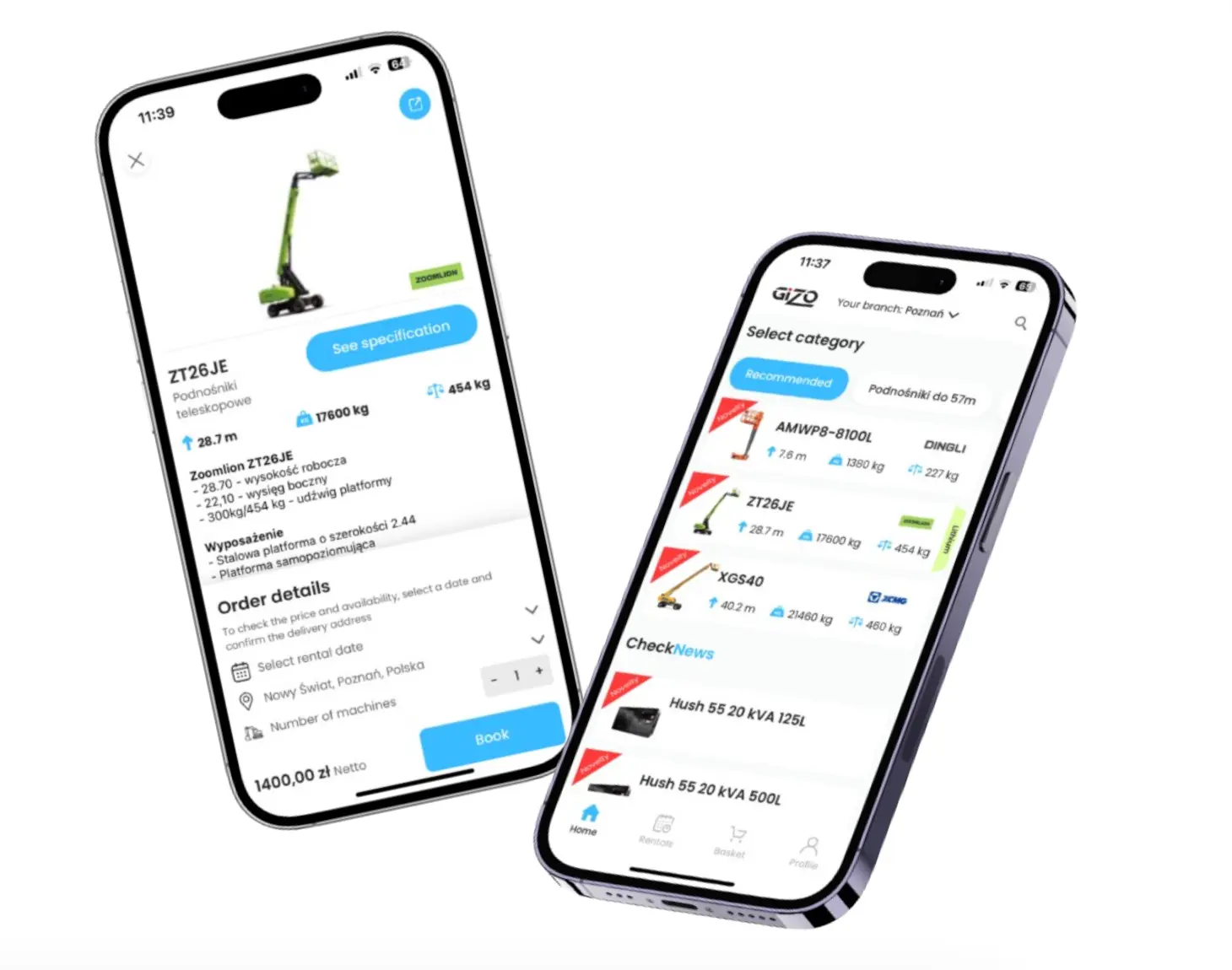
The mobile app was designed as the main customer touchpoint. Users can browse the equipment catalog, check availability, select rental parameters, see rental and transport costs, complete verification and finalize their order. We made sure the entire flow remained as simple, clear and practical as possible for construction, logistics and industrial users.
In practice, this means customers no longer need to contact the office at every stage. Instead, they can complete the entire process on their own in the mobile app, significantly improving the user experience while also reducing the operational burden on the service team.
Branch coordinator panel
Alongside the app, we designed a web-based operational dashboard for branch coordinators and internal teams. This part of the project was just as important as the mobile layer, because it is where booking handling, status management, transport organization and operational visibility come together.
The panel allows teams to track every order from inquiry and reservation, through verification and document signing, all the way to equipment handover, transport, return and settlement. As a result, the full process becomes visible in one place and the organization gains stronger control over SLA, resource utilization and branch efficiency.
Backend and integrations
The heart of the system is the backend that handles business logic and external service integrations. It is responsible for data consistency, pricing and calculation mechanisms, document generation, notifications, payments and the information flow between the mobile application and the operational dashboard.
In this project, we used a modern stack including React, React Native, TypeScript, Node.js, relational databases, caching mechanisms and integrations with geocoding, route estimation, e-signature and online payment services.
Smart transport cost calculation – a core feature of the system
One of the most important parts of the entire solution was automatic transport cost calculation. In the equipment rental industry, this is a particularly sensitive area because it directly affects both the customer experience and the profitability of operations.
We designed a mechanism that takes the customer address, geocodes it, selects the nearest branch out of ten locations across Poland, and then estimates the route and delivery cost. This means the user receives transparent information about the total price already at the ordering stage, without needing additional office contact.
Such a feature significantly shortens the order lead time, increases predictability and builds trust in the platform. From a business point of view, it also means less manual work for branch teams and greater scalability of the service model.
One cohesive user flow – from machine selection to payment
In projects like this, success is not defined only by the list of features, but also by how the user moves through the full journey. That is why we designed a single, cohesive flow where the customer can go through each stage without leaving the application.
The process includes equipment selection, rental parameter setup, availability checking, automatic price calculation, contractor verification, document generation, electronic signing, payment and later fulfillment status tracking. This allowed all critical interactions to be brought into one digital environment.
That is what separates a simple catalog application from a true business operating system. The user is not just browsing an offer—they are completing a real transaction through a fully self-service rental journey.
Implementation results – measurable impact on sales and operations
The Gizo project delivered clear value not only technologically, but above all from a business perspective. The application became a new equipment rental channel and started to materially influence how the company acquires and serves its customers.
Among the most important outcomes were a significantly shorter time from inquiry to booking, a growing number of verified B2B users, fewer calls to the office and improved offer conversion thanks to combining fast pricing, online signing and payment in one flow.
Equally important, the organization gained a unified operational record of the entire process and stronger control over fulfillment stages. This means not only better internal order, but also a stronger foundation for reporting, further optimization and business model scaling.
Why this case study matters for companies in rental, logistics and field services
The Gizo case study shows that digitizing the rental process does not have to stop at a simple contact form or product catalog. A well-designed system can connect sales, operations, logistics, documents and settlements within one environment that works faster, is more predictable and is more convenient both for customers and for the internal team.
This approach is relevant not only to companies renting lifts, cranes, forklifts or power generators. A similar architecture can also be applied to logistics, specialist equipment rental, field services, technical fleets and many other business models where fast availability, transport and operational control matter.
If your company is planning a similar implementation, it is worth reviewing other Softech case studies that show how we design and build custom systems for different industries.
Summary
The Gizo Rental project is a strong example of how a mobile app for online equipment rental can become much more than just another customer communication channel. When designed properly, such a system can organize operations, increase self-service, shorten execution time and build a new scalable sales channel.
Projects like this prove that modern software should not be designed only around features, but above all around the real business model and the processes it is meant to support.
At Softech, we build custom mobile applications, web systems and business platforms that combine technology, UX and operational logic into one cohesive whole. If you are planning a similar implementation, explore our services and our mobile app development offering.