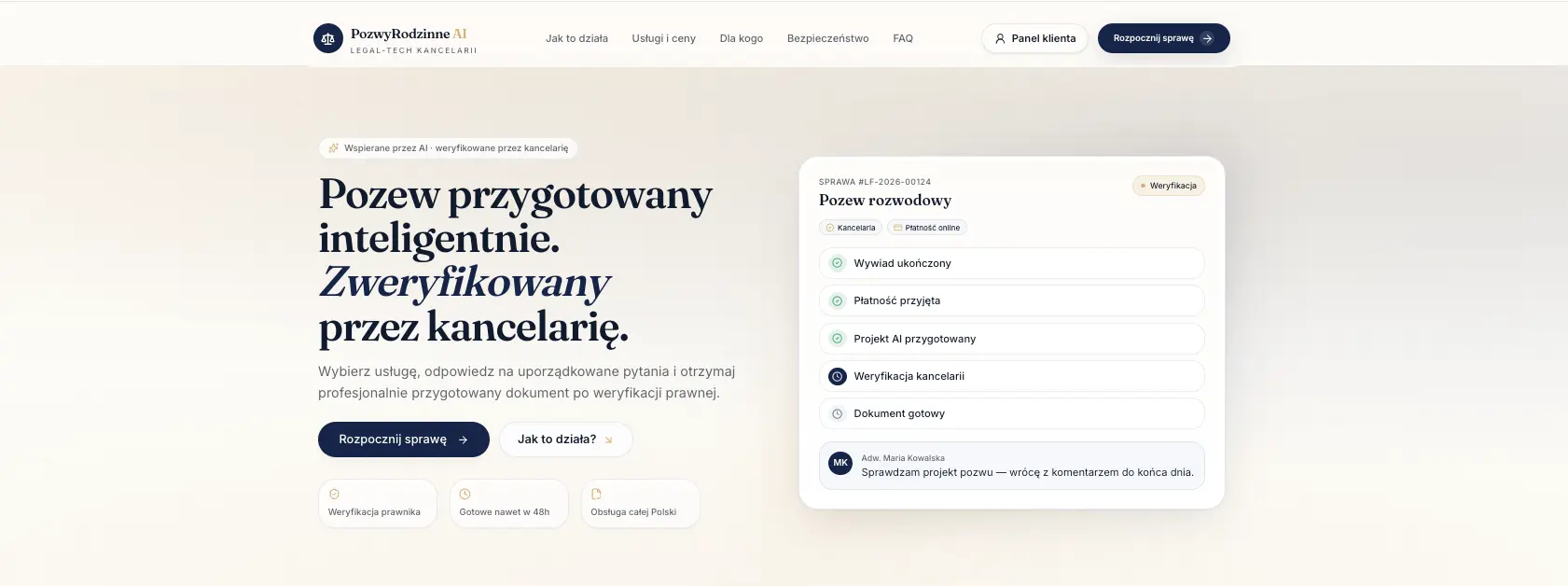
PozwyRodzinne.pl as a Complete LegalTech Platform
Family law cases are among the most complex and sensitive areas of legal practice. A person seeking support with divorce, child maintenance, parental contact, parental authority or a child’s place of residence often begins the process under stress and uncertainty.
At the same time, the law firm must collect a significant amount of information, assess its completeness, identify contradictions, prepare documents and maintain full control over legal quality.
PozwyRodzinne.pl was created to address both sides of this challenge.
It is not a simple informational website or a basic online form generator. It is a complete LegalTech platform combining digital client service, intelligent legal intake, document automation, online payments and a comprehensive operational panel for the law firm.
Softech.app was responsible for designing and developing the entire product: from business and legal process analysis, through system architecture and UX/UI, to frontend development, backend API, database design, AI modules, document automation, security and internal tools for the legal team.
The Business Problem: Delivering a Complex Legal Service Digitally
A traditional family law process often begins with a phone call, email or in-person meeting. The client explains the situation in an unstructured way, while a lawyer or staff member asks additional questions, requests documents and returns to missing information.
Information may end up scattered across emails, notes, attachments and separate tools. This creates several operational problems:
- information may be incomplete,
- the client may not understand which facts are important,
- the same data may need to be collected more than once,
- answers may contradict one another,
- staff may have to copy information manually,
- preparing the first document draft takes considerable time,
- interview quality may vary between cases,
- important circumstances may be overlooked.
The digitalisation of legal services cannot simply mean moving a traditional questionnaire online.
A legal process is conditional. The next question often depends on an earlier answer. A divorce case follows a different path than a maintenance claim, and a parental contact case requires a different set of facts again.
The platform therefore had to understand case structure, guide the user through relevant paths and preserve full professional control on the lawyer’s side.
Product Vision: From a Website to a Digital Case Management System
From the beginning, the project was developed as a multi-layer digital product.
The public website and service selection were only the first step. Behind them, the platform needed a system responsible for:
- user management,
- case creation and case handling,
- intelligent intake,
- answer storage,
- missing data and conflict detection,
- document version generation,
- payment processing,
- document management,
- operational tasks and communication,
- access control,
- reporting and monitoring.
A key architectural decision was to separate the user interface from the legal and process logic. This allows forms and screens to evolve independently from the rules controlling the next question, case status or data completeness.
The Digital Client Journey
One of the most important parts of the project was translating a complex legal process into a clear and reassuring user journey.
Selecting the Type of Case
The process begins with selecting a case or legal service. The user can indicate that they need support with matters such as:
- divorce,
- child maintenance,
- parental contact,
- parental authority,
- determining a child’s place of residence,
- another family law proceeding.
Each option can activate a different form structure, interview scope and document workflow.
Clear Explanation of the Next Steps
The user should understand what happens after selecting the service, which information will be needed, why the platform asks for it, how many stages remain, whether progress has been saved, when payment takes place and when the case reaches legal review.
In family law matters, a lack of clarity can increase stress. The interface should therefore do more than display input fields. It should act as a guide through the process.
Forms Adapted to the Case
Instead of one large questionnaire, the system uses paths adapted to the case type and previous answers.
Questions may concern parties to the proceedings, children, family circumstances, place of residence, income, maintenance costs, care arrangements, previous agreements, evidence and documents.
Saving Progress
Users can pause the process and return later. The system preserves not only form values, but also information about completed sections, unresolved gaps and issues requiring clarification.
Payment and Activation of the Next Stages
The payment layer is directly connected with the selected service and case.
After a transaction is completed, the system can confirm payment, update the case status, unlock the next stage, create a task for the law firm, start preparation of a working draft and notify the user.
Intake AI — the Intelligent Legal Interview
One of the most important modules in the platform is Intake AI.
It is not a generic chatbot conducting an unrestricted conversation. It is a controlled data collection process combining business rules, case structure, validation mechanisms and language models.
Understanding Case Context
The system knows the type of proceeding and the information already provided. Based on this context, it can determine:
- which question should come next,
- whether a section is complete,
- whether an answer requires clarification,
- whether a contradiction has occurred,
- whether the process can move to the next topic,
- which information should later be used in document preparation.
For example, an answer concerning children may activate additional questions about their age, residence, care arrangements, contact with the other parent or maintenance costs.
Confirmed Facts and Information Requiring Clarification
Not every user response should automatically be treated as a complete and unambiguous fact.
The system distinguishes between:
- confirmed facts,
- incomplete information,
- ambiguous answers,
- potential conflicts,
- matters requiring lawyer review.
If the user states in one section that the other parent does not contribute to the child’s maintenance, but later mentions regular transfers, the system should identify a potential inconsistency and ask for clarification.
Follow-Up Logic and Completion Semantics
The system must understand the difference between a question being asked, an answer being submitted, the answer being saved, the information being sufficient, a conflict remaining unresolved and a section being ready for closure.
Without this distinction, the interview may enter a loop and ask the same question repeatedly.
An important part of development was therefore separating factual information from process statuses and defining precisely when a topic should be reopened.
Preventing Repeated Questions
The mechanism must remember which information has already been collected. Comparing only the wording of questions is not sufficient because the same issue can be phrased in several ways.
The system should recognise the semantic meaning of an answer and determine whether the required information is already available without ignoring genuine gaps.
Answer Versioning
User answers may change. A client may clarify a statement, correct a mistake or provide missing information.
Versioning supports review of case history, identification of changes, tracing the source of information, document updates and lawyer oversight.
AI Quality Control
A model-generated response cannot autonomously determine a legal conclusion or replace professional judgment.
AI can support interpreting the user’s language, structuring information, identifying potential gaps, formulating follow-up questions and preparing structured data.
The result must still operate within a controlled workflow with validation and human review.
Legal Document Generation and Versioning
The data collected during the interview can be used to create working drafts of legal documents.
The system can support the preparation of:
- claims,
- applications,
- procedural requests,
- justifications,
- factual descriptions,
- evidence lists,
- attachments,
- supplementary information.
Structured Document Generation
A document is not created as one uncontrolled block of text. It is generated from structured sections such as:
- court and heading,
- parties to the proceedings,
- document type,
- claims and requests,
- justification,
- factual background,
- reasoning,
- evidence,
- attachments,
- items requiring review.
Each section can have its own completeness status and confidence level.
Completeness Assessment
Before generating a document, the system should assess whether the necessary information is available.
It can flag missing party details, incomplete information about children, unconfirmed amounts, missing documents, contradictions between answers or sections requiring professional review.
Successive Document Versions
A legal document is rarely final after the first generation. The platform supports a versioned workflow:
- a working draft is generated,
- the lawyer reviews it,
- corrections are introduced,
- AI suggestions may be used,
- selected changes are approved,
- a new document version is created.
The version history makes it possible to compare changes and maintain control over the editorial process.
AI as Support, Not a Replacement for a Lawyer
The system can suggest language improvements, highlight unclear passages or propose that a section be expanded.
The final decision remains with the lawyer. The platform is not designed to provide autonomous legal advice or approve documents without professional review.
The Law Firm Operations Panel
The law firm needed a system that could organise the entire service process.
The panel was designed as an operational centre, not merely a database.
Dashboard and Priorities
The dashboard can present:
- new cases,
- active cases,
- clients requiring contact,
- documents awaiting review,
- incomplete intake sessions,
- tasks and deadlines,
- payment statuses,
- alerts requiring attention.
The main value of the dashboard is answering one practical question: what should the team focus on now?
Client View
A client profile can include contact details, related cases, documents, payments, internal notes, change history, representation information, recent activity and outstanding tasks.
Instead of a flat contact list, the system provides an organised view of the relationship between the client and the law firm.
Case View
A case connects the client, proceeding type, intake session, documents, payments, status, deadlines, tasks and change history.
This means staff do not need to search for information across several disconnected tools.
Documents and Interview Sessions
The panel makes it possible to move between Intake AI sessions and document drafts.
A lawyer can review which questions were asked, which answers were submitted, where conflicts occurred, which data remains incomplete and what information supported a particular document section.
Roles and Permissions
The platform can support several roles:
- administrator,
- lawyer,
- law firm employee,
- client.
Each role should only have access to the information and actions necessary for its responsibilities.
UX/UI in a Family Law Platform
In PozwyRodzinne.pl, UX is not a decorative layer.
The user may be dealing with a difficult life situation. The interface should therefore reduce stress, explain the process and avoid creating additional information overload.
Plain Language
Where possible, the platform avoids unnecessary legal jargon. When a legal term is required, it should be explained.
The system should clarify what the question concerns, why the information is needed, what type of answer is expected and whether the user can return to it later.
A Visible Sense of Progress
A multi-stage process requires a visible current stage, completed section indicators, progress saving, clear summaries, missing information messages and confirmation that data has been saved.
Professional Visual Design
The product should feel modern, minimal and premium, while remaining calm and trustworthy.
The design covered the marketing website, service selection, case initiation, forms, the AI interview, the client panel, the law firm panel, document views, payment and confirmation screens, error states and empty states.
Technology Architecture
PozwyRodzinne.pl was designed as a modern web system with clear separation between application layers.
The architecture includes a frontend based on Next.js, React and TypeScript, a backend API built with Node.js and TypeScript, a PostgreSQL relational database, Prisma, cloud infrastructure, object storage for documents, payment integration, AI model integration, authentication, authorisation, asynchronous processing, event logging and error monitoring.
The main business benefits of these decisions are:
- modularity,
- easier maintenance,
- support for future services,
- separation of data and logic,
- resilient AI workflows,
- versioning,
- error control,
- retry mechanisms,
- scalability.
Separating Legal Logic from the Interface
Rules controlling questions, completeness and conflicts should not exist only inside interface components. They should operate as a separate domain layer.
This makes it possible to test legal and process logic independently from visual design and introduce new service paths without rebuilding the frontend.
Asynchronous Processes
Document generation or larger data analysis may take longer than a standard HTTP request.
Such tasks are handled with explicit statuses: queued, processing, completed, failed or ready for retry.
Security and Data Privacy
Family law matters involve highly sensitive information.
The system was designed with security and personal data protection requirements in mind.
The approach includes:
- role-based access control,
- session protection,
- input validation,
- secured API endpoints,
- restricted access to confidential information,
- secure document storage,
- logging of important operations,
- separation of client and law firm data,
- audit mechanisms,
- privacy-by-design principles.
The solution can support GDPR-related obligations, although formal compliance also depends on organisational procedures, legal bases, documentation and the way the data controller operates the system.
Payments and Sales Process Automation
PozwyRodzinne.pl connects the product layer with the sale of legal services.
The user can select a service, understand its scope, view the price, pay online, receive confirmation and access the next stage.
On the system side, payment is linked to the client, case, service, delivery status and subsequent tasks.
Automation reduces manual transfer verification, data copying and the need for staff to activate processes manually.
The Most Important Project Challenges
Translating Legal Processes into System Logic
A legal process is not a linear questionnaire. It contains conditions, exceptions, contradictions, missing data and matters requiring professional interpretation.
Multiple Possible Case Paths
Each answer can change the next stage of the interview. The system must support many possible scenarios without becoming unreadable or impossible to maintain.
Conflicts and Missing Data
Incomplete or contradictory answers cannot be transferred directly into a document without review. The platform requires mechanisms for flagging conflicts and reopening selected areas.
Preventing Interview Loops
An AI model may suggest a follow-up question, but the system must control whether the issue has already been resolved.
Consistency Between Answers and Documents
Each document section should be based on the current version of the available data. Changing an answer may affect several parts of the document.
Full Lawyer Control
A lawyer must be able to review the source information, change the text, reject an AI suggestion and approve the final version.
The Project Delivery Process
- Business and legal process analysis — mapping data collection, case handling and document preparation.
- User journey mapping — processes for clients, lawyers, law firm staff and administrators.
- System architecture — application layers, data models and relationships between case, intake, document, payment and user.
- UX/UI design — public website, service selection, forms, dashboards, documents and process states.
- Public platform development — the marketing and informational layer.
- Service selection and payments — connecting the offer with payment and automatic activation of subsequent stages.
- Intake AI development — case context, validation, conflict handling and completion semantics.
- Document generator — structured generation, completeness assessment, versioning and editorial workflow.
- Law firm panel — clients, cases, documents, payments, intake sessions and tasks.
- Edge case testing — incomplete answers, contradictions, changed information, repeated questions and failed processes.
- Security and performance — access control, monitoring, error handling and process resilience.
- Iterative development — continuous testing of process logic and model behaviour.
The Business Outcome
Without introducing unverified figures, several qualitative outcomes can be identified.
The platform:
- organises the information collection process,
- improves the completeness of data provided to the law firm,
- reduces manual copying of answers,
- standardises the intake process,
- supports faster creation of first document drafts,
- improves case status visibility,
- organises the work of the legal team,
- increases the availability of legal services online,
- creates a digital client acquisition and service channel,
- prepares the law firm to scale without increasing administrative work at the same pace.
Softech.app’s Scope of Work
Softech.app was responsible for combining the product, technology and operational layers.
The scope included:
- business analysis,
- product strategy,
- legal process mapping,
- system architecture,
- UX/UI design,
- frontend development,
- backend API,
- database design,
- payment integrations,
- AI modules,
- intelligent intake,
- document automation,
- client panel,
- law firm panel,
- permissions and roles,
- security and monitoring,
- deployment, testing and further optimisation.
Key Conclusions
PozwyRodzinne.pl reflects a wider trend in which traditional professional services are being transformed into scalable digital products.
Well-designed artificial intelligence in the legal sector is not about adding a chatbot window to a website.
AI should be embedded throughout the process: collecting data, identifying missing information, validating answers, selecting the next question, detecting conflicts, creating working document drafts, supporting editing and organising the law firm’s work.
Technology does not replace professional legal expertise. It can, however, organise data, reduce repetitive work and give lawyers more time for analysis, strategy and responsible decision-making.
Are you planning a SaaS product, LegalTech platform, document automation system or AI-powered application? Let’s discuss how to transform a complex business process into a secure, scalable and intuitive digital product.