Introduction
Most companies launching a new digital product focus almost entirely on the product itself.
The platform gets built.
The application gets launched.
The technology stack is selected.
Only later does an important question emerge:
“How will we attract users and customers?”
This is one of the most common mistakes made by startups and product teams.
Even the best product will struggle to generate business results if potential customers cannot quickly understand its value.
That was one of the challenges behind Gizo Rental.
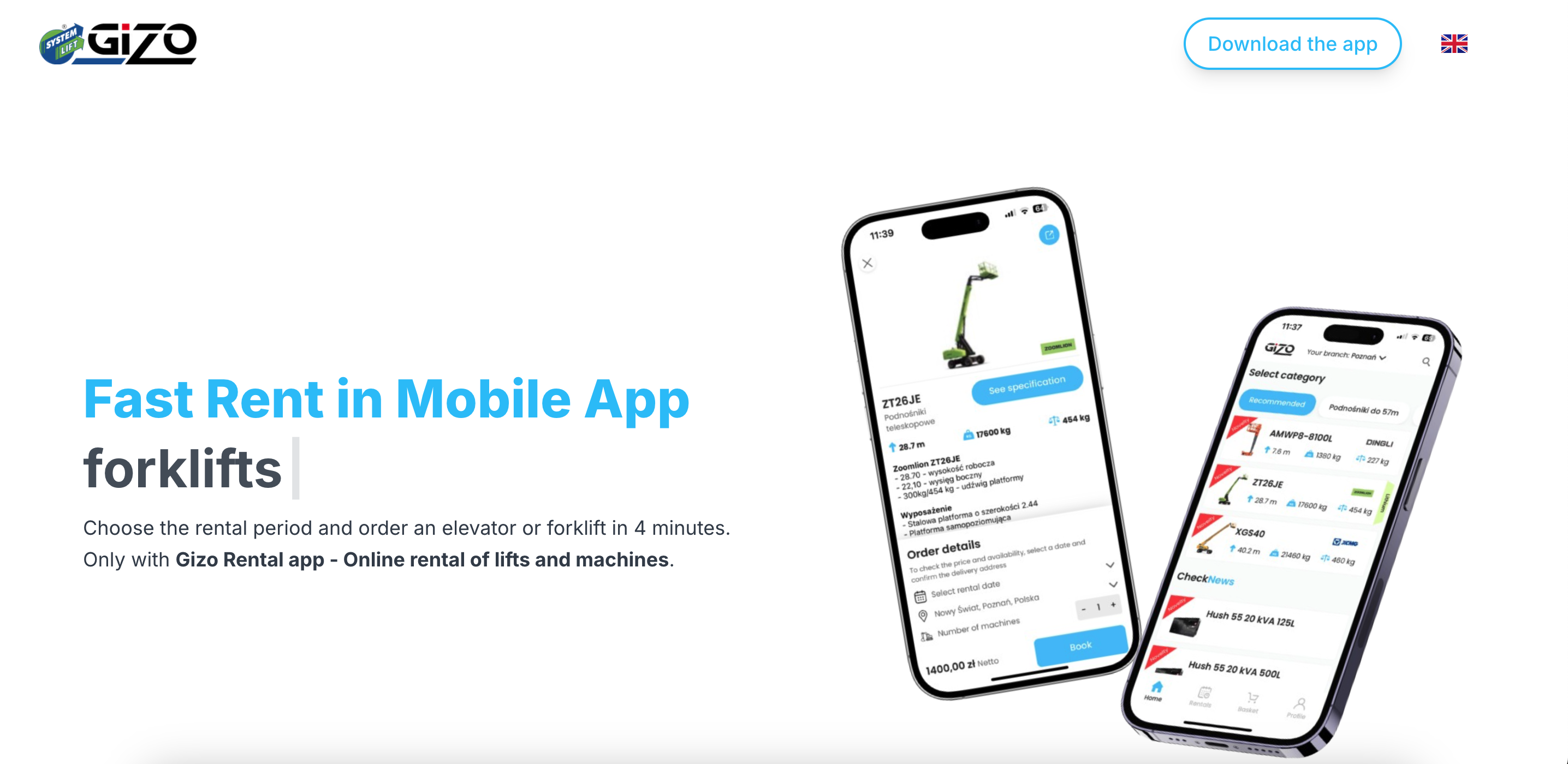
Gizo Rental was created to simplify the rental process for aerial lifts, machinery and construction equipment through a modern web and mobile platform.
Our goal was not simply to build a landing page.
Our goal was to create a business asset capable of generating trust, visibility and qualified leads.
From the beginning, we treated the landing page as a sales and growth tool rather than a marketing brochure.
About Gizo Rental
Gizo Rental is a digital platform designed to simplify machinery and aerial lift rentals.
The project combines marketplace principles with modern web and mobile experiences.
Traditionally, machinery rental processes are fragmented.
Customers often rely on:
- phone calls,
- manual quotations,
- email exchanges,
- multiple suppliers.
This creates friction for both customers and equipment providers.
Gizo Rental was designed to streamline this experience through a centralized platform.
Users can browse available equipment, compare options and manage rentals through a digital-first experience.
As a result, the product required a landing page capable of clearly communicating its value proposition.
The Business Challenge
At the beginning of the project we identified four major challenges.
1. Building Trust From Scratch
Gizo Rental was a new product.
New products lack reputation.
They lack customer testimonials.
They lack brand recognition.
The landing page therefore had to establish credibility immediately.
2. Industry-Specific Buying Behavior
The machinery rental market is fundamentally different from consumer applications.
Customers make decisions more carefully.
Purchase cycles are longer.
Reliability matters more than novelty.
The website needed to communicate professionalism, safety and operational competence.
3. Lead Generation Requirements
The website was not intended to simply present information.
It had to support growth.
Every section of the landing page was designed to move users closer to a meaningful action.
4. SEO From Day One
Many startups treat SEO as a future project.
First they launch.
Then they optimize.
We chose the opposite approach.
SEO considerations influenced the information architecture from the very beginning.
This allowed us to create foundations for long-term organic growth.
Our SEO-First Approach
At Softech we frequently use what we call a SEO-First Product Marketing approach.
This means websites are designed not only for users but also for search engines and AI systems.
Before creating wireframes, we analyzed:
- target audience behavior,
- search intent,
- industry terminology,
- customer concerns,
- information architecture.
This helped us create a structure optimized for both discoverability and conversion.
For B2B products, a single qualified lead can be significantly more valuable than thousands of low-intent visitors.
As a result, every design decision was evaluated through both business and user perspectives.
UX/UI Design Process
Once the strategy was defined, we moved into UX and interface design.
The primary objective was simplicity.
Users needed to understand the platform within seconds.
To achieve this, we mapped customer journeys and identified the most important questions prospective users would ask.
Among them:
- What does the platform actually do?
- Why should I trust it?
- How does the rental process work?
- What makes it different from traditional alternatives?
The resulting structure prioritized:
- clarity,
- trust signals,
- visual hierarchy,
- mobile responsiveness,
- conversion-oriented design.
The interface was designed in Figma before implementation.
The visual language combined modern SaaS aesthetics with the credibility expected within industrial markets.
Framework: High-Converting Industrial Landing Pages
During this project we followed a framework that we frequently use for industrial and B2B websites.
1. Trust
Trust comes first.
Users must believe the company is capable of delivering value.
2. Clarity
Products should be explained using simple language.
Complexity reduces conversion.
3. Offer
Benefits matter more than features.
Customers care about outcomes.
Not technical specifications.
4. Proof
Evidence builds confidence.
Process explanations, expertise and real examples all contribute to credibility.
5. Conversion
Only after trust and clarity are established should users be asked to take action.
This creates a natural conversion path instead of a forced sales experience.
Technical Implementation
After finalizing the strategy and design phase, we moved into development.
Technology decisions were guided by three primary objectives:
- performance,
- search visibility,
- future scalability.
The landing page was not intended to be a temporary marketing asset.
It needed to become the foundation for future growth.
For this reason, we selected a modern technology stack capable of supporting long-term development.
Why We Chose Next.js
Next.js has become one of the most popular frameworks for modern websites and SaaS products.
However, the choice was not driven by trends.
It was driven by business requirements.
Next.js offered several important advantages:
- excellent performance,
- server-side rendering,
- SEO-friendly architecture,
- scalability for future product expansion,
- strong developer experience.
For companies investing in long-term digital growth, these characteristics create a significant competitive advantage.
Performance is not merely a technical metric.
Performance directly influences user experience, conversion rates and search visibility.
Tailwind CSS and Design Consistency
To support rapid development and maintain visual consistency, we implemented the interface using Tailwind CSS.
This allowed us to create a clean design system while keeping the codebase maintainable.
Consistency becomes increasingly important as products evolve.
A scalable design system reduces future development costs and improves the overall user experience.
SEO Architecture and Visibility Strategy
One of the core objectives of the project was long-term discoverability.
Many websites are visually attractive but invisible in search engines.
Our goal was to avoid this mistake from the beginning.
The SEO strategy focused on several areas.
Information Architecture
The structure of the landing page was designed around how users search for information.
Sections were organized to answer real customer questions.
This improves both user experience and search engine understanding.
Content Hierarchy
Clear heading structures, descriptive content blocks and logical information flow help search engines understand the purpose of the page.
Good SEO starts with information architecture.
Keywords come later.
Technical SEO Foundations
Technical considerations included:
- semantic HTML structure,
- optimized metadata,
- fast page rendering,
- mobile responsiveness,
- performance optimization.
These elements create a foundation for future organic growth.
Performance and Core Web Vitals
Speed was treated as a product feature.
Modern users expect instant access to information.
Delays increase bounce rates and reduce conversions.
Performance optimization included:
- image optimization,
- efficient asset loading,
- minimal JavaScript overhead,
- responsive image delivery,
- optimized rendering strategies.
Fast websites create better user experiences.
They also align with Google's recommendations regarding Core Web Vitals.
For businesses competing in crowded markets, performance can become a meaningful differentiator.
Conversion Optimization
Traffic without conversions creates little business value.
That is why conversion optimization was considered throughout the project.
Several principles guided our approach.
Clear Value Proposition
Visitors should understand the platform within seconds.
The core message was positioned prominently and supported by clear supporting content.
Strategic Calls-to-Action
CTAs were placed throughout the page to support different stages of the customer journey.
Some users are ready to act immediately.
Others require additional information.
The page was designed to accommodate both behaviors.
Reducing Friction
Every unnecessary step increases the risk of abandonment.
The design therefore focused on simplicity and clarity.
The goal was to make decision-making easier, not harder.
Lessons Learned
Every project creates insights.
Several lessons from this case study stand out.
Trust Matters More Than Features
Particularly in industrial and B2B markets, trust often has a greater impact on conversion than technical specifications.
Customers need confidence before they commit.
SEO Starts Before Development
SEO is most effective when considered during planning.
Retrofitting SEO after launch is significantly more difficult and less efficient.
Speed Influences Business Outcomes
Performance is frequently viewed as a technical concern.
In reality, it affects user satisfaction, lead generation and conversion rates.
Clarity Beats Complexity
Many companies attempt to communicate everything.
The most effective websites focus on communicating the most important things clearly.
Recommendations for Similar Companies
Companies operating in industrial, logistics, rental or B2B markets can benefit significantly from digital-first experiences.
When building a landing page, focus on:
- business goals before design trends,
- trust before persuasion,
- clarity before complexity,
- SEO before traffic acquisition,
- conversion before vanity metrics.
These principles consistently outperform short-term tactics.
Project Outcomes
The project delivered a modern, scalable and conversion-focused landing page capable of supporting the growth of a digital rental platform.
Beyond the website itself, the project established:
- a clear digital positioning strategy,
- strong technical foundations,
- SEO-ready architecture,
- a scalable design system,
- a foundation for future growth initiatives.
Most importantly, the landing page became more than a website.
It became a business asset.
Conclusion
Building successful digital products requires more than great technology.
It requires communication.
It requires trust.
It requires discoverability.
And it requires a clear path from attention to action.
The Gizo Rental project demonstrates how a landing page can support much more than brand awareness.
When designed strategically, it becomes part of the growth engine behind a product.
For companies launching new platforms, SaaS products or digital services, investing in a conversion-focused and SEO-first foundation can create long-term advantages that compound over time.
Technology alone rarely creates growth.
Well-designed systems do.
Planning a SaaS, Marketplace or Industrial Platform?
If you're building a digital product and want a website that supports growth from day one, we'd be happy to discuss your project.
At Softech, we combine product strategy, UX/UI, engineering and SEO-first thinking to create digital products designed for long-term success.