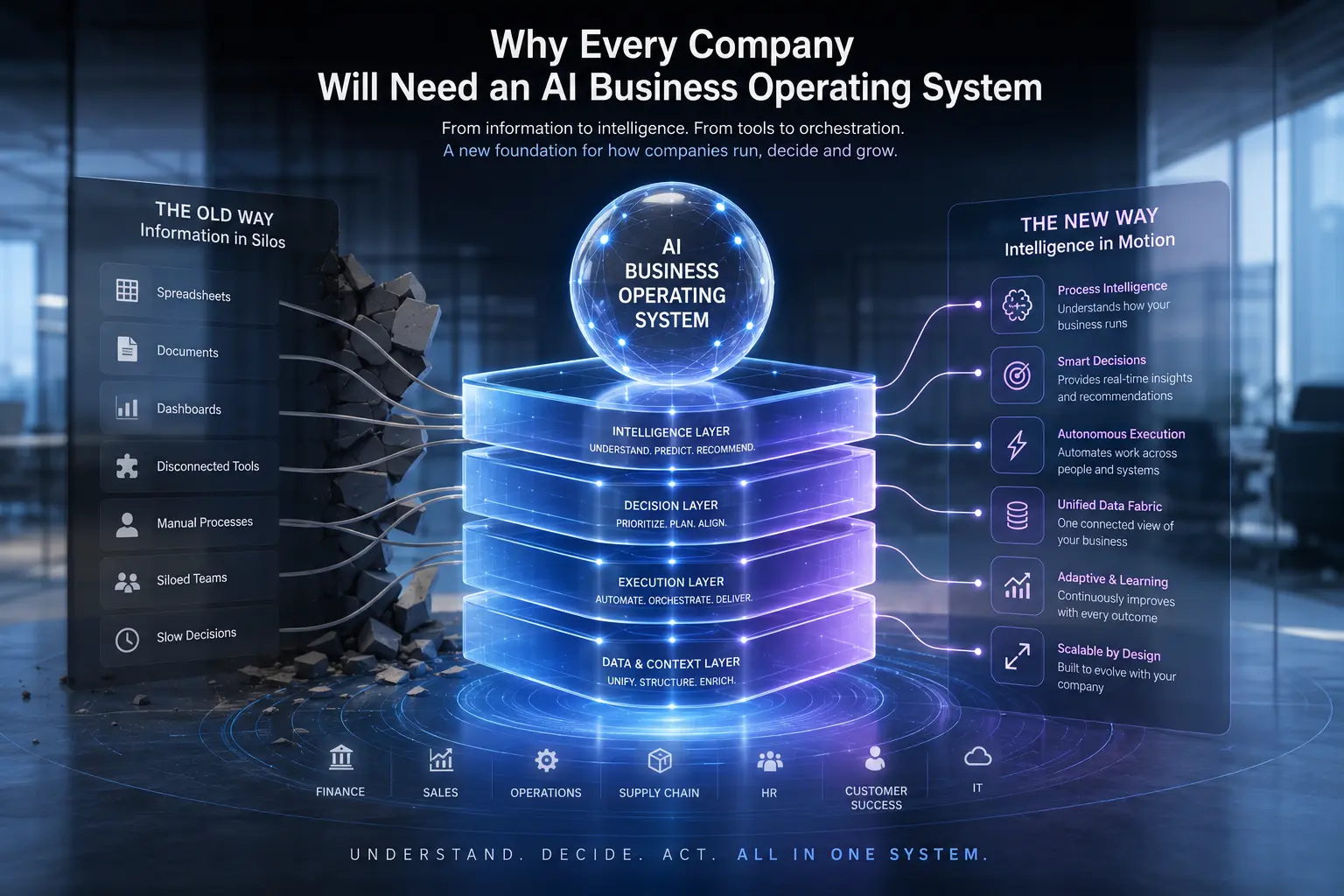
From CRM to AI Business Operating Systems
For the last three decades, companies have invested billions of dollars into business software.
First came spreadsheets. Then CRM platforms. Then ERP systems, help desks, project management tools, business intelligence platforms and thousands of SaaS products.
Each generation of software solved a specific business problem.
CRM helped organizations manage customer relationships.
ERP helped manage resources and operations.
Help desks improved customer support.
Analytics platforms provided reporting and insights.
Yet all of these systems shared one fundamental characteristic.
They stored information.
They did not understand the business.
A CRM knew a customer existed.
It did not understand why that customer might leave.
An ERP knew a process had been completed.
It did not know how to improve that process.
A support platform knew a ticket had been opened.
It did not know how to prevent similar issues from happening again.
As a result, organizations accumulated enormous amounts of data while remaining dependent on humans to interpret information and make decisions.
This is where the era of AI Business Operating Systems begins.
For the first time in history, organizations can build systems that not only store information but also understand business context, support decision-making and actively participate in execution.
This is not another CRM.
This is not the next ERP.
It is an entirely new operational layer for modern organizations.
Why Existing Business Systems Are No Longer Enough
Most organizations do not suffer from a lack of data.
They suffer from an inability to leverage it effectively.
The average company operates across dozens of disconnected tools.
- CRM stores customer information.
- ERP stores operational data.
- Help desk platforms store support interactions.
- Slack stores communication.
- Google Drive stores documents.
- Notion stores knowledge.
- Accounting systems store financial information.
Each tool performs its function well.
The problem is that none of them truly understands the organization as a whole.
Information is fragmented.
Processes are fragmented.
Knowledge is fragmented.
Decision-making is fragmented.
Organizations have created enormous amounts of data but lack a unified operational system capable of understanding and acting on that information.
Consider the daily reality of a founder or business owner.
Every day they need answers to questions such as:
- Which customers are at risk of churn?
- Which projects generate the highest margins?
- What tasks are delayed?
- Which teams are overloaded?
- Where are operational bottlenecks emerging?
- Which actions will create the greatest impact?
In most companies, the answers are scattered across multiple systems.
Someone has to collect the data manually.
Someone has to interpret the information.
Someone has to decide what happens next.
AI Business Operating Systems are designed to eliminate this gap.
What Is an AI Business Operating System?
An AI Business Operating System is a new category of business software.
It combines organizational knowledge, workflows, operational data, decision support and AI agents into a single operational layer.
A useful analogy is the operating system on a computer.
An operating system does not perform every task itself.
Instead, it coordinates applications, resources, communication and information flows.
An AI Business Operating System serves a similar purpose inside a company.
It does not replace every business tool.
It connects them into an intelligent system.
In practice, an AI Business Operating System consists of five layers.
Layer 1: Data Layer
The foundation is data.
The system integrates information from CRM platforms, ERP systems, customer support tools, communication channels, documents and other business systems.
This creates a single source of truth for the organization.
Layer 2: Process Layer
The second layer models business workflows.
The system understands how processes work.
It recognizes dependencies, identifies bottlenecks and understands how activities connect to outcomes.
Layer 3: Knowledge Layer
This may be the most important layer.
The organization's knowledge becomes part of the system.
Policies.
Procedures.
Historical decisions.
Best practices.
Operational expertise.
The company gradually becomes less dependent on individual employees because institutional knowledge becomes accessible and reusable.
Layer 4: Decision Support Layer
At this stage AI begins supporting business decisions.
The system identifies risks.
Detects anomalies.
Predicts outcomes.
Analyzes trends.
Recommends actions.
The organization moves from reporting toward intelligent decision support.
Layer 5: AI Agents Layer
The highest layer introduces AI agents.
These are not simple chatbots.
They are operational actors capable of executing workflows.
AI agents can:
- Create tasks.
- Analyze documents.
- Coordinate projects.
- Generate reports.
- Communicate with customers.
- Monitor operations.
- Trigger workflows.
This is where software begins evolving from a passive database into an active participant in business operations.
What Does an AI-Native Organization Look Like?
Imagine a new customer enters the business.
In a traditional organization, employees manually create records, assign tasks, update systems, send notifications and coordinate activities.
In an AI-native organization, much of this process happens automatically.
The system analyzes the customer.
Reviews previous interactions.
Identifies similarities with existing accounts.
Creates workflows.
Assigns responsibilities.
Generates recommendations.
Schedules follow-ups.
Monitors risks.
Produces summaries for the team.
If potential issues emerge, the system alerts decision-makers before problems become visible.
The organization begins functioning more like a coordinated operating system than a collection of disconnected activities.
Why Most Companies Are Not Ready for AI Business Operating Systems
If AI Business Operating Systems represent such an obvious evolution of enterprise software, a natural question emerges.
Why are most organizations still far from implementing them?
The answer is not technology.
The technology already exists.
Large language models exist.
Workflow automation platforms exist.
AI agents exist.
Integration frameworks exist.
The real challenge is organizational.
Most companies did not design their systems intentionally.
They evolved over time.
A CRM was added when customer management became difficult.
An ERP was introduced when operations became more complex.
Project management software was adopted when teams expanded.
Knowledge bases appeared when information became difficult to find.
Communication tools multiplied as organizations grew.
Over time, businesses accumulated dozens of disconnected systems.
Each solved a specific problem.
Together, they created complexity.
This is why many organizations have data but lack organizational intelligence.
They have systems but lack coordination.
They have processes but lack visibility.
They have employees but lack institutional memory.
An AI Business Operating System requires something many companies have never formally documented:
- How decisions are made.
- How information flows.
- How processes operate.
- How knowledge is stored.
- How teams collaborate.
AI cannot create organizational clarity where none exists.
It amplifies what already exists.
If an organization operates efficiently, AI can dramatically increase leverage.
If an organization operates in chaos, AI often accelerates chaos.
The Biggest Mistakes Companies Make with AI Transformation
Mistake 1: Focusing on Tools Instead of Systems
Many organizations start by asking:
“Which AI tool should we buy?”
This is usually the wrong question.
A better question is:
“Which business processes create the most friction in our organization?”
Tools are temporary.
Systems create long-term leverage.
The companies creating the greatest value from AI are not necessarily using the most advanced tools.
They are redesigning how work happens.
Mistake 2: Trying to Automate Everything
Not every process should be automated.
Not every decision should be delegated to AI.
The greatest value comes from automating repetitive, predictable and high-frequency activities.
Strategic thinking, prioritization and accountability remain human responsibilities.
The future is not AI replacing people.
The future is AI augmenting people.
Mistake 3: Ignoring Organizational Knowledge
Many companies focus heavily on data.
Far fewer focus on knowledge.
Data answers questions about what happened.
Knowledge explains why it happened.
Policies.
Procedures.
Best practices.
Historical decisions.
Operational expertise.
Without this layer, AI becomes little more than an advanced search engine.
With it, AI becomes a true organizational asset.
Mistake 4: Treating AI as an IT Initiative
This may be the most expensive mistake of all.
AI Business Operating Systems are not technology projects.
They are organizational transformation projects.
The technology is usually the easiest part.
The difficult part is redesigning workflows, governance, communication and decision-making.
The companies that understand this distinction will move far ahead of competitors who view AI purely as software.
AI Business Operating Systems vs CRM vs ERP vs SaaS
Understanding the differences between these categories is critical.
| System | Primary Purpose |
| CRM | Manage customer relationships |
| ERP | Manage enterprise resources |
| SaaS | Perform a specific business function |
| AI Business Operating System | Coordinate operations, support decisions and execute workflows |
A CRM answers:
“What do we know about our customers?”
An ERP answers:
“What resources does the organization have?”
A SaaS application answers:
“How do we complete a particular task?”
An AI Business Operating System answers:
“What should we do next?”
This distinction is profound.
For decades software has primarily stored information.
The next generation of software will increasingly help organizations think, decide and act.
The Road to an AI-Native Organization
Becoming AI-native does not happen overnight.
The most successful organizations typically move through five stages.
Stage 1: Digitalization
Processes become digital.
Information becomes accessible.
Manual work begins to decrease.
Stage 2: Integration
Systems start communicating.
Data moves across departments.
Information silos begin to disappear.
Stage 3: Automation
Repetitive workflows become automated.
Teams spend less time on administrative work.
Operational efficiency improves.
Stage 4: Intelligence
AI begins supporting decisions.
The organization gains predictive capabilities.
Recommendations emerge.
Risks become visible earlier.
Decision-making improves.
Stage 5: AI-Native Operations
At this stage, workflows are designed around AI from the beginning.
The organization develops its own AI Business Operating System.
AI becomes embedded into everyday operations rather than existing as an external tool.
What Will Business Look Like in 2030?
No prediction is guaranteed.
However, several trends appear increasingly likely.
First, most organizations will operate with an AI layer supporting daily work.
Just as websites became standard.
Just as CRM systems became standard.
AI Business Operating Systems are likely to become standard.
Second, AI agents will become part of every organization.
Not as replacements for employees.
As additional operational capacity.
Third, competitive advantage will increasingly come from learning speed rather than information access.
Information is becoming abundant.
The ability to interpret and act on information quickly will become the true differentiator.
Fourth, software will become more proactive.
Instead of waiting for instructions, systems will increasingly anticipate needs, identify opportunities and recommend actions.
Fifth, organizational intelligence will become a measurable business asset.
The most valuable companies will not necessarily have the largest teams.
They will have the most effective learning systems.
Strategic Implications for Leaders
For founders, CEOs, operators and technology leaders, the key lesson is surprisingly simple.
Do not ask:
“How can we use AI?”
Ask:
“What should our operating system look like in an AI-driven world?”
This is a fundamentally different perspective.
It shifts the focus from tools to systems.
From automation to organizational design.
From isolated productivity gains to long-term competitive advantage.
The companies that win during the next decade will not simply adopt AI.
They will redesign themselves around AI.
Conclusion
For the past thirty years, enterprise software evolved through increasingly sophisticated categories.
CRM improved customer management.
ERP improved resource management.
SaaS applications improved execution.
AI Business Operating Systems represent the next major step in that evolution.
For the first time, organizations can build systems that not only store information but also understand context, support decisions and actively participate in business operations.
The most important transformation is not technological.
It is organizational.
Future companies will not be defined by the number of applications they use.
They will be defined by the quality of the operating systems they build around knowledge, workflows and artificial intelligence.
Just as ERP became a standard for enterprise organizations during the 1990s, AI Business Operating Systems may become the defining operational layer of AI-native organizations throughout the coming decade.
And the organizations that begin this transition early may create advantages that become increasingly difficult for competitors to replicate.