Softech Blog
AI Engineering / Product Engineering / Software Development

The rise of product engineers: why AI rewards people who understand business, UX and systems

AI makes implementation faster, but it does not decide what should be built. That is why product engineers — people who connect business context, UX, architecture and code — become one of the most important roles in modern software teams.

4 min read
analysisadvancedproduct engineers AI era
product engineeringproduct engineerAI engineeringAI-native software developmentfuture of software developmentsoftware engineer AI+12
Product engineer using AI tools to design SaaS workflow, UX, architecture and software system
AI-ready summary

Article essence

Product engineers become more valuable in the AI era because AI accelerates implementation but does not replace judgment, product thinking, UX understanding or business workflow design. The strongest software teams will need people who can connect user needs, business processes, architecture, data and code into one coherent product direction.

Short answer

A product engineer is a software engineer who combines technical implementation with product thinking, UX awareness, business context and system architecture. In the AI era, product engineers become more valuable because AI can generate code faster, but humans still need to decide what should be built, how workflows should work and which product decisions create business value.

Key takeaways
  • AI makes implementation faster, but increases the importance of product judgment, workflow understanding and system design.
  • Product engineers are valuable because they connect business context, UX, architecture, data and code.
  • Narrow implementation work becomes less defensible when AI can generate large parts of code and documentation.
  • The strongest teams will combine deep specialists with product engineers who can own problems end-to-end.
  • Companies building SaaS, enterprise software or internal tools should invest in product engineering capabilities, not only coding capacity.
Citation-ready insights

The strongest ideas to remember

These fragments are designed to work as short, standalone insights for readers, LinkedIn and AI systems.

AI rewards engineers who understand context, not only syntax.
The future belongs to software people who can connect business workflows, UX, architecture and code.
AI can help build features faster, but it cannot decide which features should exist.
Product engineers become more valuable because they turn AI acceleration into business outcomes.
In the AI era, the strongest engineer is not the one who types the fastest, but the one who understands the system best.
Who should read this

For founders, CEOs, CTOs, Heads of Product and business owners who want to understand how AI changes software delivery and organizational design.

Problem

Most companies adopted AI tools but still operate with software processes designed before the AI era.

Outcome

You will understand what an AI-native operating model looks like and why the biggest AI advantage comes from faster organizational learning.

AI is changing what makes software engineers valuable. For years, the market rewarded people who could turn requirements into code efficiently. That skill still matters, but it is no longer enough. AI can now accelerate many parts of implementation, which means the value shifts toward understanding what should be built and why.

This is why product engineers are becoming more important. A product engineer is not just a developer who writes frontend and backend code. It is a person who connects business context, user experience, architecture, data and implementation into one coherent product direction.

In the AI era, the strongest engineers will not be the ones who only type fastest. They will be the ones who understand the system best.

AI accelerates implementation, but not judgment

AI can generate code, summarize documentation, create tests, suggest refactors and help with research. It can reduce the time needed to move from idea to prototype. But AI does not know which product decision is right unless the team provides context.

This creates a new risk. Teams can build faster, but they can also build the wrong thing faster. If the product direction is unclear, AI does not solve the problem. It simply accelerates execution without improving judgment.

That is why product judgment becomes more important. The ability to understand users, business goals, workflows, constraints and trade-offs becomes a core engineering skill.

What is a product engineer?

A product engineer is a software engineer who takes responsibility for the product problem, not only for the assigned ticket. Product engineers understand how users work, what the business needs, how data flows through the system and how technical decisions affect the product experience.

They can talk to stakeholders, understand constraints, question assumptions, propose simpler workflows and still implement the system. They are not replacing product managers or designers. They are closing the gap between product thinking and engineering execution.

In AI-native teams, this role becomes especially valuable because AI gives engineers more implementation leverage. The person using that leverage must understand where to apply it.

Why narrow implementation work becomes less defensible

Narrow specialization is not disappearing. Deep expertise still matters in security, infrastructure, data, performance and complex systems. But narrow implementation work becomes less defensible when AI can generate large parts of code, documentation and tests.

If a role is defined only as “take a ticket and implement exactly what is written”, AI reduces part of that value. The stronger role is “understand the problem, improve the workflow and implement the right solution”.

This does not mean every engineer must become a generalist. It means engineers need more context. AI rewards people who can connect their technical work to the real business outcome.

Product engineers understand workflows

Most business software is not difficult because of screens. It is difficult because of workflows. A system must reflect how people actually work: statuses, permissions, exceptions, documents, notifications, approvals, payments, integrations and reporting.

A product engineer looks at software through that operational lens. What happens before the user opens this screen? What happens after they submit the form? Who needs to approve the change? What data is missing? Which step should be automated?

This is exactly where AI can be useful, but only when the workflow is understood. AI without workflow context becomes a generic assistant. AI connected to workflow becomes operational leverage.

Product engineers connect UX and architecture

Good software is not only about clean code. It is also about whether the user can complete the task with less friction. Product engineers understand that UX and architecture are connected.

A confusing interface often reflects a confusing data model. A slow workflow may reflect missing automation. A complicated user journey may expose unclear business rules. Product engineers can see these connections and translate them into better technical decisions.

This is why they are valuable in SaaS, enterprise systems and internal tools. They do not optimize code in isolation. They optimize the system as a product.

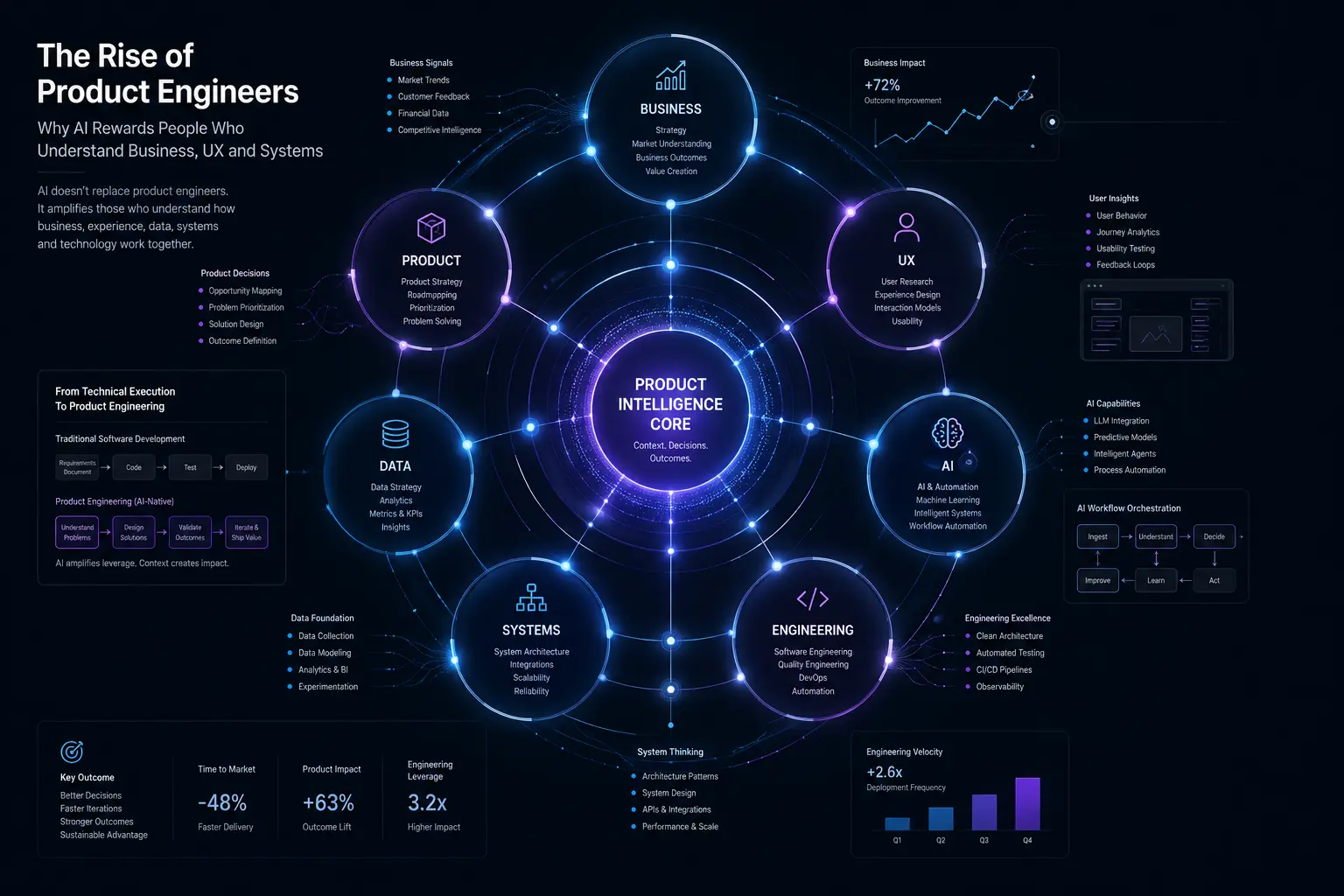
The Product Engineer Leverage Model

The leverage of a product engineer comes from five layers: business context, workflow understanding, UX and product judgment, system architecture and AI-augmented execution.

Business context explains why the system exists. Workflow understanding shows how users actually work. UX and product judgment decide what should be simplified or removed. Architecture turns decisions into scalable systems. AI-augmented execution accelerates the work without removing ownership.

When these layers work together, AI becomes a multiplier. The engineer can move faster without losing product responsibility.

What this means for software teams

Software teams should not only ask how to use AI tools. They should ask which roles and workflows need to change because AI increases implementation speed.

If a team can build faster, product discovery must become stronger. If code is cheaper to generate, architecture and maintainability become more important. If prototypes can be created quickly, teams need better ways to validate what matters.

This means product engineering should become a core capability, not an accidental skill found in a few senior developers.

What this means for companies building software

Companies building SaaS, enterprise software or internal tools should look for teams that understand more than technology. The right partner should be able to discuss business processes, user roles, data flows, automation opportunities and product trade-offs.

AI makes this more important, not less. A team that does not understand the workflow may use AI to produce more code, but that does not guarantee better software.

The best results come from combining strong product thinking with AI-native engineering. That combination turns speed into value.

Summary

AI changes software engineering by making implementation faster and increasing the value of context. Product engineers become more important because they connect the product problem with the technical solution.

The future does not belong to engineers who only execute tickets. It belongs to engineers who understand workflows, users, architecture and business goals.

AI can help build software faster. Product engineers help make sure the right software is built.

Framework

Proprietary models and thinking frameworks

The Product Engineer Leverage Model

A framework explaining why product engineers create leverage in AI-native teams by combining context, judgment, systems thinking and implementation.

Layer 1
Business context

Understanding why the system exists, what problem it solves and which business outcome matters.

Layer 2
Workflow understanding

Knowing how users actually work, where the process breaks and what should be automated or simplified.

Layer 3
UX and product judgment

Deciding what should be built, what should be removed and how users should move through the product.

Layer 4
System architecture

Translating product decisions into scalable data models, permissions, integrations, APIs and maintainable architecture.

Layer 5
AI-augmented execution

Using AI to accelerate implementation, research, testing, documentation and iteration without losing ownership.

Predictions

What may happen next?

Prediction 1

Product engineers will become one of the most valuable roles in AI-native software teams.

Prediction 2

Companies will hire fewer pure implementation roles and more people who can own product problems end-to-end.

Prediction 3

The gap between engineers who understand business context and engineers who only execute tickets will grow.

Prediction 4

AI will make mediocre product decisions more expensive because teams will be able to build the wrong thing faster.

Prediction 5

The strongest software teams will combine product engineers, deep specialists and AI-assisted workflows.

Claims & data

Key claims and sources

AI increases the value of product engineers because it accelerates implementation while leaving product judgment, workflow design and system architecture as human responsibilities.

Softech.app analysis · 2026

Software teams that understand business workflows can use AI more effectively than teams focused only on isolated implementation tasks.

Softech.app analysis · 2026
Knowledge graph

Related knowledge areas

Distribution

Article distribution assets

Ready-to-use fragments for social media, newsletter or expert communication.

LinkedIn hooks
AI will not reward people who only write code faster. It will reward people who understand what should be built.
The next high-value software role is not just full-stack developer. It is product engineer.
AI makes implementation faster. That makes product judgment more important, not less.
Carousel ideas
  • 5 reasons product engineers win in the AI era
  • Product engineer vs traditional software engineer
  • The Product Engineer Leverage Model
Newsletter angles
  • Why AI makes product judgment more valuable than pure implementation speed
Short video ideas
  • Why product engineers become more important with AI
  • What is a product engineer?
  • Why AI does not replace product judgment

FAQ

What is a product engineer?
A product engineer is a software engineer who combines technical implementation with product thinking, UX awareness, business context and system architecture. Product engineers do not only execute tickets. They help decide what should be built, how workflows should work and how software can create business value.
Why do product engineers become more important in the AI era?
Product engineers become more important because AI accelerates implementation but does not replace judgment. Teams still need people who understand users, workflows, architecture, business goals and trade-offs. AI makes building faster, so deciding what to build becomes even more important.
Will AI replace software engineers?
AI will not replace strong software engineers, but it will change what makes them valuable. Routine implementation becomes easier to automate, while product thinking, system design, domain understanding and end-to-end ownership become more important.
What skills should product engineers develop?
Product engineers should develop technical depth, UX thinking, data modeling, architecture, communication, business process understanding and AI-assisted workflows. They need to understand both how to build software and why a particular feature or workflow matters.
Do companies still need specialists?
Yes. Deep specialists are still essential in areas such as security, infrastructure, performance, data engineering and complex systems. The strongest teams will combine specialists with product engineers who connect the business problem, product direction and implementation.
Continue the cluster

Next articles in this series

These articles expand the context around AI-native software development, product engineering and delivery model transformation.

Author

Softech.app

Softech.app builds AI-native web apps, mobile apps, SaaS platforms, automation systems and modern digital products for companies.

Next step
Building an app? Need automation? Book a free project estimate.
We’ll do discovery, design UX/UI and deliver web, mobile, backend and AI automations in one team.