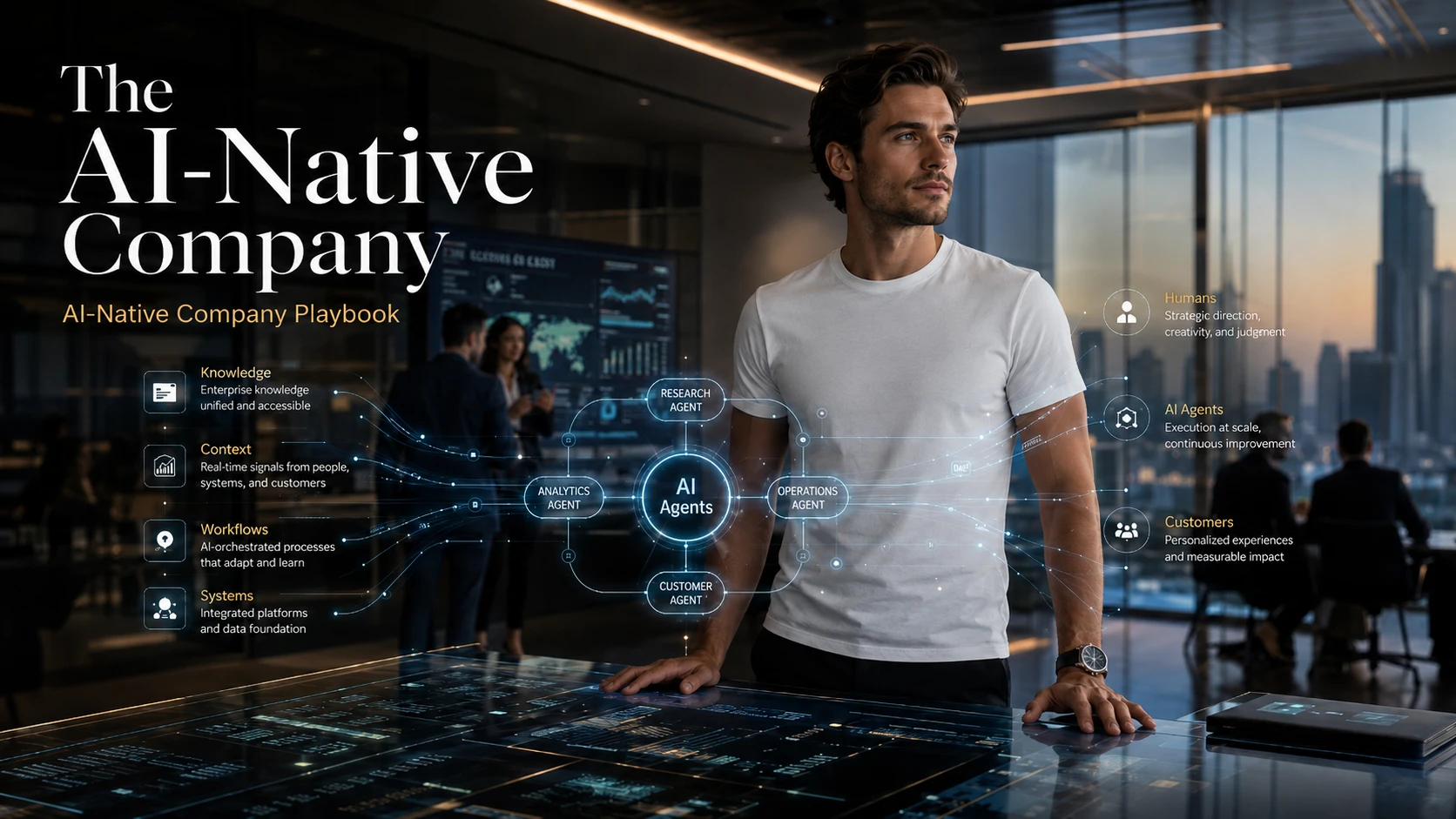
AI-Native Company Playbook — Research Paper 01
The AI-Native Company: How Businesses Will Be Designed in the Next Decade
Executive Summary
Artificial intelligence will not remain another tool used by companies. Over time, it will become a permanent operating layer of the organization, much like the internet, cloud infrastructure and business software before it.
Most companies are still adding AI to existing work. An AI-native company works differently: it designs processes, systems, knowledge, data and decision-making around the assumption that people and AI agents will collaborate continuously.
- from tools to systems,
- from isolated automations to connected workflows,
- from hidden knowledge to operationally available knowledge,
- from manual coordination to intelligent orchestration,
- from AI supporting individuals to AI supporting the organization.
The Core Thesis
Every major technological revolution eventually redesigns the company itself.
Steam changed the factory. Electricity changed production. Computers changed the office. The internet changed communication and distribution. Cloud changed software. Artificial intelligence will redesign the organization itself.
AI Is Not Another IT Tool
An AI-enabled company adds chatbots, copilots and automations to existing structures. An AI-native company begins with a different question: how would we design the organization if people and AI agents were expected to perform work together from the beginning?
Every Technological Revolution Redesigns the Organization
Steam
It allowed production to concentrate, factories to scale and work to become standardized.
Electricity
The greatest value appeared only when factories were redesigned around the new technology.
Computers
They changed administration, accounting, planning and information management.
The Internet
It changed sales, distribution, marketing, customer relationships and operating scale.
Cloud
It allowed organizations to build faster, experiment at lower cost and scale globally.
Artificial Intelligence
AI changes not only the speed of work, but who or what performs it, how it is coordinated and how quickly the organization learns.
The End of the Internet-Era Company
Traditional organizations assume that decisions, interpretation and coordination must pass through people. As the company grows, it needs more managers, reports, meetings and communication layers. An AI-native company designs a system in which people focus on direction, accountability, relationships, exceptions and risk, while AI handles more monitoring, analysis, context retrieval and repeatable workflow execution.
AI-Enabled vs AI-Native
AI-Enabled Company
- purchases AI tools,
- deploys chatbots,
- automates selected tasks,
- preserves the existing operating structure.
AI-Native Company
- designs workflows for human-agent collaboration,
- treats knowledge as infrastructure,
- connects systems around shared context,
- automates coordination,
- creates learning loops, governance and accountability.
AI-Native Organization Canvas™
The Canvas describes ten interdependent layers: Vision, Business Model, Knowledge, Context, Data, Systems, Workflows, AI Agents, Humans and Customers.
Vision
Defines the organization the company wants to become, the decisions it wants to accelerate and the value it wants to create.
Business Model
AI can change not only operating cost, but how value is created, delivered and monetized.
Knowledge
An AI-native company treats knowledge as infrastructure: it captures, validates, updates and reuses it.
Context
Context explains the current situation, prior decisions, exceptions, risks and the next appropriate action.
Data
Data records operational reality. AI can only operate as well as the company representation available inside its systems.
Systems
Systems should exchange data, recognize shared entities, expose controlled actions and enforce permissions.
Workflows
A workflow is where strategy becomes action. It should be explicit, modular, measurable and exception-aware.
AI Agents
An agent is an operational actor inside a larger system. Without the right data, context, permissions and workflow, it cannot create reliable value.
Humans
People remain accountable for vision, judgment, relationships, ethics, risk acceptance and system design.
Customers
AI transformation should improve customer outcomes through speed, quality, availability, transparency and personalization.
Do not begin by asking which agent to deploy. First design the organization in which an agent has a meaningful role.
Organizational Context Engine™
An Organizational Context Engine is the shared operational layer that makes company knowledge, rules, decisions, relationships and current state available to people, workflows and AI agents.
It connects data sources, organizational knowledge, entity models, decision history, current state, rules, operational memory and controlled access.
Context Debt
Context debt appears when important information exists but is unavailable where decisions are made. It produces status questions, manual history reconstruction, dependence on specific people and AI agents that provide technically correct but operationally irrelevant answers.
Human × AI Collaboration Matrix™
| Area | Human | AI |
|---|---|---|
| Direction | vision and priorities | scenario analysis |
| Decisions | accountability for consequences | recommendations and simulations |
| Relationships | trust, empathy and negotiation | context preparation |
| Operations | exceptions and supervision | execution and coordination |
| Risk | risk acceptance | monitoring and alerts |
| Ethics | values and boundaries | rule enforcement |
AI does not remove human accountability. It changes where accountability creates the greatest value.
AI-Native Leadership
The future CEO will manage a system composed of people, agents, workflows, data, rules, software and learning mechanisms. Leaders must move from managing activity toward managing outcomes and system quality.
Their role becomes designing accountability boundaries, escalation points, governance, controls and learning loops.
AI Leverage Equation™
AI Leverage = Knowledge Quality × Workflow Quality × Context Availability × System Integration × Adoption × Leadership
The model is multiplicative. If any factor approaches zero, the final business value falls dramatically.
- Knowledge Quality — accurate, current and retrievable knowledge.
- Workflow Quality — clear outcomes, ownership, rules, exception handling and metrics.
- Context Availability — the right information at the moment of decision.
- System Integration — the ability of AI to act across business systems.
- Adoption — trust, good UX and understanding of limitations.
- Leadership — the ability to convert technology into operating-model change.
What Does an AI-Native Company Look Like in Practice?
SaaS
Agents analyze support and usage, detect churn risk, prepare product recommendations, update documentation and monitor the impact of changes.
eCommerce
Agents forecast demand, detect inventory risk, handle standard returns, support customers and analyze the impact of decisions on margin.
Rental and Self Storage
Agents monitor availability, forecast occupancy, recommend pricing, handle payment reminders and prepare tenant communication.
Service Business
Agents qualify leads, prepare scope, launch onboarding, monitor risk and create reports.
Enterprise
The greatest value may come from reducing the time required to understand a situation by connecting cross-functional data, decision history, policies and risk.
What Will Define Great Companies in 2035?
- Greater operating scale with proportionally smaller teams.
- Flatter organizational structures.
- Knowledge as a measurable asset.
- Workflows as intellectual property.
- Digital operating teams.
- Operational intelligence instead of static reporting.
- Strategy closer to execution.
- Trust, auditability and governance as infrastructure.
Executive Takeaways
- Do not begin with the tool.
- Treat knowledge as infrastructure.
- Build context, not only data.
- Design human–AI collaboration.
- Define responsibility boundaries.
- Measure organizational outcomes.
- Create a learning loop.
- Identify the weakest multiplier in the AI Leverage Equation™.
- Prepare leadership.
- Keep the customer perspective.
Next Research Paper
The Organizational Context Engine: Why AI Agents Need More Than Data
The next Research Paper will expand the central layer of the AI-native company: organizational context. It will explain context debt, the difference between knowledge and context and how to expose context safely to AI agents.
Conclusion
The greatest benefits will not belong to companies that purchase the most tools. They will belong to organizations that best connect knowledge, context, data, systems, workflows, agents, people and leadership.
An AI-native company is not a company without people. It is a company that places human accountability, judgment and creativity where they create the greatest value—and scales the rest through intelligent systems.