AI Has Officially Moved Beyond Chatbots
Over the last two years, most organizations experimented with AI in very similar ways. Employees used ChatGPT, marketing teams generated content, developers adopted Copilot and teams tested isolated automations.
For many companies, AI became another productivity tool. But this is only the beginning of the shift.
The AI market is transitioning from conversation AI to agentic AI. This is a fundamental transformation. AI is no longer limited to answering questions. AI is beginning to perform work: planning tasks, analyzing information, coordinating workflows, writing and reviewing code, interacting with systems and supporting operational decisions.
This is why AI agents are becoming increasingly important. Not prompts. Not chatbots. Not isolated AI tools. Agents.
They are becoming the next operational layer of modern organizations.
The Problem: Most Companies Are Not Ready for AI Agents
Most businesses still assume that adopting AI is primarily about purchasing the right tool. That assumption is dangerously incomplete.
Organizations are attempting to deploy AI agents into environments that lack the operational infrastructure required for agents to function effectively. Data is fragmented. Processes are inconsistent. Knowledge exists inside individual employees rather than systems. Workflows are undefined. Permissions are chaotic. Systems do not communicate properly.
In this environment, AI does not solve operational problems. AI simply accelerates existing organizational chaos.
This is one of the main reasons many AI initiatives fail to generate meaningful ROI. The problem is rarely the model itself. The problem is the absence of infrastructure.
Definitions: What Are We Really Talking About?
AI infrastructure is the combination of data, workflows, knowledge systems, integrations, permissions and orchestration layers that allow AI agents to operate safely and effectively inside an organization.
AI agents are systems capable not only of generating responses, but also of executing tasks, interacting with tools, analyzing context and completing workflows.
AI orchestration is the coordination of multiple agents, systems and humans within one operational process.
An agent-ready company is an organization whose processes, data, knowledge and permissions are prepared for collaboration with AI agents.
An AI-native organization is a company designed around humans, systems and AI operating together as a permanent business layer.
AI Agents Require Infrastructure
AI agents do not operate in isolation. They require an operational environment, access to data, memory, permissions, context, workflows and integration with business systems.
In practice, this means organizations will need to build a new business infrastructure layer. Just as companies previously invested in cloud infrastructure, API infrastructure, data layers, workflow systems and automation platforms, a new category is now emerging: AI Agent Infrastructure.
This is not an add-on to existing software. It is a new operating architecture for companies.
MCP May Become the API Layer for AI
One of the most important emerging concepts in the AI ecosystem is MCP — Model Context Protocol. Today MCP still sounds highly technical to many business leaders. But in practice, it may become one of the foundational standards of the AI-native internet.
MCP enables AI agents to interact with tools, systems and data sources in a standardized way. It can be understood as an API layer for AI agents — a layer enabling secure execution across business systems.
Today, most AI agents operate in partial isolation. They can generate responses and analyze text, but they often lack deep operational access to company systems. MCP begins to change that model.
This is why MCP may become one of the foundations of the future agentic economy.
AI-Native Organizations Will Look Fundamentally Different
Many companies still view AI as an additional productivity layer supporting human employees. That perspective is short-term.
AI-native organizations will be designed differently at the operational architecture level. Workflows will be created for collaboration between humans and AI agents. Processes will become increasingly modular. Organizational knowledge will be structured and accessible to AI systems. Systems will communicate in real time.
This represents the emergence of an entirely new organizational model. Not software-first. Not process-first. Agent-ready.
The AI-Native Organization Maturity Model
The biggest mistake is assuming every company can immediately move to AI agents. Organizations mature in stages.
Level 0 — Manual Organization
People coordinate work manually. Knowledge exists in conversations and inside people’s heads. Processes are inconsistent. AI adoption creates confusion instead of leverage.
Level 1 — AI-Assisted Organization
Employees use ChatGPT, Copilot or other tools individually. AI improves personal productivity, but the organization itself remains structurally unchanged.
Level 2 — Workflow Automation Organization
Basic automations appear. Systems begin exchanging data. Operational bottlenecks still require human coordination.
Level 3 — AI-Orchestrated Organization
AI begins coordinating workflows. Agents interact with systems and operational intelligence begins to emerge.
Level 4 — Multi-Agent Organization
Specialized agents execute operational tasks. AI systems collaborate with each other and humans increasingly focus on supervision and strategy.
Level 5 — AI-Native Organization
The company is designed around collaboration between humans and AI systems. AI becomes a permanent operational layer of the business.
The Agent Infrastructure Stack
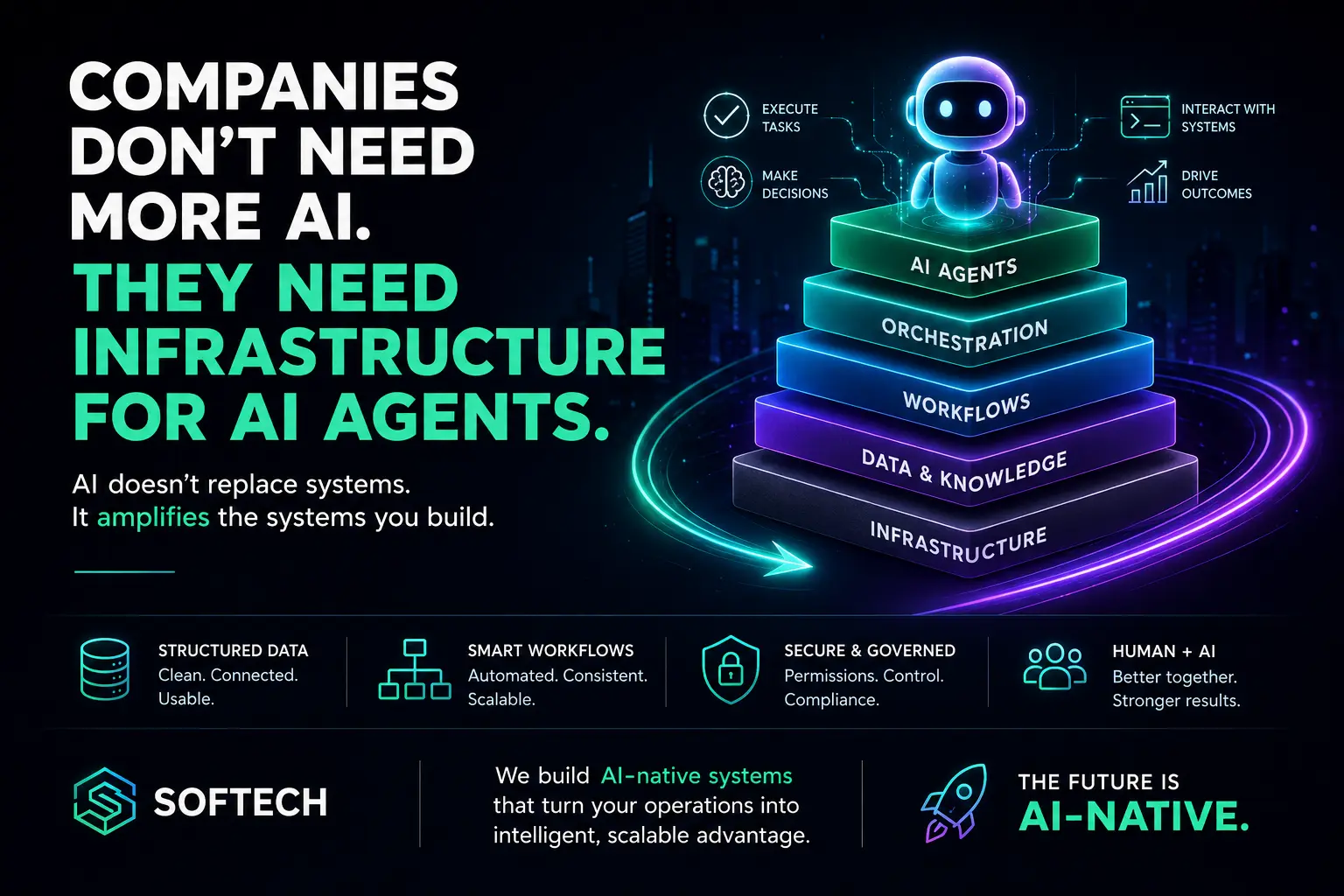
When designing AI-native organizations, it is useful to think in layers: data, workflows, knowledge, permissions, tools, agents, multi-agent systems and finally an AI Operating System.
This order matters enormously. Most companies are currently attempting to begin with the final layer — the agents themselves. But agents are only the visible layer of a much deeper infrastructure.
The real competitive advantage is created much lower in the stack: the quality of data, the quality of workflows, the quality of organizational knowledge and the level of systems integration.
What AI Agents Actually Look Like Inside Companies
The biggest problem with conversations about AI agents is that they often sound abstract. Their value becomes visible only inside specific operational processes.
SaaS company
In a SaaS company, AI agents can support user onboarding, analyze feedback, prepare documentation, monitor churn risk, suggest product improvements and assist customer success teams.
Rental / Self Storage company
In rental and self storage businesses, agents can handle reservations, payment reminders, tenant communication, occupancy forecasting, pricing optimization and operational reporting.
eCommerce company
In eCommerce, agents can support customer service, returns, inventory forecasting, pricing, product recommendations and fulfillment coordination.
Service business
In service businesses, agents can qualify leads, schedule meetings, prepare documents, create reports, track tasks and support operational coordination.
In every case, the key is not AI itself. The key is the environment in which AI can operate.
AI Coding Agents Are Transforming Software Development
One of the clearest examples of agentic AI is happening in software engineering. The market is moving from copilots toward AI agents capable of performing engineering work: Claude Code, Cursor Agents, Codex, Devin and multi-agent coding workflows.
These systems are no longer simple autocomplete tools. They represent the beginning of a new software development model.
Developers are increasingly shifting from pure execution roles toward orchestration and systems design. The highest-value skills are changing. Writing code alone is becoming less important. Architecture, business understanding, systems integration and AI orchestration are becoming more important.
The Biggest Risk Is Not Missing AI
The biggest risk is not that a company fails to adopt AI quickly enough.
The biggest risk is building an organization that AI cannot operate inside.
If a company has fragmented systems, undocumented processes, hidden knowledge, manual coordination and chaotic permissions, AI agents will not create leverage. They will create another layer of complexity.
That is why the question is no longer: “Which AI agent should we buy?” The real question is: “Is our organization agent-ready?”
The Rise of the Digital Workforce
One of the most important outcomes of agentic AI will be the emergence of digital workforces. This is not primarily about replacing humans. It is about creating a new operational layer inside organizations.
Some work will be performed by humans, some by agents and some by multi-agent systems. The most effective organizations will be those capable of orchestrating collaboration between these layers.
The future of business will not be defined by the number of AI tools a company uses. It will be defined by the quality of collaboration systems between humans and AI.
What Disappears by 2030?
By 2030, many forms of operational work may be significantly reduced: manual reporting, status-update meetings, basic coordination, repetitive administration and simple knowledge workflows.
This does not mean the end of human work. It means a shift of value toward systems design.
What Becomes More Valuable?
Workflow architecture, AI orchestration, business systems design, context engineering, operational design and the ability to connect technology with business models will become increasingly valuable.
Companies will not compete on access to AI. They will compete on the quality of infrastructure that AI operates inside.
Softech POV: The Future of Business Is AI-Native Operational Systems
At Softech, we see this shift clearly: the future of business will not be built around individual software applications. It will be built around AI-native operational systems.
The companies that win in the AI era will not simply use more tools. They will design organizations where data, knowledge, workflows, humans and agents form one coherent operating system.
Conclusion
Most organizations believe they need more AI. In reality, most organizations need infrastructure for AI.
Agentic AI will fundamentally reshape how businesses operate. But AI agents will not succeed inside organizations built on fragmented systems and operational chaos.
The future belongs to AI-native organizations designed around data, workflows, knowledge and AI agents.
This is where the next generation of business systems is being created.
Is Your Organization Ready for AI Agents?
If your company is preparing for the era of agentic AI and wants to build AI-native operational systems, workflows and infrastructure, let’s talk.
At Softech, we help organizations design modern business systems prepared for the next generation of AI-powered operations.