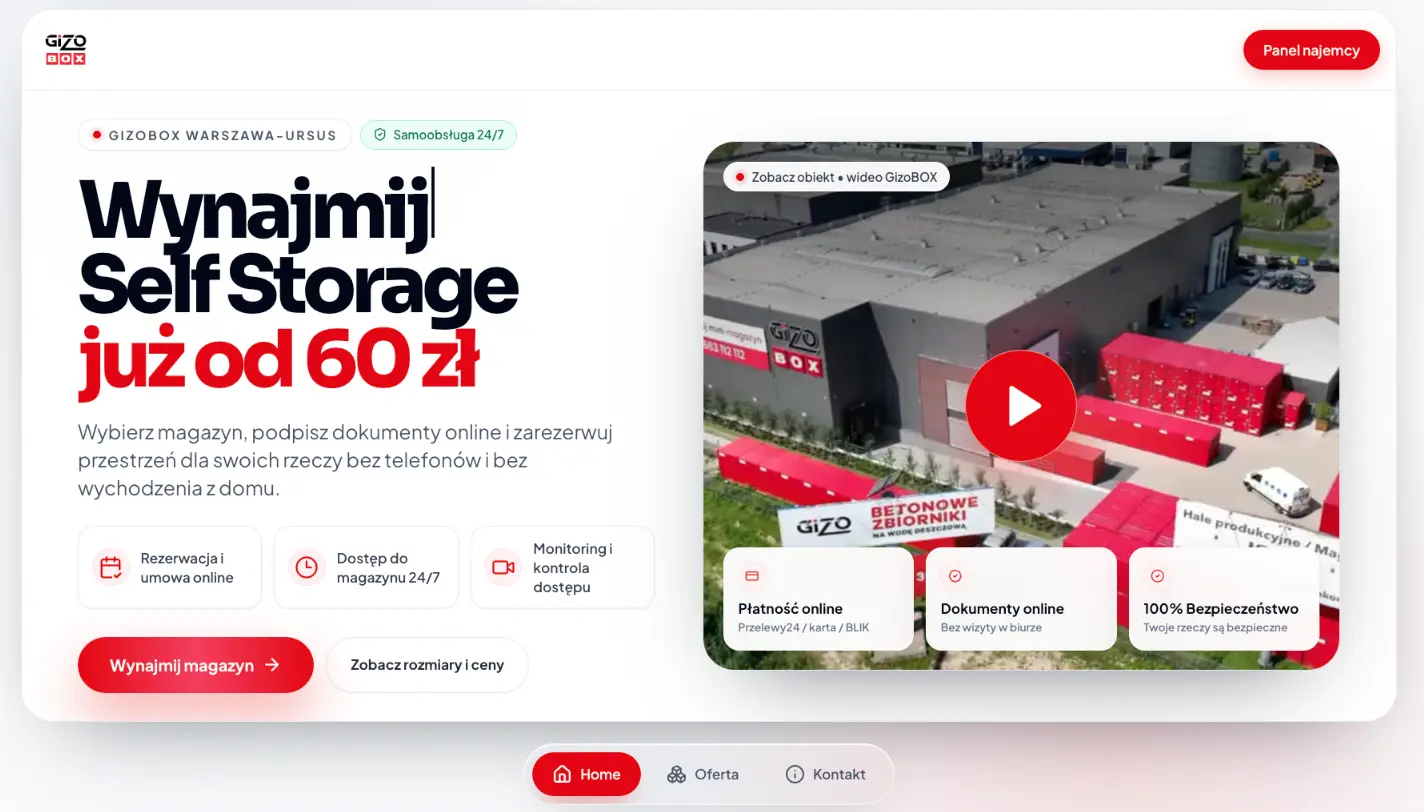
Self Storage Is Becoming a Digital Service
Only a few years ago, renting a self storage unit looked similar to traditional property rental.
A customer called the office, asked about available unit sizes, discussed conditions, visited the location, signed documents, paid for the service and only then received access to storage space.
This model worked, but it had one major limitation.
It depended heavily on manual operations.
Every reservation required staff involvement. Every payment required verification. Every status change required administration. Every customer question went through support.
For a small facility, this may be acceptable. For a growing storage network, it becomes an operational bottleneck.
This is why self storage is moving toward digital operating platforms.
The GizoBOX example shows what a modern storage rental journey can look like: a customer enters the website, explores the offer, starts an online reservation, manages the account in a tenant dashboard, pays online, monitors statuses and accesses key information from a computer or phone.
This is no longer just a website.
It is a digital operating system for a self storage business.
Why a Website Alone Is Not Enough
Many self storage operators start with a website. That is a natural first step.
A website presents the location, photos, storage sizes, contact details and basic offer information.
The problem appears when the website only generates inquiries.
If the customer still has to call, wait for a reply, manually sign documents and coordinate every detail with staff, the business still operates in an analog model.
Modern self storage needs more than a website.
It needs a platform that handles the entire process.
- It presents the offer and available storage units.
- It allows customers to choose unit size and rental period.
- It supports online reservations.
- It generates or provides digital documents.
- It handles payments.
- It shows rental status.
- It sends notifications.
- It gives tenants a self-service dashboard.
Only then can the customer complete the journey without unnecessary friction.
And only then does the operator gain a process that is repeatable, measurable and scalable.
The Tenant Panel as the Customer Service Center
One of the most important elements of a modern self storage system is the tenant panel.
It is the dashboard where customers can manage their service independently.
In the GizoBOX example, the tenant panel allows users to see the most important information immediately after logging in: active reservations, payments requiring action, the nearest payment date, rental history and notifications.
The main value is simple: customers do not need to contact support for every basic issue.
They can open the dashboard from a desktop or mobile device and check:
- how many active reservations they have,
- whether any payments are outstanding,
- when the next payment is due,
- which notifications require attention,
- what their reservation history looks like,
- whether they can start another reservation.
For the customer, this means convenience.
For the operator, it means fewer repetitive questions, less manual support and better process visibility.
The tenant panel turns storage rental into a self-service experience.
Online Reservations: When Self Storage Becomes Available 24/7
The strongest advantage of the digital model appears when customers can start and complete the reservation process online.
Self storage is often purchased at a very specific moment of need.
Someone is moving.
Someone is renovating an apartment.
A company needs space for equipment, inventory or documents.
The customer does not want to wait hours for a response.
They want to quickly check price, availability and conditions.
That is why the system should make the path from interest to reservation as short as possible.
In practice, this means:
- clear location presentation,
- easy-to-understand unit sizes,
- transparent pricing,
- a simple reservation flow,
- online payment options,
- automatic confirmation,
- access to the tenant dashboard.
This is the moment when self storage stops being an administrative process and starts behaving like a modern service e-commerce experience.
Payments and Documents: Less Administration, More Control
The second critical area is payments and documents.
In the traditional model, staff must monitor due dates, verify transfers, remind customers about payments, send documents and update statuses manually.
In a well-designed system, many of these actions can happen automatically.
The tenant panel should clearly show:
- the amount due,
- payment status,
- the next payment date,
- billing history,
- related documents,
- notifications requiring action.
For the operator, this creates better control over receivables.
For the tenant, it creates a simple and transparent experience.
The customer does not need to search through emails, bank details or payment deadlines.
Everything is available in one place.
Access as Part of the Digital Process
Access to the storage facility is one of the most important operational elements in self storage.
Depending on the business model and infrastructure, access can be handled through codes, gates, security integrations, staff procedures or physical handover.
Regardless of the technology, the system should treat access as part of the business process, not as a disconnected manual step.
This means access status should be connected with:
- an active reservation,
- payment status,
- signed documents,
- security rules,
- customer communication.
If the customer has an active and paid reservation, the system should guide them through the next steps.
If there is an unpaid balance, the system should detect the risk and notify the right person or the customer.
This is where software begins to support real facility operations.
What Should the Operator See?
The tenant panel is important, but it is only one side of the system.
The operator needs an administrative dashboard that controls the business.
Such a dashboard should include:
- facility management,
- storage unit management,
- pricing and promotions,
- unit availability,
- active and historical reservations,
- tenant data,
- payments and overdue balances,
- documents,
- notifications and communication,
- operational reports.
The greatest value appears when the operator does not have to check everything manually.
The system should immediately show which reservations require payment, which documents are incomplete, which units are available and where risks appear.
This allows the facility to be managed more like an operating system and less like a collection of spreadsheets, emails and phone calls.
Why a Custom Platform Can Be Better Than Generic SaaS
There are ready-made self storage tools available on the market.
For some operators, they can be enough.
The problem appears when a company wants to build its own brand, customer experience, pricing logic, local payment integrations, document workflows or custom access process.
Generic SaaS often forces the business to adapt to the tool.
A custom platform allows the tool to adapt to the business.
This matters in areas such as:
- unique website and tenant panel design,
- local payment methods,
- custom reservation flow,
- individual pricing structures,
- access system integrations,
- custom documents and agreements,
- reports aligned with the operator’s management model,
- full control over product development.
For an operator building a modern self storage network, a custom platform can become a competitive advantage.
It does not only support the current business.
It allows the operator to design the future operating model.
Self Storage as Service E-Commerce
The most interesting change is that self storage increasingly resembles service e-commerce.
The customer compares the offer, chooses a variant, checks the price, completes a reservation, pays online and manages the service from an account.
The difference is that the product is not a physical item shipped by courier.
The product is access to space.
This means self storage operators should think about their systems similarly to modern e-commerce companies.
Speed matters.
UX matters.
Trust matters.
A simple checkout matters.
Payment handling matters.
Automated communication matters.
The customer panel matters.
If the process is too complicated, the customer may choose a competitor.
If the process is simple, transparent and available 24/7, conversion can improve.
The Main Benefits for Operators
1. Less Manual Support
Customers can check statuses, pay, access documents and start new reservations independently.
2. Better Scalability
The operator can serve more tenants without increasing administrative workload at the same pace.
3. Better Payment Control
The system shows outstanding balances, due dates and notifications requiring action.
4. Higher Conversion
A simple online reservation process reduces abandoned inquiries.
5. Consistent Customer Experience
The customer receives a modern service that works well on both desktop and mobile.
6. Better Operational Data
The operator can analyze occupancy, payments, reservation history, demand and customer behavior.
The Biggest Mistakes When Building a Self Storage System
Mistake 1: Treating the System Like a Simple Website
An informational website does not solve operational problems.
The business needs a system that supports the process from customer acquisition to rental management.
Mistake 2: No Tenant Panel
Without a tenant dashboard, customers will continue to contact support about issues they could solve independently.
Mistake 3: Manual Payment Management
With a growing number of tenants, manual payment control quickly becomes a source of errors and delays.
Mistake 4: Weak Mobile Experience
Customers often search for storage from a phone. If the mobile journey is poor, conversion suffers.
Mistake 5: No Operational Integrations
The platform should be ready to integrate with payments, documents, communication and access-related workflows.
How Softech Builds These Systems
At Softech, we do not look at self storage as only a website or an admin panel.
We see it as a complete operating system for a specific business model.
This means we start with the process.
We analyze how customers discover the offer, how they choose a unit, what information they need, how the reservation works, which documents are required, how payments are handled and how the operator manages the facility internally.
Only then do we design the application architecture.
A typical platform can include:
- a public website or facility landing page,
- an online reservation module,
- a tenant dashboard,
- an operator panel,
- facility and unit management,
- pricing and promotions,
- online payments,
- document generation,
- email or SMS notifications,
- access system integrations,
- reporting and analytics.
The goal is not to add technology for its own sake.
The goal is to build a system that genuinely simplifies sales, operations and scaling.
Conclusion
Self storage is going through the same shift that previously transformed e-commerce, financial services, hotel reservations and many other industries.
Customers expect a simple online process.
Operators expect automation, control and scalability.
A modern self storage management system connects these two worlds.
On the customer side, it provides online reservations, a tenant panel, payments, documents and access to key information.
On the operator side, it provides management of units, reservations, payments, documents, availability and communication.
The GizoBOX example shows that storage rental can become a digital, transparent and self-service experience.
This is where the market is heading.
Modern self storage does not end with physical space.
It begins with a well-designed system.