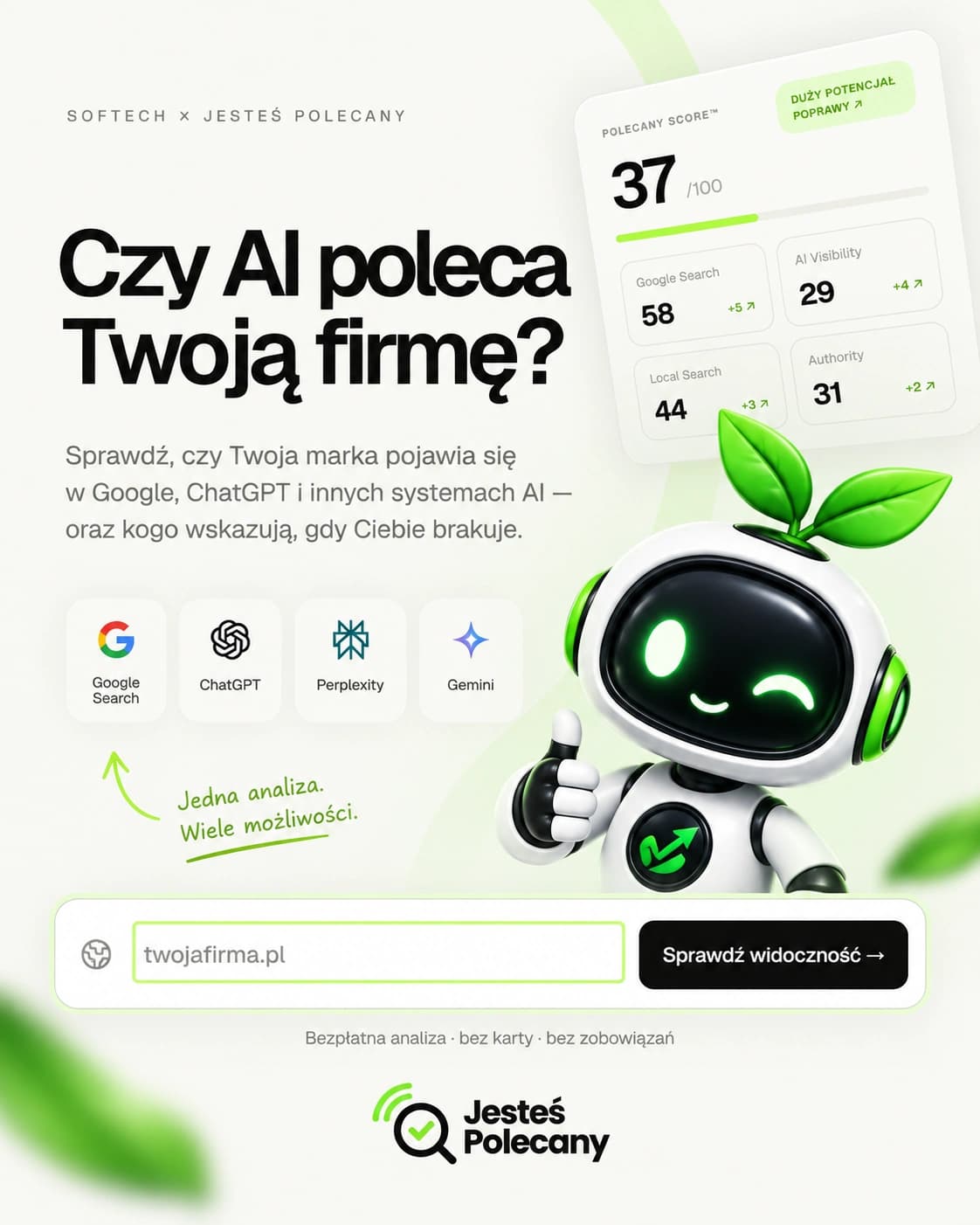
Softech designed Jesteś Polecany as a new product type: a Recommendation Intelligence Platform. The system combines Google Search, AI Search, Local Search and Authority into one model for evaluating brand presence, then simplifies that complexity into Polecany Score™ and prioritised opportunities. The defining decision was to build a product that does not pretend AI models produce a stable ranking, but instead honestly separates readiness from observed recommendations and turns analysis into action through the Recommendation Readiness Loop. The public product layer, growth UX and API-first architecture together create the foundation for the future dashboard, shared read models and the broader recommendation-intelligence engine.
Business context and the situation before implementation
The market needs growth tools for the new search environment, yet most offers blur SEO, AI visibility and recommendation promises into one unclear category. Jesteś Polecany was created to structure that space and build a comprehensible product for companies that want to understand whether they are being found and considered across Google and AI systems.
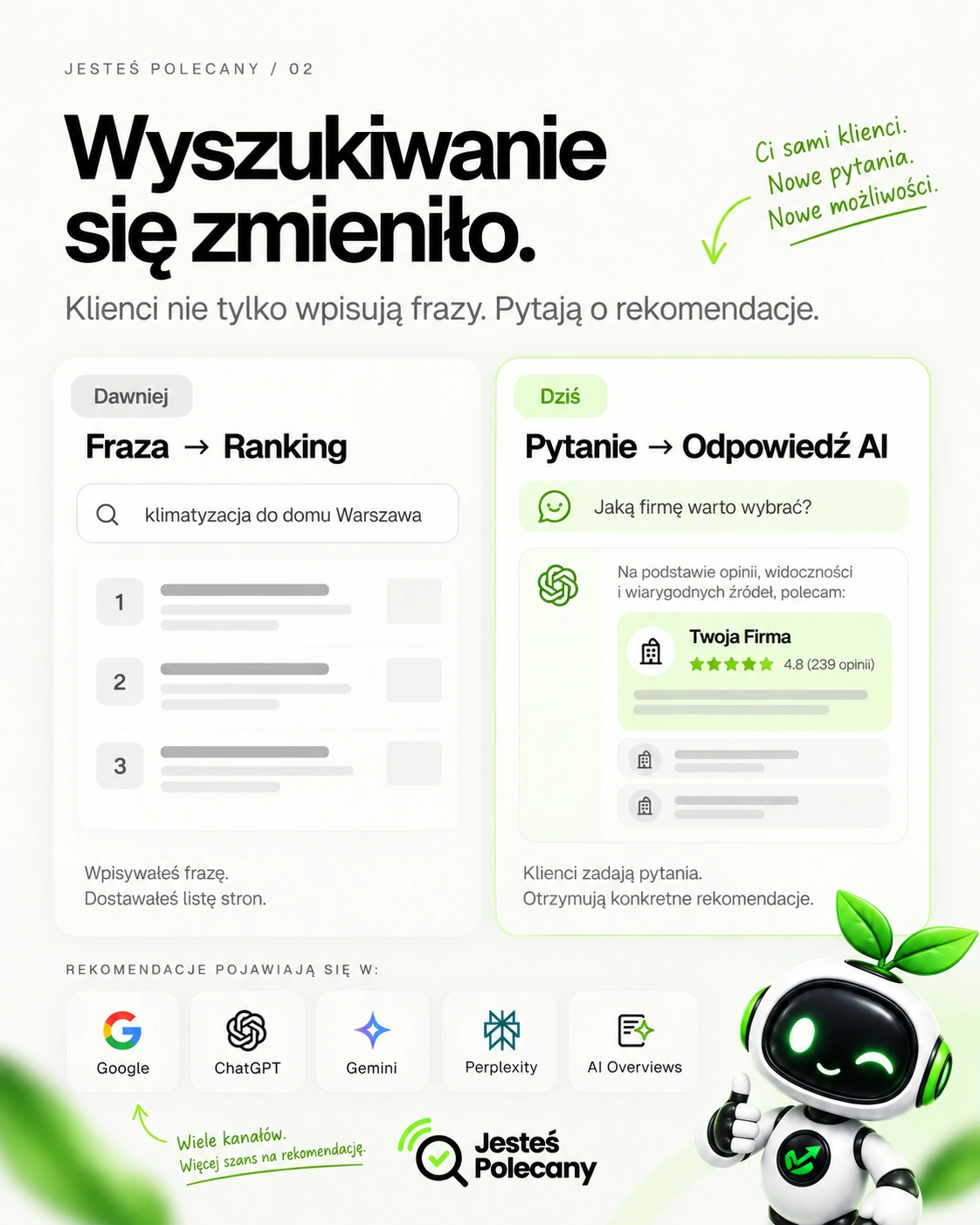
- Customers increasingly ask for recommendations instead of only typing keywords.
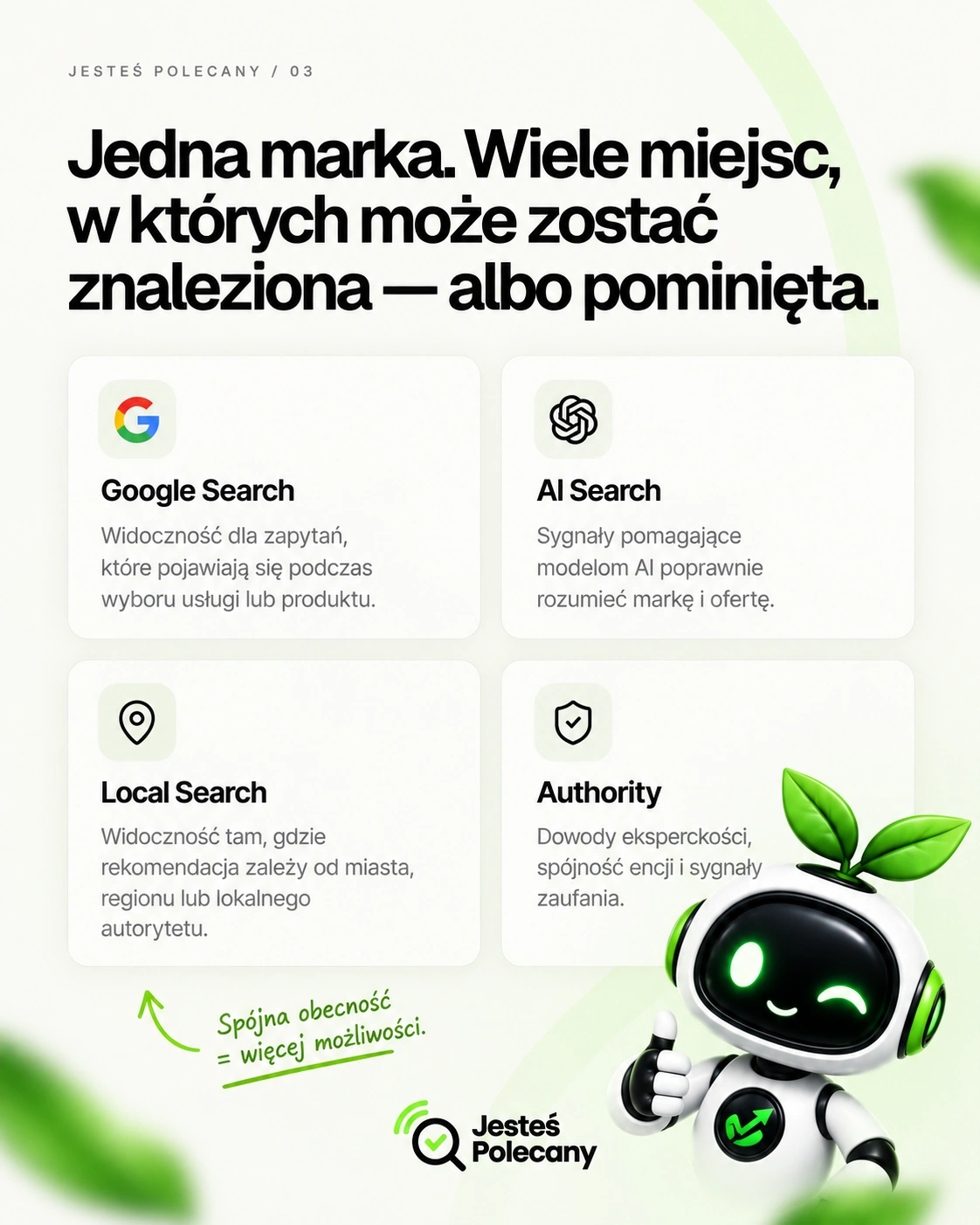
- Brand visibility now depends on multiple surfaces: search, AI, local and authority.
- Businesses need action priorities, not only charts and reports.
- The product needs to combine education, scoring and action in one experience.
Before state
The initial problem space was fragmented: classic SEO did not explain AI visibility, while claims about “appearing in ChatGPT” were often commercially attractive but methodologically weak. The product needed to be more honest, more useful and more strategic.
- There was no simple model connecting Google, AI, local visibility and authority.
- Single model screenshots were often mistaken for stable rankings.
- A typical report left the client with information but no operating system for action.
- It was hard to distinguish diagnosis from an actionable growth plan.
Goals, success criteria and constraints
Discovery focused on the changing nature of search behaviour, the gaps in existing offers and the way businesses make growth decisions. The most important insight was simple: for companies, the most useful output is not only a score, but the questions the brand does not answer or the places where it is absent.
Product goals
- Design a comprehensible product category: Recommendation Intelligence.
- Connect multiple visibility surfaces into one business-readable model.
- Turn analysis into prioritised actions and a repeatable workflow.
- Create a public entry product that supports market education and sales.
- Lay the foundation for the future dashboard and recommendation intelligence layer.
Success criteria
- Users understand what the product measures and why it is not a “ChatGPT ranking”.
- The score and opportunities shorten the path from diagnosis to decision.
- The public UX clearly guides users from the problem statement to the free analysis.
- The product preserves a clean path to the future API and dashboard.
- The public layer and the case study remain methodologically honest and avoid unrealistic promises.
No deterministic guarantees
The product cannot promise recommendations inside generative models because outputs vary by prompt, model, time and context.
Business readability
The advanced methodology had to be simplified into language and UX that business owners and marketers can understand.
Separating brand quality from website quality
The product model must distinguish the actual quality of the business from the quality of its digital representation.
Roadmap consistency
The public layer needed to be useful today while remaining aligned with the future platform and dashboard.
Analysis and product decisions
- The highest value comes from decision moments, not only presence observation.
- The product must educate the market as much as it measures it.
- A new category requires its own language and proof points.
- The free entry point must promise first insights without overwhelming the user with complexity.
- If the product does not explain what to do next, the user falls back to a generic report with no decision path.
Solution architecture
The product architecture combines a public growth UX with a domain model prepared for broader platform evolution. The public layer simplifies complexity into understandable surfaces, while the product foundation preserves room for scoring, read models, opportunities and evidence-driven monitoring.
- 0101
Public product and growth UX
The landing flow, category education, free check, CTAs and offers guide users from the problem statement to the first action.
Next.jsTypeScriptTailwind CSS - 0202
Signal model and Polecany Score™
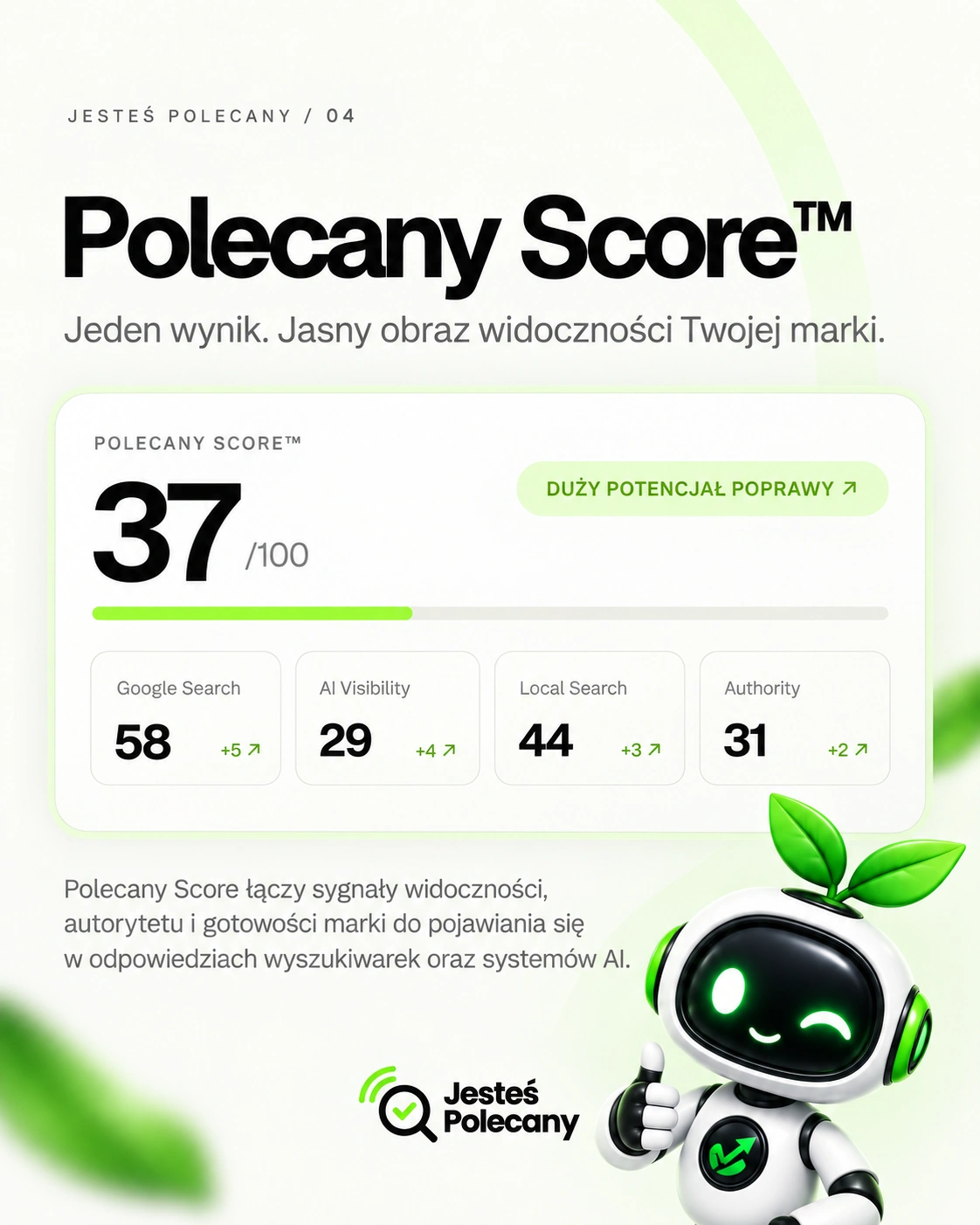
The measurement layer describes Google Search, AI Visibility, Local Search and Authority and simplifies them into one decision-support score.
TypeScriptShared content models - 0303
Opportunity Engine
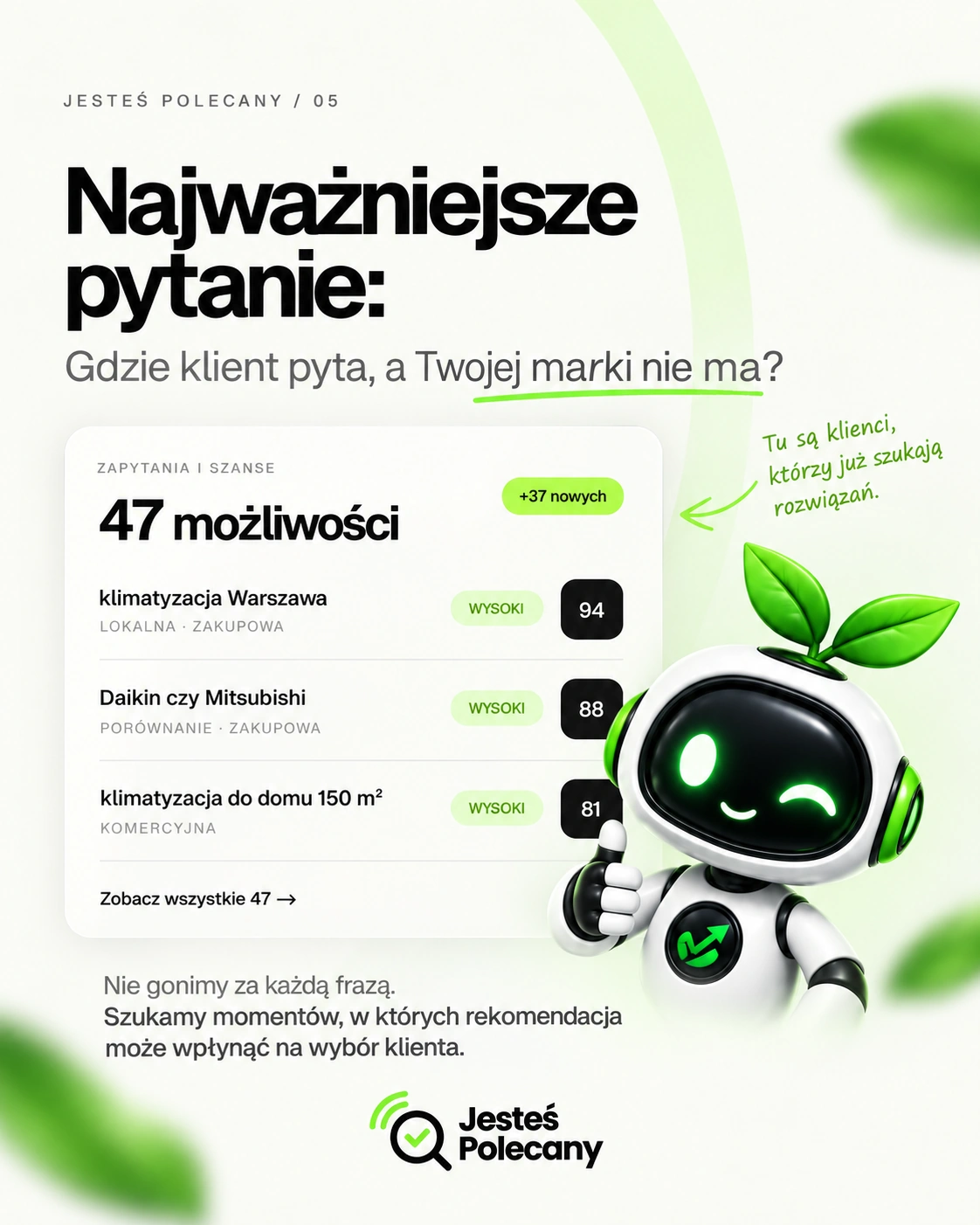
This mechanism surfaces questions, comparisons and local intents where brand presence can influence a buyer’s decision.
Prioritisation logicRead models - 0404
API-first platform foundation
The platform layer prepares a shared domain model for the dashboard, evaluations, evidence sources and future workflows.
Node.jsNestJSPrismaPostgreSQL - 0505
Content & evidence layer
Educational content, case narratives and controlled proof points support category understanding and product credibility.
Structured contentEditorial system
Problems, decisions and implemented capabilities
The market does not understand how AI visibility differs from classic SEO.
A dedicated category narrative was built around Recommendation Intelligence.
A new product language, market education and clearer positioning.
The product becomes easier to understand and easier to sell.
Visibility data is too complex for most business users.
Polecany Score™ was introduced as a simplified decision layer.
One entry point for the brand-visibility conversation.
Businesses understand their starting point and improvement potential more quickly.
A report alone does not show where to act first.
The Opportunity Engine was added.
Questions and intents are prioritised by value and business importance.
The product moves from diagnosis to prioritisation.
Automation alone reduces trust for brand-impacting decisions.
AI speed and expert judgement were explicitly separated.
Research and monitoring are fast, while strategy and quality remain supervised.
The product is more credible and closer to real client processes.
Users need a simple first step instead of a long onboarding process.
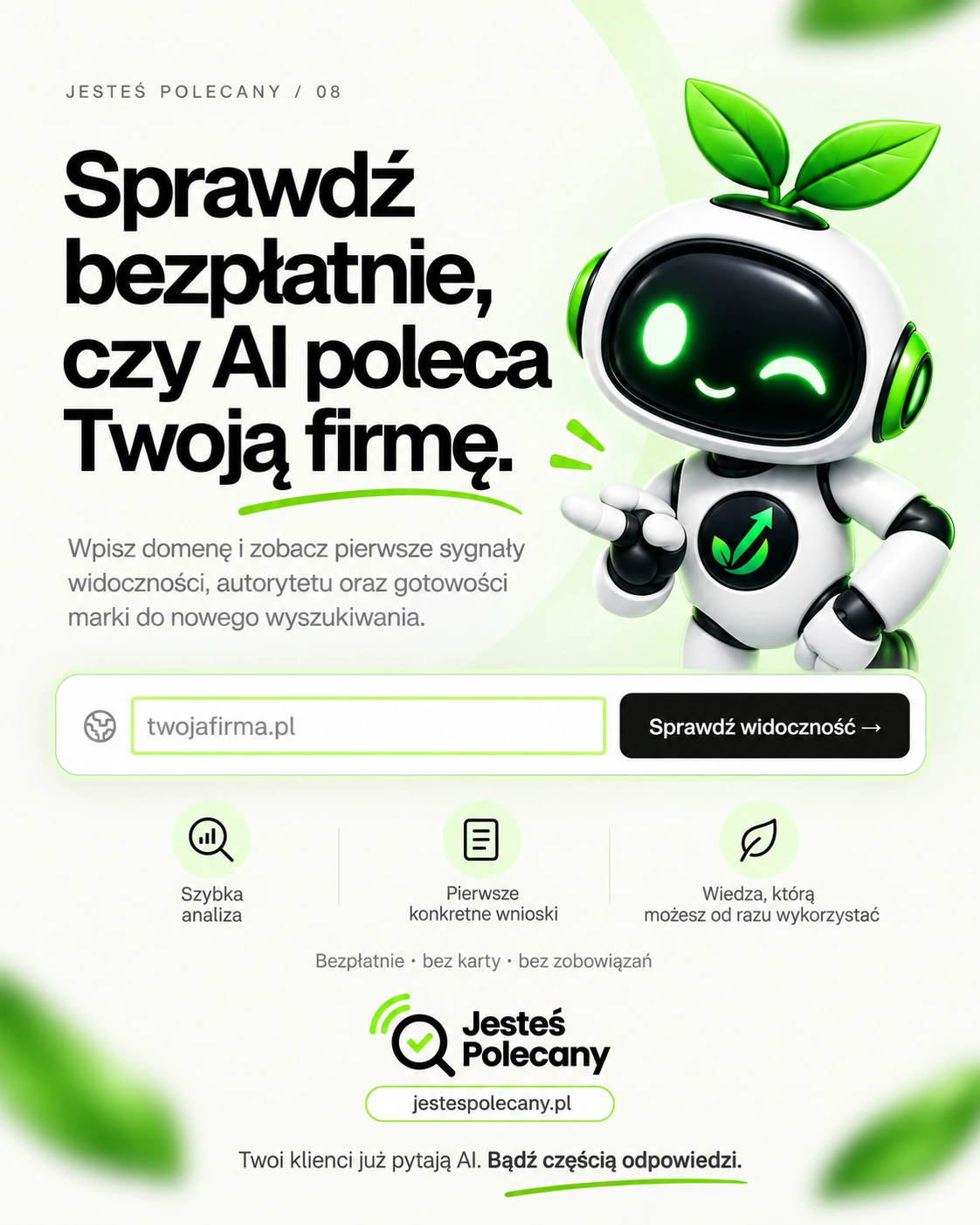
A free domain check was introduced as the public entry point.
A fast entry into the brand-visibility and recommendation-readiness conversation.
A lower barrier to entry and a stronger closure for the growth flow.
Technology decisions
| Technology | Role | Rationale | Trade-off |
|---|---|---|---|
| Next.js | Public product and content layer | It combines SEO, content, fast iteration and a flexible growth UX. | Part of the product logic must live outside the frontend to preserve scalability. |
| TypeScript | Shared product and content model | It helps maintain consistency between the web layer, content and the API foundation. | It requires stricter modelling discipline and contract design. |
| NestJS + PostgreSQL | Product API foundation | They support the domain model, read models and broader Recommendation Intelligence workflows well. | The public site can evolve faster than the backend, so the roadmap must remain controlled. |
| Tailwind CSS | Visual system and iteration speed | It helps maintain a lightweight, coherent visual system for the growth UX. | It requires discipline so that utility-first styling does not reduce component clarity. |
| Vercel | Hosting and fast deployment for the public layer | It supports fast iteration, preview environments and performance for the public entry product. | The broader platform still needs its own backend and deployment plan. |
Integrations and data flows
Google Search surface
inputVisibility-layer modelling for search and buying-intent queries.
Controlled through internal observation and analysis methodology.
AI Search observation layer
inputObservation of model answers and recommendation patterns.
Results are interpreted cautiously; a single answer is not a ranking.
Local visibility context
inputEvaluation of local presence where city and regional context influence supplier choice.
Evaluated from local signals and entity context.
AI, security and reliability
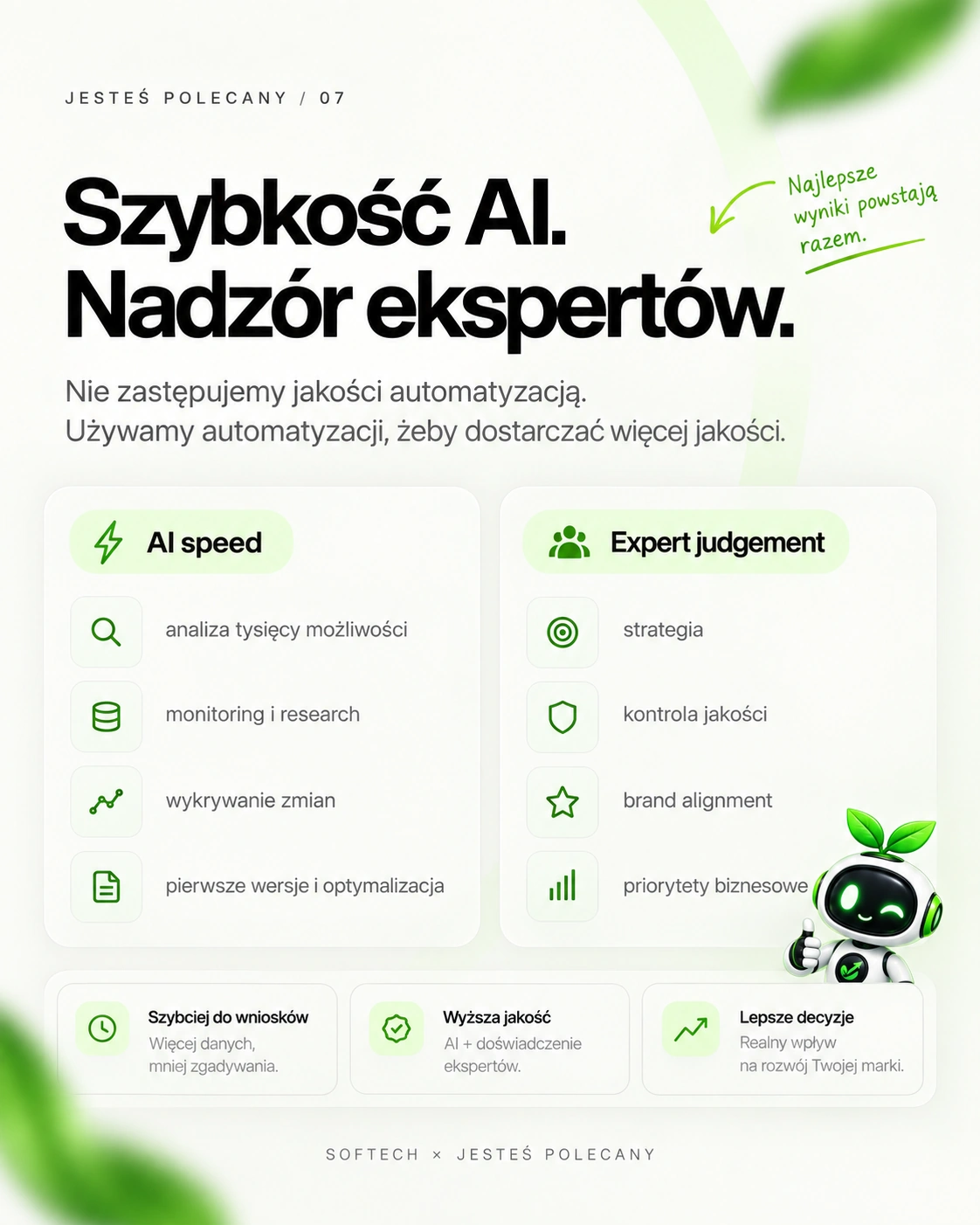
AI in the project accelerates research, monitoring and first drafts, but it does not replace professional strategy or brand-impact judgment.
AI workflow
- analysis of many possibilities
- monitoring and research
- change detection
- first drafts and optimisation
- preparing structured insights for expert review
Controls
- strategy remains under expert control
- quality control and brand alignment
- business priorities determine execution
- methodology-boundary control
- publication and claims approval
Limitations
- The product does not guarantee recommendations from AI models.
- Single answers require interpretation and a repeatable measurement protocol.
- The public score does not capture the full complexity of the internal model.
- Recommendation quality also depends on data quality and changes in external ecosystems.
Methodology boundaries
The product explicitly distinguishes readiness, visibility and actual recommendation behaviour.
Evidence over promises
The case study and product avoid unapproved KPIs and do not rely on unsupported marketing claims.
API-first continuity
The architecture preserves continuity between the public entry layer, the future dashboard and subsequent workflows.
Review gates
High-impact claims and interpretations are reviewed before appearing in the public product or the case study.
Implementation, testing and release
- 1Phase 1
Category strategy and positioning
- category language and naming
- value proposition
- buyer narrative
Result: A coherent framing emerged around Recommendation Intelligence.
- 2Phase 2
Product model and methodology visualisation
- Polecany Score™
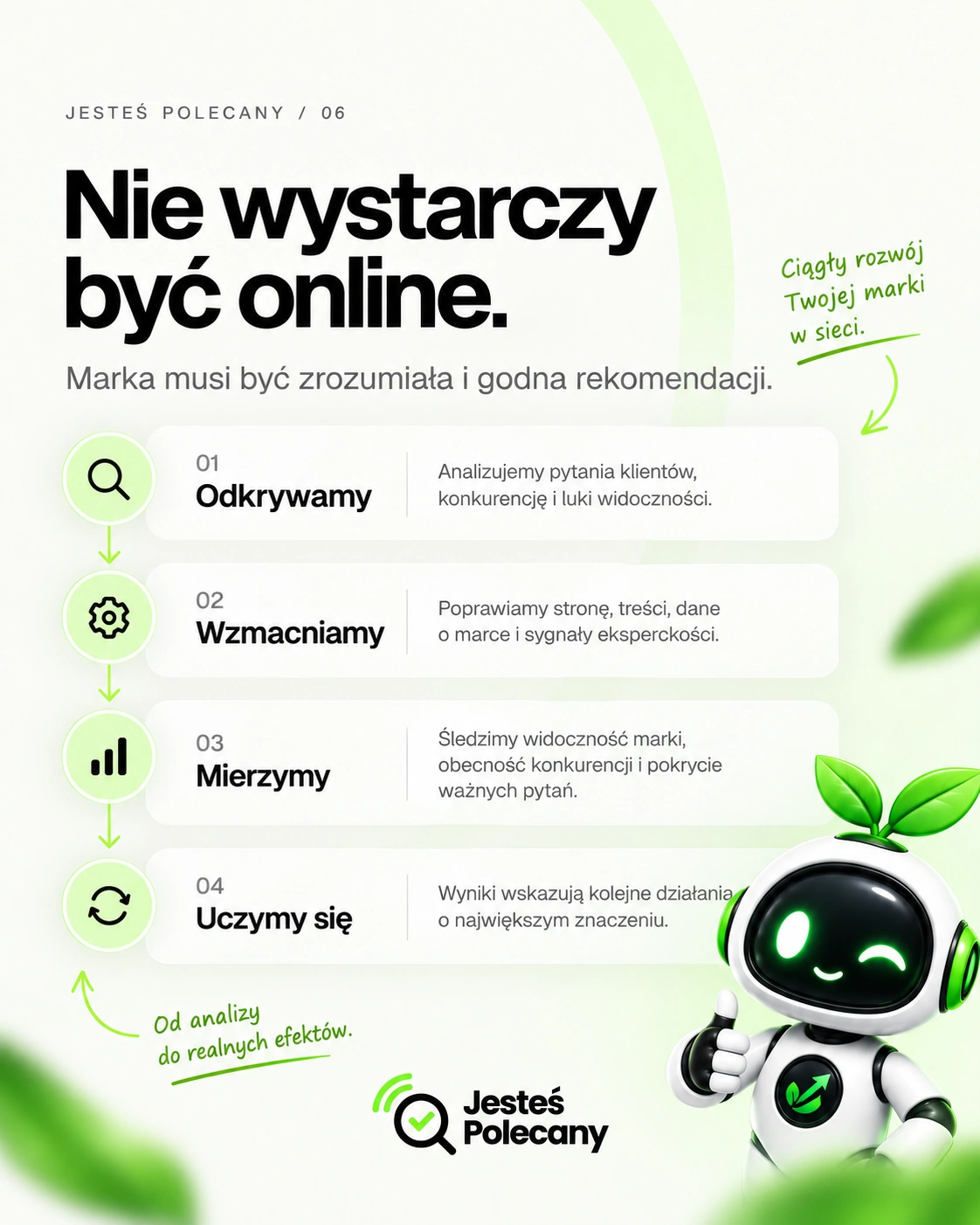
- Recommendation Readiness Loop
- Opportunity Engine
Result: A complex methodology was turned into a simple decision framework.
- 3Phase 3
Public product UX
- hero and free check
- educational sections
- offers and CTAs
Result: A commercial asset was created that combines market education with sales.
- 4Phase 4
Platform foundation
- API-first roadmap
- domain models
- evidence assumptions
Result: The product retains a clean path to the future dashboard and the Recommendation Intelligence engine.
Copy and methodology consistency
Each section was reviewed for alignment with the public product and the approved methodology model.
Responsiveness and clarity
The visual layer and UX were designed to shorten the path to understanding and taking a first action.
Evidence control
Public materials intentionally avoid unverified numerical claims.
Content and route linkage
Links between the article, case study, visual assets and CTAs were reviewed so the product forms one coherent narrative.
What confirms the project description
This public case study evaluates the project through functional scope, model coherence and strategic value rather than unapproved commercial numbers. Every claim was limited to what can be shown publicly or confirmed internally.
| Scope | Basis | Reference | Confirmation | Interpretation boundary |
|---|---|---|---|---|
| Jesteś Polecany presents the product through Google Search, AI Search, Local Search and Authority. | Public product | JP-03 · Public product model | Confirmed | This covers the public layer, not the complete map of every internal component. |
| Polecany Score™ simplifies visibility complexity into one decision layer. | Product model | JP-04 · Polecany Score™ explanation | Confirmed | The score is a decision aid and does not replace full interpretation. |
| The product uses a Discover → Strengthen → Measure → Learn loop. | Workflow | JP-06 · Recommendation Readiness Loop | Confirmed | The public description simplifies the full delivery workflow. |
| The operating layer separates AI speed from expert judgement. | Operating principle | JP-07 · AI speed + expert judgement | Confirmed | This is an operating principle rather than a standalone module. |
| The public flow closes with a free domain check as the entry point into analysis. | UX / CTA | JP-08 · Homepage hero and CTA | Confirmed | This does not describe the full post-analysis sales process. |
| The product presents opportunities as questions and decision moments rather than only a keyword list. | Product mechanic | JP-05 · Opportunity Engine narrative | Confirmed | Public examples are simplified compared with the full internal model. |
How to read this information
- Unapproved traffic, lead and revenue figures are intentionally excluded.
- The API and dashboard roadmap is broader than the currently disclosed public layer.
- AI-system outputs always require context and repeatable measurement.
- The public product narrative is a simplified version of the full operating model.
Process change, decision consequences and lessons
| Area | Before | After | Business impact |
|---|---|---|---|
| Category framing | Fragmented messaging about SEO and AI visibility | A clear Recommendation Intelligence category | Easier market education and commercial positioning |
| Visibility model | No shared model for Google, AI, local and authority | Four coherent product surfaces | Better clarity and stronger action prioritisation |
| Score and decision | Data difficult to interpret | Polecany Score™ as a conversation and decision layer | Faster onboarding and a shorter path to action |
| Transition to action | Analysis ended with a report | The Opportunity Engine and Readiness Loop drive the next actions | Higher product usefulness for brand growth |
| Role of AI | An unclear promise of automation | A clear split between AI speed and expert judgement | Greater trust in the product and delivery process |
We do not promise AI recommendations
- Alternative
- Aggressive marketing based on oversimplification
- Trade-off
- A less sensational message, but stronger credibility.
- Rationale
- In the long run, trust and methodology matter more than inflated promises.
We build the public entry product first
- Alternative
- Start with a larger dashboard and backend first
- Trade-off
- The public layer validates the category and messaging faster, but part of the roadmap remains behind the scenes.
- Rationale
- The market first needs to understand the problem and the product value.
We simplify the outcome into one score
- Alternative
- Showing many complex metrics from the start
- Trade-off
- Less data at first contact, but significantly better clarity.
- Rationale
- An entry product should shorten the path to a decision, not make it longer.
Market education is part of the product
- Alternative
- Focusing only on a dashboard and data
- Trade-off
- More investment in content and UX, but better category understanding.
- Rationale
- A new category will not succeed on raw data alone without context and explanation.
Key lessons learned
- A new category requires its own language, not only a new feature.
- The most useful score is one that opens a prioritisation discussion rather than closing it.
- A product’s highest value often appears in the opportunities, not in the score alone.
- AI increases value only when it is embedded in a controlled workflow.
- A public entry product can educate the market while building the foundation for a broader platform.
Which organisations this model is relevant for
Service businesses
Where customers ask for recommendations about providers, experts or contractors.
Local & multi-location
For brands whose visibility depends on city-level, regional and local authority signals.
B2B and manufacturers
Where comparisons, research and credibility affect the vendor shortlist.
Experts and specialist practices
Where customer choice depends on trust, qualifications and the quality of recommendations.
Related expertise and services
AI Automation
Design of controlled AI workflows that support the business without sacrificing quality or control.
SaaS Development
Building SaaS products with strong architecture, growth UX and iterative delivery.
AI-native SaaS architecture
Broader architectural context for products built around AI and controlled execution.
Article about Jesteś Polecany
An article expanding the public narrative around the product and its relevance to the market.
KILOGRAM — AI system and marketplace
Another Softech project showing how we combine product strategy, architecture and controlled AI workflows.
Software House — Softech
Broader context for web, mobile and AI-native product delivery from strategy to implementation.
Building a product at the intersection of AI, search and brand growth?
Let’s discuss product strategy, category design, growth UX, scoring, evidence models and architecture before complexity starts slowing the product down.
Key confirmed facts
The following statements summarise the confirmed product scope and contain no unapproved growth data.
- 1
Recommendation readiness is not the same as an observed AI recommendation.
- 2
The best opportunity is often the question where demand already exists but the brand is absent.
- 3
Polecany Score™ is meant to simplify decisions, not pretend to be a model ranking.
- 4
AI accelerates execution, but quality and strategy still require expert supervision.
- 5
Google Search, AI Search, Local Search and Authority should be evaluated together rather than as isolated channels.
- 6
The new search experience begins with a question and an answer, not only with ranked keywords.
- 7
A free domain check lowers the barrier to entering the brand-visibility discussion.
- 8
A public product should educate the market when the category itself is new.
- 9
The Opportunity Engine matters more than a keyword list when the key issue is a buying decision moment.
- 10
The best AI products do not hide model limitations; they make them explicit.
- 11
Readiness, visibility and recommendation behaviour are different but related layers of evaluation.
- 12
Scoring has value only when it leads to the next actions rather than just another report.
- 13
An API-first foundation allows the public product and the platform layer to evolve without chaos.
- 14
Expert supervision remains essential whenever decisions affect the brand and the business.
Visual evidence
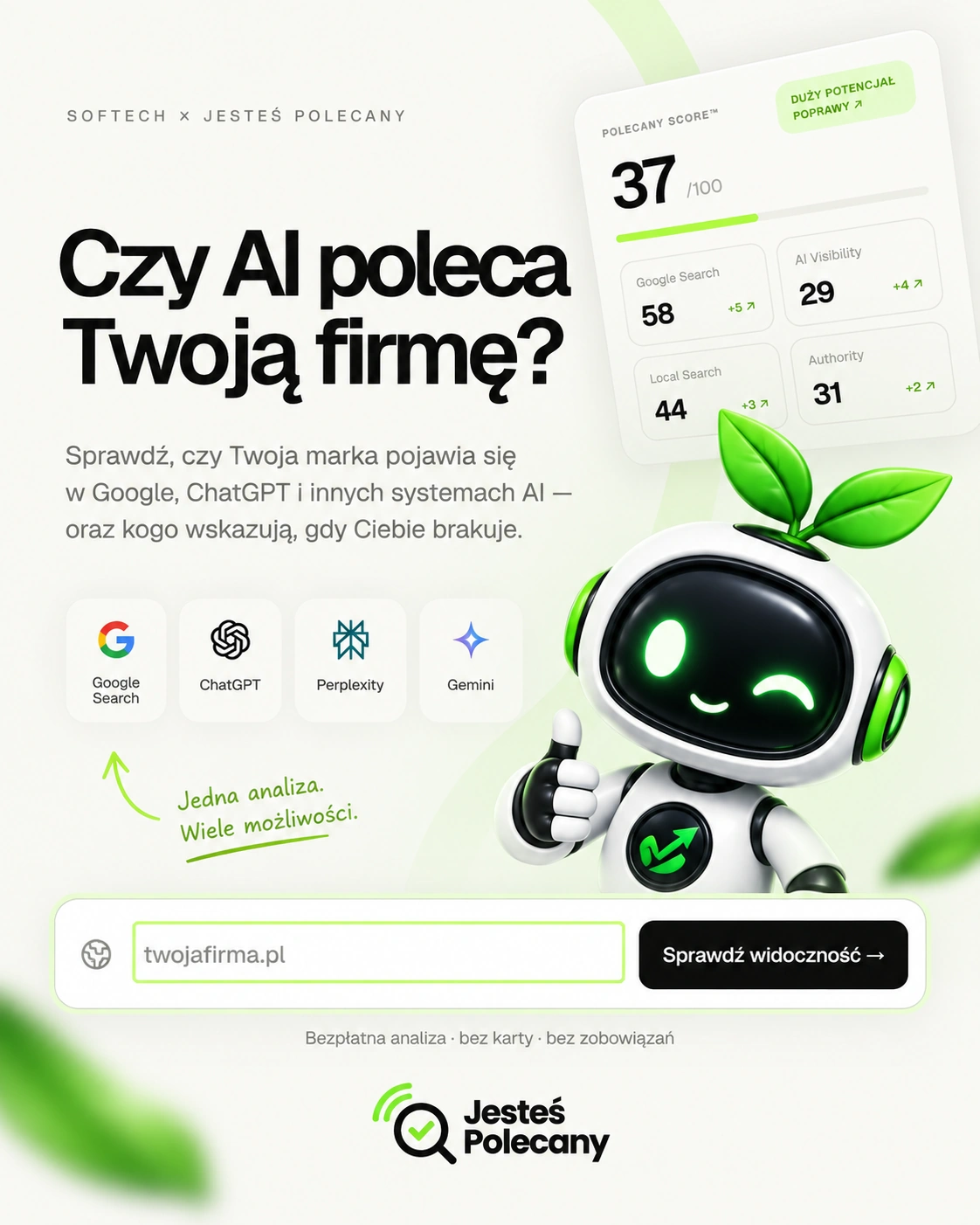
The diagrams present confirmed product scope and workflows described in this material. They are not mock-ups or claims of undocumented outcomes.
FAQ
How is Jesteś Polecany different from a classic SEO tool?
The product does not stop at keyword rankings or a basic audit. It connects Google Search, AI Search, Local Search, Authority, Polecany Score and an Opportunity Engine into one operating model.
Is Polecany Score a ChatGPT ranking?
No. It is a simplification layer for observable readiness and visibility signals. Actual mentions, citations and supplier recommendations require separate monitoring and a repeatable prompt protocol.
Why is the Opportunity Engine important?
Because the highest value does not come from the score alone, but from identifying the questions and decision moments where a brand can realistically win visibility or recommendation.
Is the product only for local service businesses?
No. It fits service companies, multi-location brands, B2B organisations and manufacturers whenever recommendation or research affects the buying decision.
Why separate AI speed from expert judgement?
Automation accelerates research, monitoring and first drafts, while strategy, quality and high-impact brand decisions still require human control.