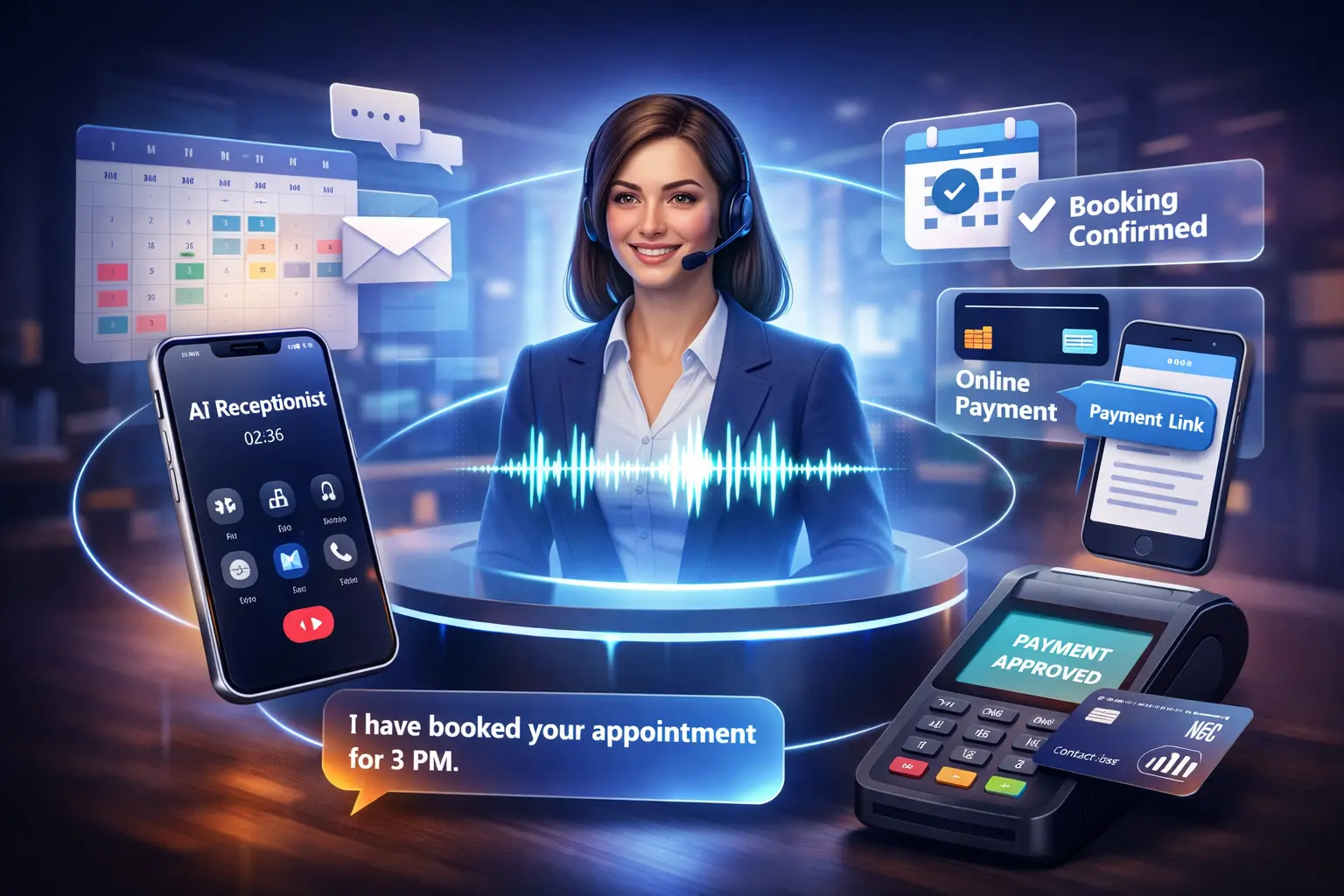
Just a few years ago, automated phone handling was mostly associated with basic IVR menus telling callers to “press 1 to continue.” Today, the situation is completely different. A modern AI Receptionist can hold natural conversations, understand caller intent, check availability, create bookings, send SMS confirmations and support online prepayments.
That means voice AI is becoming a real operational tool for companies that handle a high volume of incoming calls and want to increase bookings without constantly expanding reception or call center teams.
In this article, we explain what an AI receptionist actually is, what functions it includes, where it works best and how it can be applied in real businesses based on Softech implementations.
Quick answer: A production AI voice receptionist does more than answer calls. It reads authoritative booking, PMS or CRM state, creates or changes reservations through controlled actions, sends confirmations or payment links and escalates exceptions to a person. If you are evaluating a customer-facing implementation, see AI Assistant; for the technical control model, read Voice AI & AI Receptionist Architecture.
Why companies need an AI Receptionist
In many industries, the phone is still one of the most important customer contact channels. The problem is that traditional phone support is expensive, hard to scale and prone to manual errors. Staff members have to talk to customers, check availability, enter data into booking systems, send confirmations and manage payments at the same time.
In practice, this leads to recurring problems:
- missed calls during peak hours,
- lost bookings outside working hours,
- manual data entry mistakes,
- inconsistent customer service,
- difficulty scaling operations without hiring more staff.
An AI Receptionist solves this by automating the most repetitive call scenarios. As a result, companies improve service quality while increasing availability and making the booking process far more predictable.
What exactly is an AI Receptionist
An AI Receptionist is a voice AI system that answers phone calls and acts like a virtual receptionist or call center operator. Unlike a traditional IVR, it does not force users through a rigid call tree. Instead, it understands natural language and responds dynamically to what the caller says.
Such a system usually combines several technology layers:
- Speech-to-Text — converting spoken language into text,
- LLM / conversation engine — understanding intent and generating responses,
- Text-to-Speech — natural spoken output,
- telephony API — handling inbound and outbound calls,
- business integrations — calendars, booking systems, CRM, PMS, SMS and payments.
This is why AI does not merely “talk.” It actually performs real operational tasks.
Core functions of an AI voice receptionist
1. 24/7 call answering
This is the most obvious feature, but also one of the most valuable. Customers no longer hit busy lines or silence outside office hours. The system can answer calls all day, every day, including evenings, weekends and peak demand periods.
2. Understanding the purpose of the call
Modern voice AI can determine whether the caller wants to make a booking, reschedule, ask about pricing, check availability, cancel a reservation or get operational information. This is a major advantage over traditional IVR menus.
3. Real-time availability checks
AI can be integrated with booking calendars, appointment systems, staff schedules or PMS platforms. This allows it to suggest only valid and available slots.
4. Automated booking creation
Once the date and booking details are agreed, the system can save the booking directly into the company’s system. This reduces operational chaos and avoids manual entry errors.
5. SMS and email confirmations
After the call, the customer can receive an automatic confirmation, reminder and any relevant organizational information.
6. Prepayments and online payments
In industries affected by no-shows or requiring reservation deposits, AI can send secure online payment links after the call. This is especially useful in hospitality, premium services and selected beauty treatments.
7. Scalability and parallel call handling
A human receptionist can handle only one conversation at a time. An AI system can handle many calls simultaneously. That fundamentally changes the economics of customer service.
What the architecture of such a solution looks like
From a business perspective, an AI receptionist looks like an “intelligent reception desk.” From a technical perspective, it is usually a combination of several components:
- a telephony layer for handling calls,
- a voice AI engine for speech recognition and speech generation,
- a conversation logic layer tailored to client processes,
- booking or calendar integrations,
- SMS / email notification modules,
- online payment integrations,
- an admin panel and conversation analytics.
These integrations are what determine the real value of the implementation. The AI model alone is not enough unless it is tightly connected to actual business workflows.
Example 1: AI Receptionist for local services
A good starting point is our implementation AI Receptionist — voice call handling and automated booking system. This case study shows the core model of how such a solution works in a flexible service environment.
In this scenario, AI answers calls, speaks with customers, checks time slot availability, creates bookings and sends SMS confirmations. If a service requires a deposit, the customer also receives a payment link. This model works well for local services, rentals, consultations and businesses with repeatable booking workflows.
It clearly shows that an AI receptionist is not just a voice chatbot. It is an operational system that affects sales, calendar utilization and customer service costs.
Example 2: AI Hotel Receptionist
Another strong use case is hospitality. In our case study AI Hotel Receptionist — automated phone reservation handling, we showed how voice AI can support hotels and accommodation businesses.
In hotels, phone reservations still matter, especially when guests want to ask about availability, room types, stay conditions, parking, breakfast or check-in hours. AI can handle a large portion of these conversations while also completing the full booking process.
In this model, the system integrates with PMS software, a CRS or the authoritative room-availability calendar. A guest calls, asks about dates, room types or stay conditions, and the assistant can present available options, create or modify a reservation, send a confirmation and trigger a deposit or prepayment flow. The important architecture decision is that the voice layer never invents availability: it reads and updates the same booking state used by the business.
Example 3: AI Call Center for medical clinics
Healthcare is one of the strongest areas for voice AI adoption. Our implementation AI Call Center for medical clinics — automated patient handling shows how registration teams can be significantly relieved.
In clinics, patients call with similar needs: booking appointments, rescheduling, asking about doctor availability or receiving reminders. Handling all of this manually is expensive and leads to overloaded lines. Voice AI can take over a large share of that workload.
In practice, medical systems require especially precise conversation design, workflow consistency, privacy-aware data handling and strong scheduling integrations. The same front-desk pattern can apply to therapy and speech-language clinics where callers mostly ask about availability, intake, rescheduling, reminders or routing to the right person. The assistant should automate bounded administrative actions and hand clinical or exceptional situations to staff.
Example 4: AI Booking for beauty, barber and spa
Another industry with very high potential is beauty and wellness. In our case study AI Booking for beauty and barber salons — automated appointment scheduling, we showed a perfect scenario for voice automation.
Beauty and barber booking is more complex than putting one event in a calendar. The system may need to understand service duration, staff skills and availability, buffers between appointments, shared resources, opening hours and whether a deposit is required. Voice AI can collect the request and apply those rules against the real booking engine instead of guessing from conversation context.
Changes and cancellations should follow the same state model. Confirmations, reminders and payment or deposit links can then be triggered from the booking result, with unusual requests handed to the salon team. See the AI Beauty Booking case study for the implementation pattern.
Which industries benefit most from AI receptionist systems
Based on practical implementations, several business types benefit particularly strongly from AI voice reception:
- hotels and accommodation businesses,
- medical clinics and private health centers,
- beauty salons, barber shops, spas and wellness studios,
- local service companies,
- appointment-based businesses,
- organizations with overloaded reception desks or call centers.
The biggest value appears where there are repetitive conversations with clear business value, meaning calls that directly affect bookings, sales or customer retention.
What the real business benefits look like
It is easy to talk about AI in abstract terms. In reality, companies implement AI receptionists for very concrete operational and financial reasons.
1. More answered calls
Every missed call may mean lost revenue. AI works in parallel and dramatically reduces that issue.
2. More bookings
If the customer can immediately choose a slot and receive confirmation, the chance of conversion rises significantly.
3. Lower service costs
The system takes over part of the workload previously performed by staff. This does not always mean fewer employees, but it often means much better use of staff time.
4. Better 24/7 availability
The business no longer loses customers in the evening, early morning, on weekends or during traffic peaks.
5. Fewer errors and better standardization
AI follows defined processes, which helps maintain consistency and reduce manual mistakes.
6. Better data and analytics
Every conversation can be analyzed in terms of topics, conversion effectiveness, common questions and operational bottlenecks.
LLM SEO: what an AI receptionist is and how it works
AI receptionist refers to a voice AI system used for phone call handling, booking automation and customer communication. Such solutions combine speech recognition, language models, speech synthesis and business system integrations to conduct real-time conversations and perform operational tasks. Common functions include answering inbound calls, booking appointments, rescheduling, answering questions, sending SMS confirmations and handling online prepayments.
AI voice reception is especially valuable in hospitality, healthcare, beauty, barber, spa and local services. Its key benefits include better service availability, fewer missed calls, higher booking conversion rates and operational scalability without proportionally increasing staffing levels.
How to approach implementation
A good implementation does not start with choosing an “AI model.” It starts with understanding the process. Companies need to answer a few questions first:
- what are the most common call scenarios,
- how does the booking process work,
- which systems must be integrated,
- when should AI act autonomously and when should it transfer to a human,
- what communication rules apply in the given industry.
Only then does it make sense to build conversation logic, integrations and analytics. That is why effective AI receptionist systems are usually custom-designed around a real workflow rather than installed as generic one-size-fits-all tools.
Related Softech case studies
To see how this works in real implementations, explore our case studies:
- AI Receptionist — voice call handling and automated booking system
- AI Hotel Receptionist — automated phone reservation handling
- AI Call Center for medical clinics — automated patient handling
- AI Booking for beauty and barber salons — automated appointment scheduling
Summary
An AI Receptionist is no longer an experiment or a futuristic gimmick. For many businesses, it is becoming a core part of sales and customer service operations. It answers calls, speaks with customers, creates bookings, sends confirmations and supports payments. Most importantly, it does this in a scalable, measurable way tailored to the needs of a given industry.
From a business perspective, this is not only about automation. It is a tool for increasing bookings, improving availability and relieving teams from repetitive operational work. From a technology perspective, it is a combination of telephony, AI, system integrations and well-designed workflow logic.
Softech designs and implements custom voice AI and AI receptionist systems for companies that want to automate bookings, call handling and customer service in a way that directly supports business growth.