Fire safety service companies and facility managers often search for solutions like “fire extinguisher inspection software”, “fire hydrant management software”, or “fire inspection software” when spreadsheets and PDFs stop scaling. Missed inspections, scattered documentation and manual reporting quickly become a compliance and operational risk.
At Softech.app we designed and delivered a fire safety service management system covering hydrants, fire extinguishers and measurement devices — including scheduling, on-site technician workflows, automated PDF reports and IoT/GSM-ready integrations. Here is how the project worked and what it changed in day-to-day operations.
The challenge: spreadsheets, paper protocols and manual measurements
The client serviced hundreds of locations and thousands of assets. Scheduling was time-consuming, technicians worked with paper forms, and measurement data was typed in manually. There was no single source of truth for assets and inspection history, and reminders were handled ad-hoc. That increased the risk of errors, delays and audit issues.
The solution: fire extinguisher & hydrant inspection software with automated PDF reporting
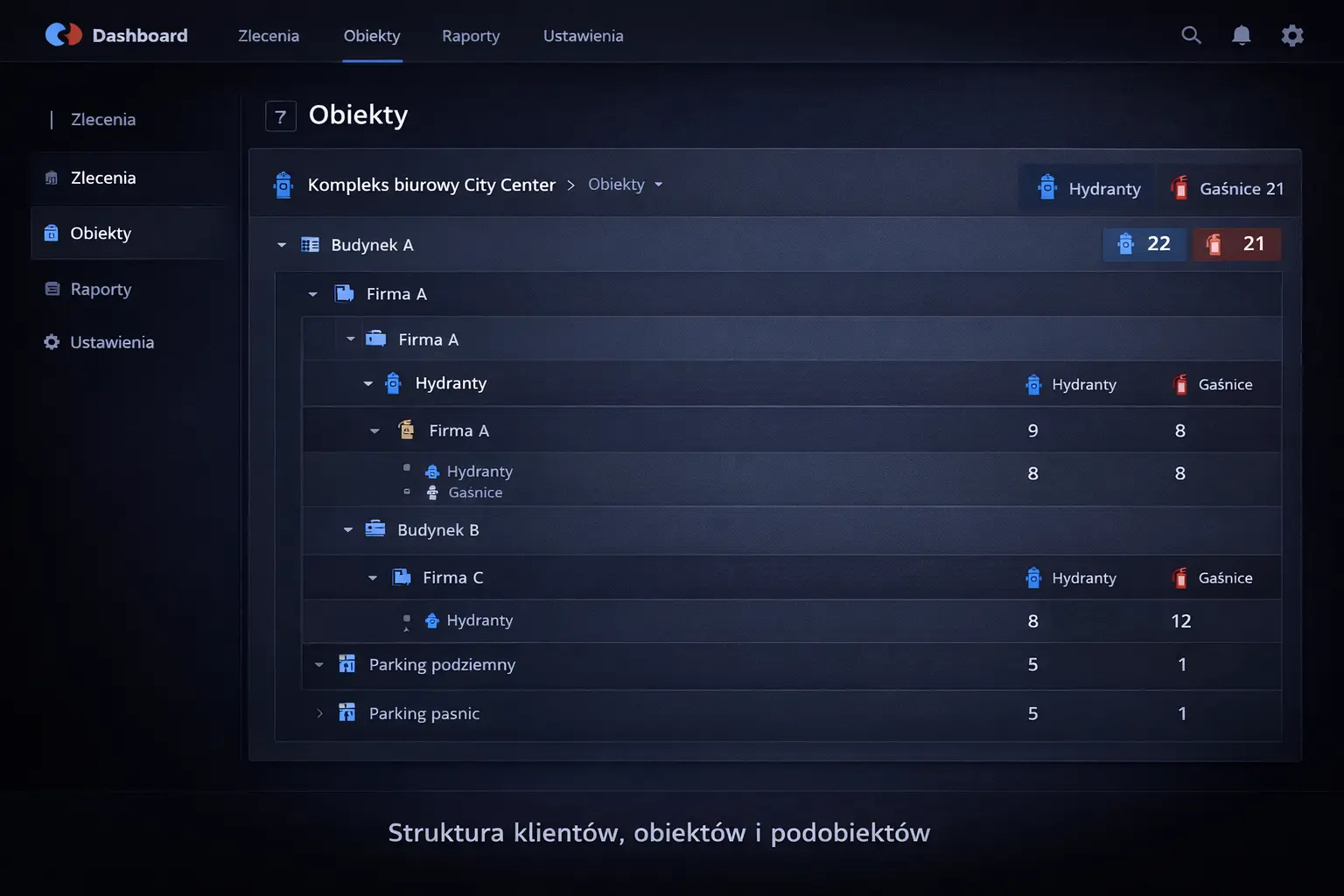
We built a SaaS-ready web system that mirrors real-world structure:
- company → site → sub-location → asset (hydrant / extinguisher)
- inspection history and asset status tracking
- calendar scheduling and technician task management
- automatic PDF protocols from templates
- manual or automated measurements (IoT/GSM) stored in one data model
Central asset registry: one source of truth
The platform provides a central registry for hydrants and extinguishers with complete history: inspections, measurements, documents and statuses. This is the core of modern fire safety inspection management — not just “record-keeping”.
Scheduling & reminders: inspection calendar at scale
We introduced calendar-based planning and operational filters (by site, status, due date, technician). Coordinators can instantly see what is due this week/month and dispatch teams accordingly.
Field workflows: technicians without paperwork
Technicians complete inspections on-site using structured checklists. This eliminates paper protocols, improves data consistency and speeds up completion and reporting.
Automated reports: 100% PDF protocol generation
After an inspection is completed, the system generates the full documentation pack automatically using templates and inspection data (including measurements). PDFs are archived and linked to the asset and location — ready for customers or audits.
IoT / GSM measurement integrations
A key requirement was capturing real measurement data. The system supports manual input and integrations via API/TCP/WebSocket, allowing devices to push measurements directly and build a reliable asset history.
Business impact: faster operations, fewer errors, full control of due dates
- ~40% faster inspection handling through automation and checklists
- ~90% reduction in paperwork with digital protocols
- 100% automated PDF reporting
- ~60% fewer documentation errors
- 12,000+ assets in the central registry
Technology stack
We delivered a scalable web application and IoT-ready backend using Next.js, TypeScript, NestJS, PostgreSQL and Prisma. Documents are generated as PDFs, and files can be stored in S3/Blob storage.
Need a system like this for your fire safety service business?
If you’re looking for fire inspection software that truly runs operations (not just logs data), we can help. Softech.app builds custom B2B systems end-to-end — from discovery to production.
Learn more: web application development and mobile app development.
FAQ
Does the system support multiple fire equipment types?
Yes — the architecture is modular. Hydrants and extinguishers are the current modules, and more can be added.
How are inspection protocols generated?
Automatically from templates and inspection data, exported and archived as PDFs.
Can it integrate with IoT measurement devices?
Yes — integrations can run via API, TCP or WebSocket, and measurements are linked to inspections and assets.